Bitcoin's struggle above $80K raises critical questions about demand absorption: Market analysis
Fresh analysis of Bitcoin's price movement indicates that emerging purchasing power must materialize as BTC encounters difficulty in establishing sustained resistance at recent peaks.

The world's leading cryptocurrency Bitcoin (BTC) continues to exhibit vulnerability to selling pressure around the $80,000 threshold, despite the fact that holders are generally refraining from widespread profit realization.
Key points:
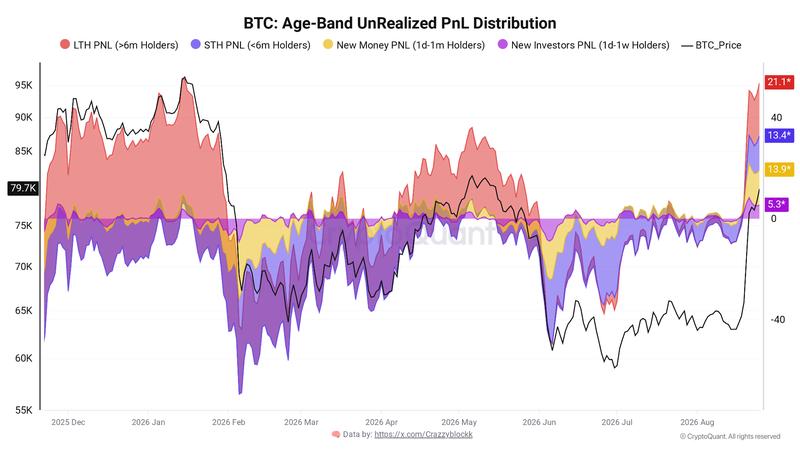
- The unrealized profit and loss position for Bitcoin holders transitions into positive territory across all wallet categories, creating what appears to be a deceleration in price trajectory.
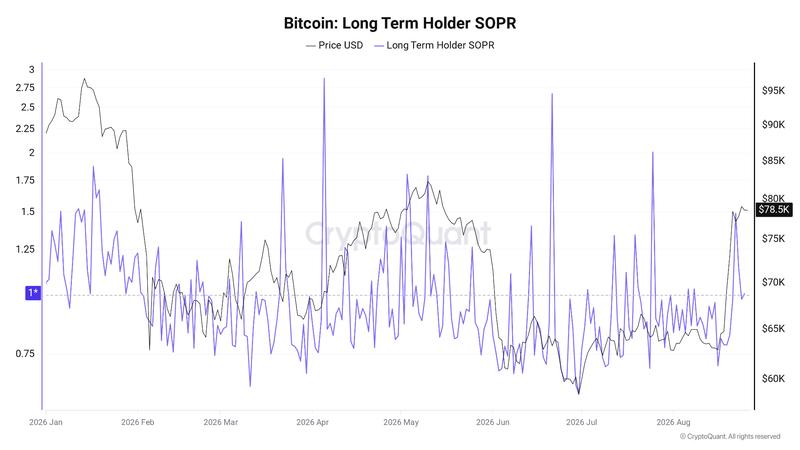
- Profitability metrics for long-term holders experience an increase to 1.48, though short-term holders continue to represent the bulk of profitable coins being transferred on the blockchain.
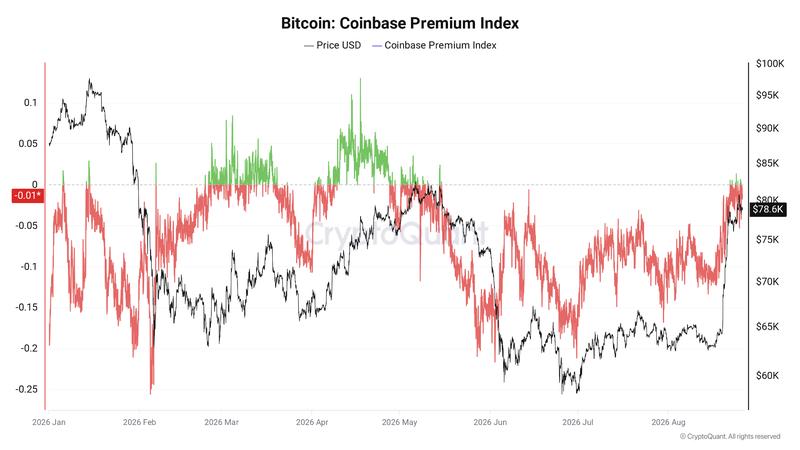
- The Coinbase premium indicator remains unable to cross into positive values, registering at -0.015, highlighting subdued demand from United States markets.
Older Bitcoin investors reactivate around 14-week highs
Information sourced from the blockchain analytics firm CryptoQuant demonstrates that coins held for extended periods showed increased onchain movement as the BTC/USD trading pair advanced by more than 25% throughout the previous week.
The spent output profit ratio (SOPR), which measures the relationship between the present value of recently transferred UTXOs compared to their original creation value, climbed to 1.48 on Aug. 22, signaling heightened blockchain activity associated with profitable coin movements.
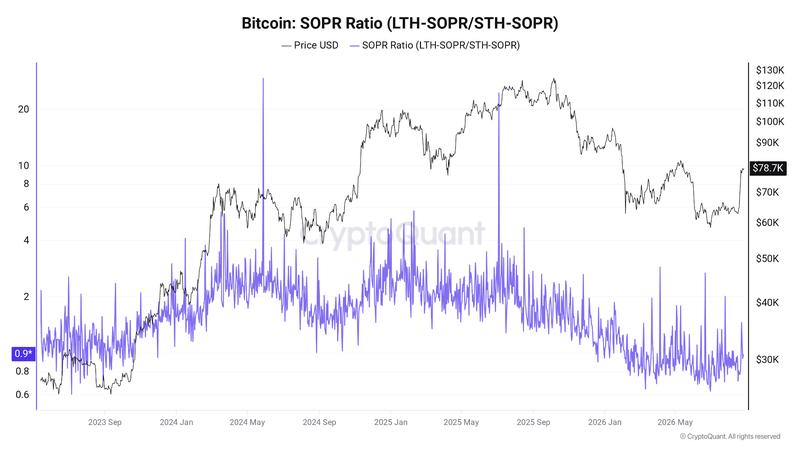
While price action stabilized in the vicinity of $79,500, the SOPR ratio metric, calculated by dividing the SOPR of short-term holders (STH) by the SOPR of long-term holders (LTHs), reached 1.4, marking its most elevated level since July 25. The STH and LTH classifications refer to wallet addresses that maintain BTC holdings without disposing of them for periods of up to six months (STH) or beyond six months (LTH).
This suggests long-term holders were realizing profits at a higher relative rate than short-term holders. The ratio has since fallen to 0.93, indicating that short-term holders' realized performance is now relatively stronger.
CryptoQuant
The SOPR ratio metric has established a wide-ranging downward trajectory since the beginning of 2025, and at the conclusion of June touched 0.62, representing its weakest reading in three years as the BTC/USD pair declined to $58,000. Even though the metric has only experienced a modest reversal upward, the price has still been unsuccessful in maintaining levels above $80,000.
According to CryptoQuant's observations, every category of holder is presently showing aggregate profitability, creating a possible obstacle to additional price appreciation that could only be surmounted through consistent purchasing activity.
The key question is not whether Bitcoin can briefly touch $80,000, but whether new demand can absorb selling from profitable holders.
CryptoQuant
The analytics platform indicated that such purchasing demand might originate from the continued resumption of capital flowing into spot Bitcoin exchange-traded funds (ETFs) in the United States.
US investor demand remains weak
Additional data points indicate that notwithstanding the achievement of recent local price peaks, Bitcoin has yet to successfully persuade the wider investment community to re-enter the marketplace.
Analysis from CryptoQuant demonstrates that the Coinbase premium — representing the price differential between Coinbase's and Binance's BTC/USDT trading pairs — stays in negative territory, crossing above its zero threshold only momentarily on hourly timeframes as the price penetrated the $78,500 level.
The next key signal will be whether the index can cross above zero and remain positive. If Bitcoin continues recovering while the Coinbase premium turns positive, the market could shift from 'selling pressure is easing' to a stronger phase of renewed U.S. spot demand.
CryptoQuant
The Coinbase premium serves as an indicator of investment demand from the United States and has maintained predominantly negative values throughout 2026. As of Wednesday, the metric registered -0.015, showing improvement from -0.094 recorded at the beginning of August.