Bitcoin requires 'strategic growth' approach, Saylor argues amid institutional demand questions
In a new essay, Michael Saylor advocates for Bitcoin's growth via banking systems, lending, securities and additional layers while maintaining base layer integrity.

Michael Saylor, co-founder and executive chairman of Strategy, has stated that Bitcoin requires "disciplined expansion" via banking institutions, corporations, securities markets, lending platforms and capital markets, outlining a roadmap for the digital asset while spot exchange-traded fund (ETF) redemptions and widespread market downturn challenge institutional appetite.
In an essay released Friday, Saylor articulated that Bitcoin's foundational layer deserves treatment as "sacred infrastructure," with the majority of development happening via upper layers, software applications, custody solutions, lending products and financial systems.
These remarks position Bitcoin's upcoming evolution as a confrontation between two institutional pathways: passive spot ETF participation, which has expanded accessibility yet remains vulnerable to withdrawals, and the corporate plus credit-market integration approach championed by Saylor's Strategy.
According to Saylor, Bitcoin must be woven into the fabric of the financial system instead of relying exclusively on spot purchasers or ETF capital inflows. He stated that Bitcoin's trajectory demands equilibrium between widespread acceptance, technological development and independent custody while safeguarding the network's fundamental characteristics.
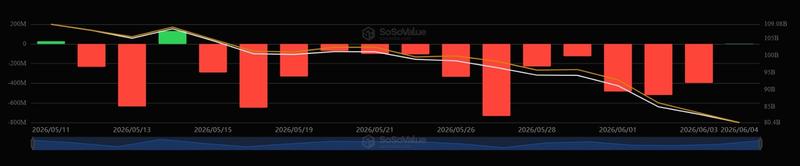
The published essay arrives amid a pronounced Bitcoin market downturn that has placed both principal institutional pathways under strain. Spot Bitcoin ETFs recorded weekly net redemptions totaling $1.42 billion, $1.26 billion and $1 billion across the final three weeks of May, while the present week's redemptions have already hit $1.4 billion.
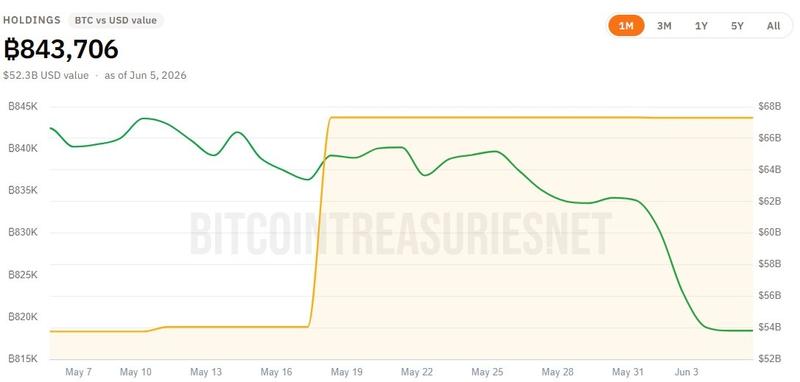
Strategy additionally sold 32 Bitcoin recently to finance preferred stock dividend payments, marking its first sale since 2022, undermining the "never sell" philosophy that has historically characterized Saylor's corporate Bitcoin approach.
Analysts split on demand reset
The mounting pressure has intensified a wider discussion over whether Bitcoin's current downward movement represents a transitory correction following extreme leverage buildup, or signals that institutional appetite is diminishing after months of ETF-driven purchasing activity.
Lacie Zhang, a research analyst at Bitget Wallet, suggested Bitcoin might already be nearer to resolving the situation than stock markets following a $1.8 billion wave of liquidations, significantly negative funding rates and a substantial reset in open interest levels. Zhang indicated a potential retest of the $55,000 to $57,000 range remains plausible should redemptions continue. She added:
"The key question is not just whether BTC holds $63K, but whether ETF flows stabilize, exchange reserves keep falling, and whale accumulation picks up."
Nicolai Sondergaard, a research analyst at Nansen, offered a more conservative perspective, noting that exchange flow information indicates market participants are leveraging Bitcoin's rebound from approximately $61,000 to diminish exposure instead of increasing positions.
According to Sondergaard, Bitcoin's ETF demand story has been deteriorating since May, and a sustainable recovery would necessitate more than simply removing immediate market stress. Absent clear re-engagement from institutional purchasers, he suggested the market might face difficulty reconstructing upward momentum.
Saylor argues for Bitcoin beyond ETFs
In his published essay, Saylor outlined four broad Bitcoin philosophical perspectives: maximalists, capitalists, technologists and fundamentalists. He indicated each faction safeguards something valuable, though each can also overreach when its perspective becomes dogmatic.
The "disciplined expansion" concept aligns most closely with the capitalist perspective, which views Bitcoin as digital capital capable of integration into corporate balance sheets, securities instruments, lending markets, banking institutions, brokerage firms, insurance companies and asset management firms.
This conceptual framework diverges from ETF-based participation, where institutional engagement is predominantly measured via capital inflows and outflows.
Saylor's favored pathway indicates a more deeply integrated framework, where Bitcoin functions within corporate treasury management, collateral frameworks and capital markets instead of being maintained solely via spot investment vehicles.