Bitcoin Mining Infrastructure Becomes Valuable Commodity as AI Industry Faces Energy Shortage
Cryptocurrency miners possess the electrical grid connections that artificial intelligence firms desperately require, though converting legacy mining facilities into profitable data centers presents significant challenges.

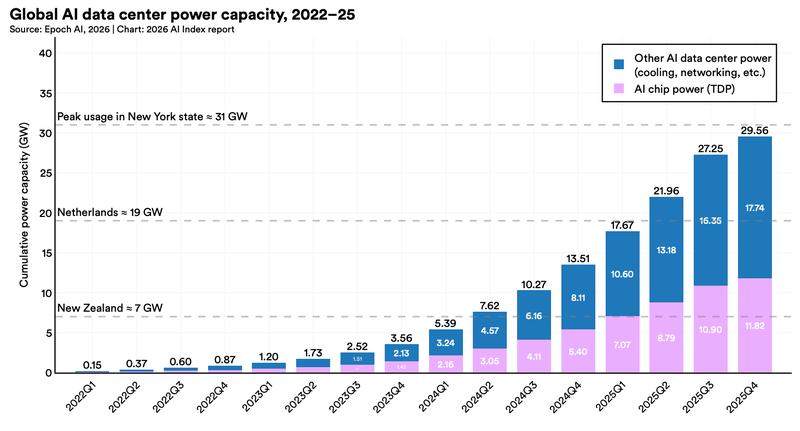
According to Stanford University's annual AI industry report, global power capacity allocated to artificial intelligence data centers had climbed to approximately 29.6 gigawatts (GW) by late 2025, representing sufficient electricity to power the entire state of New York during periods of maximum consumption.
Stanford's April-published report indicates that computational resources themselves are plentiful and becoming more economical. However, electricity that is permitted, connected to the grid, and available for immediate consumption remains in short supply, with sources to deliver such power proving even more scarce. One sector has been quietly constructing precisely this type of infrastructure over the previous ten years for an entirely different purpose: cryptocurrency mining operations.
Computing efficiency improves while aggregate consumption continues climbing
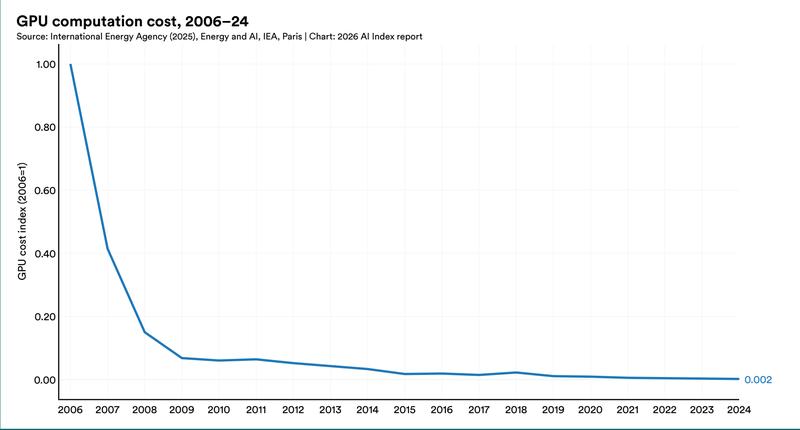
Chip economics are trending in the reverse direction. According to Stanford's findings, GPU computational costs have plummeted by over 99% since 2006, while contemporary leading-edge chips now execute substantially more operations per watt compared to their predecessors from ten years prior. Yet these efficiency improvements have failed to curtail overall consumption. Instead, these gains are being reinvested into developing larger, more complex models rather than being preserved as cost reductions, thereby maintaining sustained pressure on electrical grids.
According to Stanford's estimates, the most resource-intensive training operations, including those for platforms like Llama 4 Behemoth, have consumed upward of 100 megawatts (MW), an amount equivalent to what a modest power generation facility produces. AI-dedicated capacity has experienced roughly a 200-fold increase over three years, growing from less than a gigawatt in 2022, with projections indicating data center electricity consumption will continue its upward trajectory through 2030.
This constraint is as much about location as it is about raw numbers. Stanford's data shows the United States maintains 5,427 data centers, exceeding any other nation by more than tenfold.
While chips can be procured and shipped within a matter of months, bringing a site online—complete with its substation, interconnection authorization, and cooling infrastructure—requires multiple years.
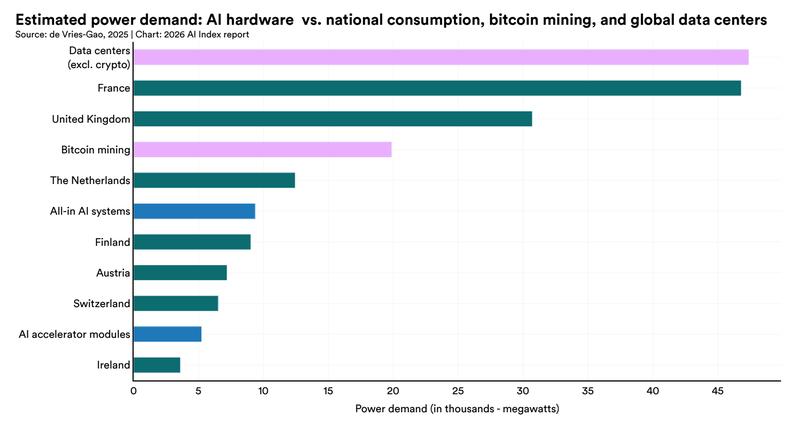
When measured across complete systems rather than focusing solely on accelerators, AI's cumulative electrical requirements through 2024 reached approximately 9.4 GW, approaching the total national electricity consumption of countries like Switzerland or Austria and representing roughly half the estimated consumption of Bitcoin mining operations.
The valuable commodity was always the infrastructure, not the equipment
However, cryptocurrency miners cannot simply transfer their equipment to artificial intelligence laboratories. Bitcoin mining ASICs (the specialized chips designed for Bitcoin calculations) perform one highly specific function and prove worthless for training or inference tasks. What can be transferred is everything surrounding those chips, including the energized facilities, electricity purchase agreements, grid interconnections, and the physical structures designed to cool high-density equipment racks.
A cryptocurrency mining operation that possesses an existing grid connection maintains infrastructure positioned to address the gaps faced by AI developers, and leasing that capacity proves more advantageous than beginning from scratch. Mining operations also typically occupy locations where AI companies want to establish themselves, particularly in low-cost electricity states throughout the United States such as Texas and along the Gulf Coast region.
The economics of mining represents its own computational challenge. JPMorgan's recent analysis estimated Bitcoin's comprehensive production cost at approximately $78,000 per coin, substantially exceeding BTC's market valuation of around $53,400 at the time of writing, representing a decline of more than 34% year-to-date, based on CoinGecko data.
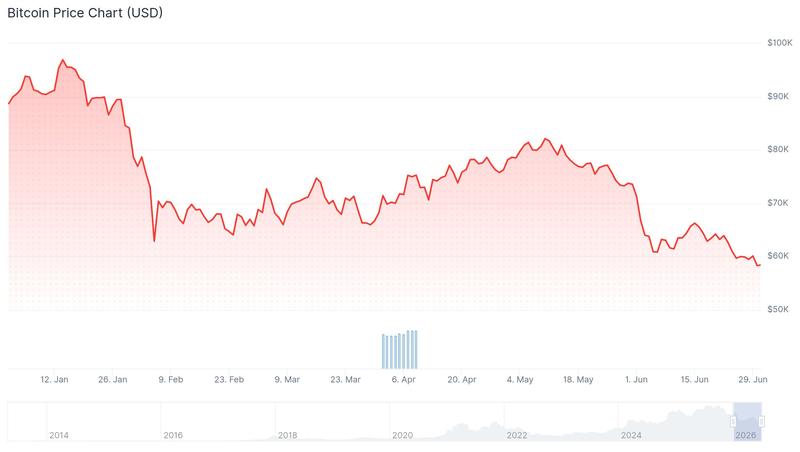
Cointelegraph had previously documented that hashprice had dropped beneath the breakeven threshold for numerous mining operations, pushing approximately 20% of the sector into unprofitable operations.
Several significant agreements between mining companies and AI infrastructure providers subsequently emerged. During November 2025, Iren executed a five-year GPU cloud agreement with Microsoft valued at approximately $9.7 billion, utilizing a 750-megawatt facility located in Childress, Texas. The following month, cryptocurrency miner Hut 8 finalized a 15-year, $7 billion lease arrangement with Fluidstack covering 245 megawatts at its River Bend facility in Louisiana, with payment obligations guaranteed by Google.
Market investors have nevertheless compensated this strategic pivot favorably. According to Reuters reporting, Hut 8's stock price surged approximately 20% during premarket trading on the day its lease announcement was made, and throughout the sector, company valuations are progressively becoming linked to computational infrastructure pipelines rather than Bitcoin pricing alone. CoinShares reported that mining companies holding HPC contracts were valued at 12.3 times their 12-month revenue compared to 5.9 times for those exclusively focused on mining. CoinShares' projections suggest publicly traded miners could generate as much as 70% of their revenue from AI operations by the conclusion of 2026, increasing from roughly 30% during Q1.
The transition requires substantial investment and complexity
Nevertheless, the transformation process is far from inexpensive, and cannot be characterized as a simple plug-and-play operation. According to CoinShares estimates, mining infrastructure investments total approximately $700,000 to $1 million per MW, whereas AI-grade, liquid-cooled infrastructure can require $8 million to $15 million per MW. Hyperscale operators additionally require power density levels, redundancy systems, and uptime assurances that many existing mining facilities were never engineered to deliver.
Mining companies are bridging this financial gap through debt financing and fresh capital-raising initiatives. Iren had previously disclosed approximately $3.75 billion in convertible note obligations at the conclusion of March, subsequently raising an additional $3 billion through a new convertible note offering during May.
The industry is also depending heavily on a limited number of hyperscale providers and AI infrastructure purchasers. Should demand weaken, customers renegotiate terms, or projects experience delays, mining operations that have dismantled their ASICs may discover themselves with diminished fallback alternatives.
Whether this pivot away from BTC mining operations will prove financially successful remains an unanswered question. Securing multibillion-dollar AI infrastructure contracts represents one achievement, but generating the earnings that investors anticipate constitutes another matter entirely.
Currently, the market is assigning premium valuations to mining companies executing this transformation rather than those continuing to simply generate new BTC. Should AI demand maintain its pace of outstripping electricity availability, these infrastructure assets could ultimately prove more valuable than the mining equipment they were initially constructed to accommodate. Conversely, if conditions change, some of the industry's most ambitious AI-focused strategies could turn out to be expensive miscalculations, rather than genuine successful second chapters for former cryptocurrency mining enterprises.