Bitcoin mining hashrate drops 13.4% among public operators amid rising AI infrastructure earnings
Mining sector economics undergo transformation as operators redirect data center and power resources toward AI and HPC, though select miners maintain Bitcoin capacity expansion.

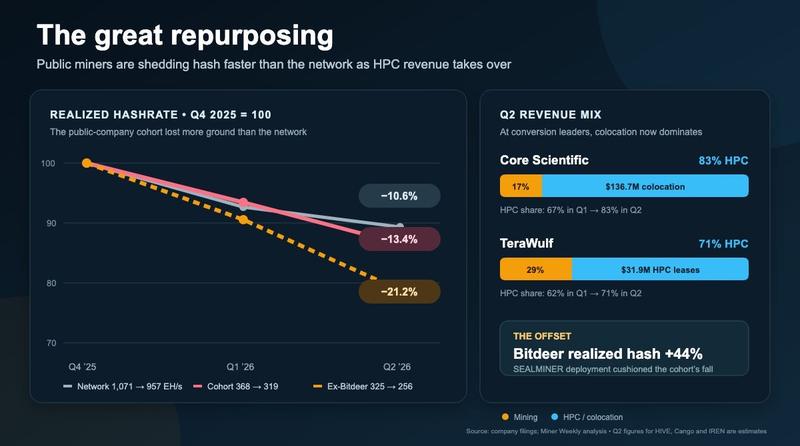
Mining capacity among publicly listed Bitcoin operators is declining at a faster pace than across the broader Bitcoin network, indicating that an increasing number of companies are channeling electricity resources and infrastructure toward high-performance computing (HPC) and data center operations, marking another milestone in the industry's transformation beyond cryptocurrency production.
The decline became more pronounced when Bitdeer's operations were excluded from the analysis. Removing Bitdeer from the group revealed a 21.2% drop in realized hashrate across the six-month timeframe, declining from 324.6 EH/s down to 255.9 EH/s. In contrast, Bitdeer's realized hashrate grew by 44% to reach 63 EH/s.
In contrast, the overall Bitcoin network experienced a 10.6% reduction in average hashrate during the identical timeframe.
This transition is occurring as an increasing number of mining companies disclose expanding revenue streams from activities outside of traditional mining operations. During the second quarter, Core Scientific recorded $136.7 million in colocation revenue, while Bitcoin mining contributed only $27.5 million. TeraWulf posted $31.9 million in HPC lease revenue, with mining operations bringing in $12.8 million.
Bitdeer and Riot Platforms find themselves in considerably earlier stages of this transformation, with their most recent quarterly results showing Bitcoin mining still representing the overwhelming proportion of total revenue.
Unwinding post-China mining boom
The present downturn was characterized by BlocksBridge as a reversal of the growth period that emerged following China's 2021 prohibition of Bitcoin mining, an event that sparked among the most dramatic reductions in network hashrate before operations quickly rebounded as mining firms moved to international locations.
Throughout North America, this relocation wave contributed to driving growth among publicly traded mining companies, which secured funding and obtained additional power facilities to scale up their mining operations.
Following one complete halving cycle, the financial landscape has undergone substantial transformation. Diminished profitability in mining operations, combined with the explosive growth in demand for AI infrastructure beginning in 2022, has led multiple public mining companies to completely redirect their facilities and power resources away from Bitcoin mining activities.