Bitcoin Mining Fee Revenue Plunges to 0.7%, Marking Decade-Low Milestone
Mining operators see transaction fees drop below 0.7% of total earnings as industry players increasingly shift focus toward artificial intelligence ventures.
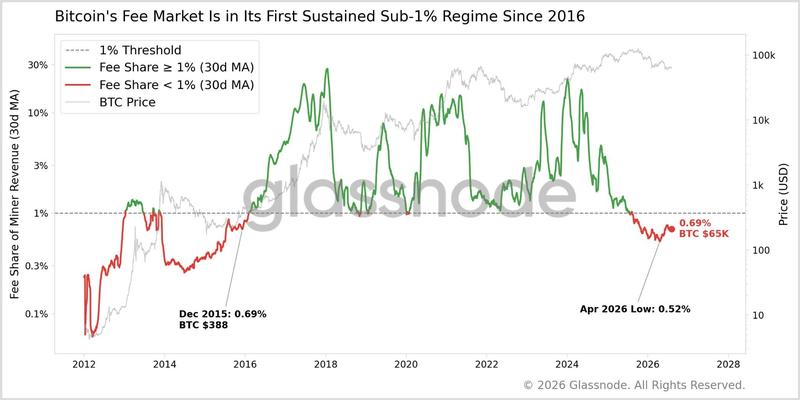
Transaction fees on the Bitcoin (BTC) network have plummeted to a mere 0.69% of total mining revenue as leading industry operators make strategic shifts toward AI infrastructure.
Key points:
- Mining operators are now more dependent on block subsidies than at any point over the last ten years, according to available data.
- The Bitcoin network's hash rate has experienced a 33% decrease since October 2025.
- Industry experts caution that the migration of miners toward AI operations may have consequences for network security.
Bitcoin miner fee revenue share returns to 2016 levels
Information compiled by Glassnode, an onchain analytics platform, reveals that transaction fees as a percentage of total mining income remain close to ten-year lows following a decline to just 0.52% during April.
Mining operations continue to face mounting pressure as Bitcoin's declining market value combined with increasing electricity expenses compress profit margins, pushing smaller operations out of business. Rafael Schultze-Kraft, who co-founded Glassnode, observed that transaction fees have represented less than 1% of total miner income for nearly twelve months.
"The last time we saw fee share at these levels, Bitcoin was trading below $400," he commented on X.
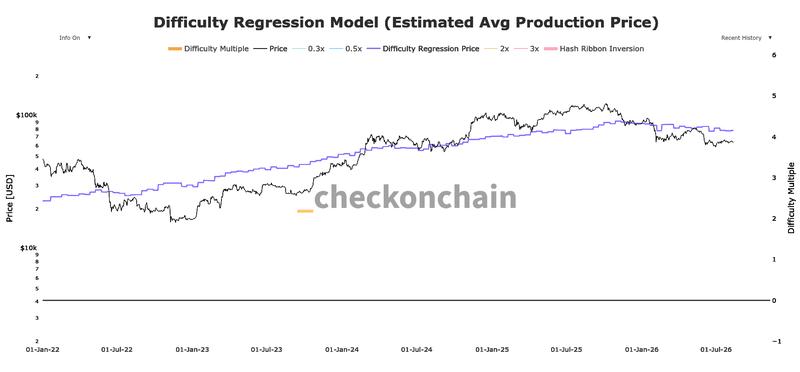
As revenue from transaction fees diminishes, mining operators become more reliant on the predetermined block subsidy for their earnings — the quantity of newly created BTC distributed for each successfully mined block, which currently stands at 3.125 BTC. The value of Bitcoin has plummeted nearly 50% from its all-time high in October 2025, reducing the US dollar equivalent of the block subsidy and placing additional pressure on miners' profitability.
Current data from Checkonchain, an onchain analytics resource, estimates the average production cost for mining one Bitcoin at $78,254 as of Tuesday — approximately 23% higher than the prevailing spot price.
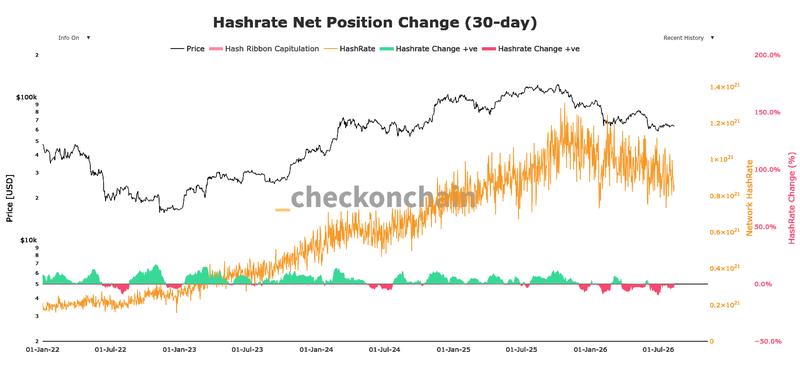
The Bitcoin network's hash rate, which provides an estimated measurement of computational power dedicated to securing the blockchain, demonstrates a mining industry undergoing significant transformation. Hash rate has dropped from its October 2025 high of 1.3 zettahashes per second (ZH/s) down to 861 exahashes per second (EH/s), according to Checkonchain data — representing a 33% reduction.
Analyst: AI pivot is "concerning development"
In research published over the weekend, independent analyst William Clemente recognized the downturn, while highlighting that mining operations would typically have been encouraged to increase activity through automated difficulty adjustments. With mining difficulty now climbing once more, the movement of miners toward more profitable AI computing operations has become increasingly apparent.
"There is no other way to slice it, hash rate has been in a decline. This has taken place as miner margins got squeezed post 2022 from more competition are higher energy prices, but more importantly the pivot of many into AI/HPC, which so far have shown to be prudent business decisions for the public names that have done it."
As previously covered by Cointelegraph, Bitcoin mining company CleanSpark recently repositioned its focus toward AI, transitioning to data center operations after failing to meet profit expectations. In a separate development, another mining operation, Keel Infrastructure, completely ceased all its United States mining activities following a 50% revenue decline in the second quarter.
"This dynamic has been reinforced as Bitcoin has underperformed AI related assets & the rate of change in demand for compute," Clemente added.
Charles Edwards, who founded hedge fund and AI platform Capriole Investments, drew a direct connection between the hash rate reduction and public mining companies' strategic pivot to AI.
"This is the least talked about, concerning Bitcoin development in 2026," he stated on X, pointing out that this trend has gained momentum since April.