Bitcoin Faces Dual Volatility Test: Senate CLARITY Vote and Federal Reserve Decision Loom
As the week begins, Bitcoin has fallen below critical support thresholds, setting the stage for potential turbulence triggered by the Federal Reserve's interest rate determination and the Senate's vote on the cryptocurrency CLARITY Act.
As September enters its third week, Bitcoin (BTC) finds itself trading beneath critical weekly support thresholds while market participants position themselves for incoming volatility catalysts.
- Market expectations point toward a 0.25% interest rate increase by the US Federal Reserve on Wednesday, driven by persistent inflation pressures and escalating oil prices.
- A crucial Senate procedural vote scheduled for Tuesday will determine whether the crypto CLARITY Act advances, representing a pivotal juncture for cryptocurrency market confidence.
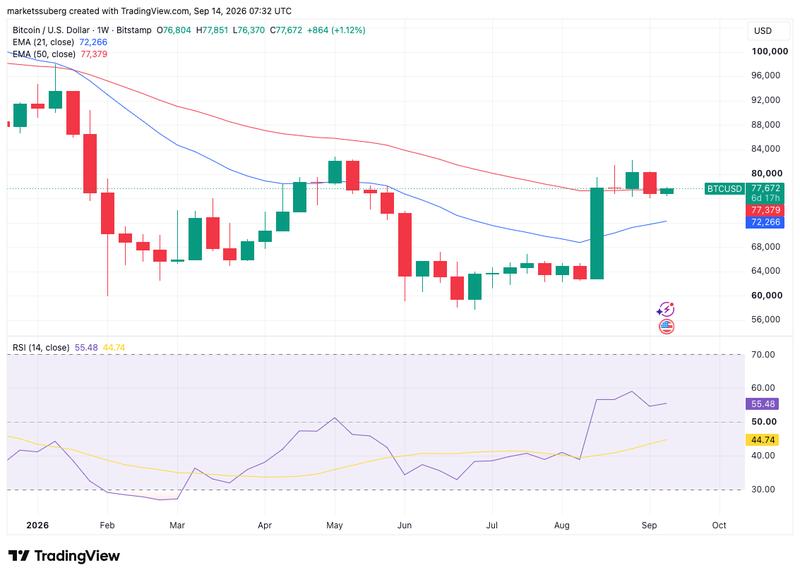
- Last week's close saw Bitcoin trading beneath its 50-week moving average around $77,400, though technical indicators show a bullish RSI divergence pattern remains active.
Despite Trump Opposition, Fed Chair Warsh Expected to Implement Rate Increase
This week places the Federal Reserve squarely in focus for traders across risk-asset markets, with Wednesday's rate determination poised to influence overall market sentiment significantly.
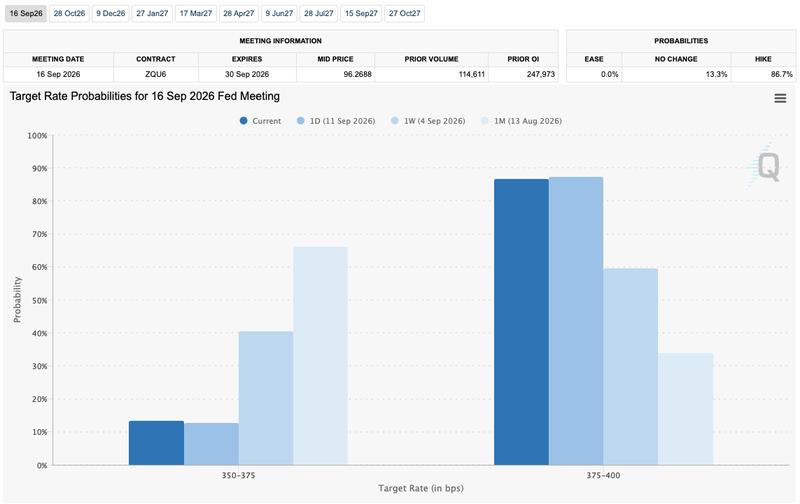
Following elevated inflation readings and measured commentary from chairman Kevin Warsh, market consensus anticipates a 25 basis point rate increase to a range of 3.75-4%, notwithstanding dissenting voices among several officials who advocate maintaining current levels. This scenario mirrors the Fed's July rate deliberation, during which Warsh maintained existing rates despite arguments from multiple voices favoring an increase. Currently, Warsh confronts opposition from US president Donald Trump, who advocates not merely for pausing hikes but for implementing rate reductions.
Current projections from the CME Group's FedWatch Tool indicate merely 13.3% probability for rates remaining unchanged as of this writing. Seven days earlier, market-implied odds of a rate pause exceeded 40%, before retreating in response to fresh inflation metrics and oil price surges stemming from Middle East tensions.
Although both the August Consumer Price Index (CPI) and Producer Price Index (PPI) figures avoided significant upward deviations, market participants responded with hawkish positioning as crude oil prices climbed back above $100 per barrel amid an unresolved supply crisis.
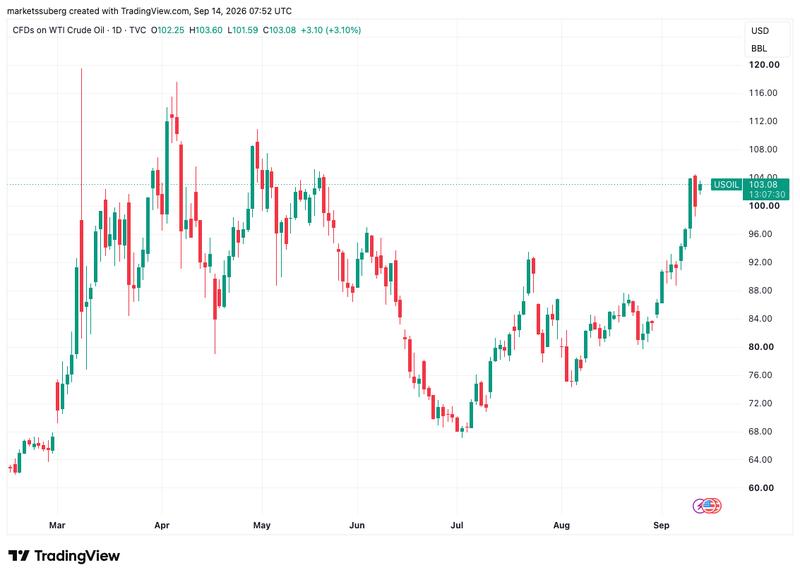
In analysis published by trading resource The Kobeissi Letter, concerns were raised regarding the magnitude of the resulting energy crisis, noting that 30 million barrels daily face potential disruption through the Strait of Hormuz and Saudi Arabia's East-West pipeline, with additional risks emerging at the Bab el-Mandeb Strait.
Even after accounting for some overlap between these routes, the scale of the potential disruption is enormous relative to the ~100 million barrel per day global oil market.
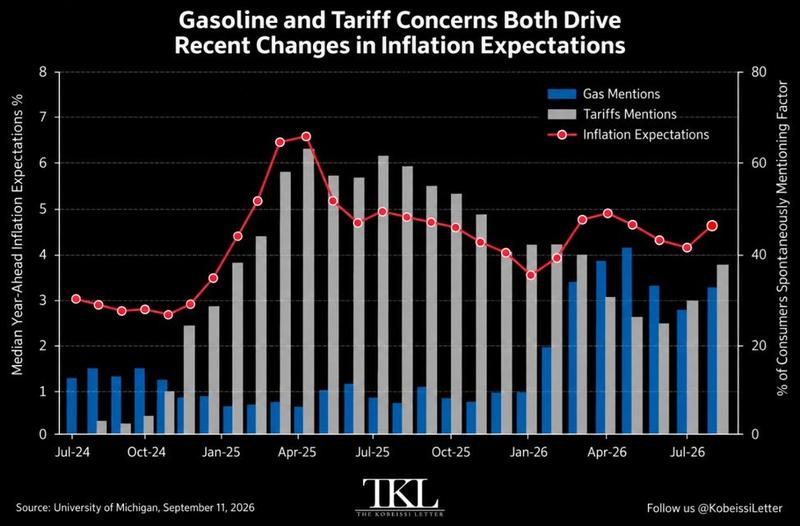
The analysis highlighted rising inflation expectations among American consumers, who now anticipate price increases of 4.6% over the next twelve months—representing a 1.1% increase compared to their projections at 2026's beginning—with gasoline prices and trade tariffs cited as primary concerns.
Critical Senate Vote Looms for CLARITY Act Revision
One day before the Fed announcement on Tuesday, cryptocurrency markets will confront their own pivotal moment as US lawmakers deliberate on the CLARITY Act.
Senate Republicans unveiled what they characterized as their "last, best and final offer" regarding the Act's language on Monday, culminating bipartisan negotiations aimed at establishing clear regulatory parameters for the cryptocurrency industry in the United States.
After a year of intense daily bipartisan negotiations, this bill is ready,
Senator Cynthia Lummis
"President Trump voluntarily agreed to unprecedented ethics restrictions, holding every federally elected official, judge, and their spouses to some of the toughest ethics restrictions in US history."
The CLARITY legislation now confronts a procedural vote scheduled for 2:15 pm Tuesday, necessitating 60 votes for advancement. The outcome could trigger immediate market volatility. Should the measure succeed in its current iteration, it would proceed to the Senate floor for full debate.
"A no vote on Tuesday means opposing real ethics reforms on politicians' personal investments, handing American leadership in digital assets to our foreign competitors, and leaving Americans with zero protections in the digital asset markets," Lummis continued.
During a Saturday discussion with podcast host Kyle Chasse, Tyler Williams, a crypto policy insider who previously served as crypto adviser to US Treasury Secretary Scott Bessent, expressed optimism regarding Tuesday's vote.
What are the odds? I think they are better than they have ever been. We are closer — we are on the precipice of this becoming law.
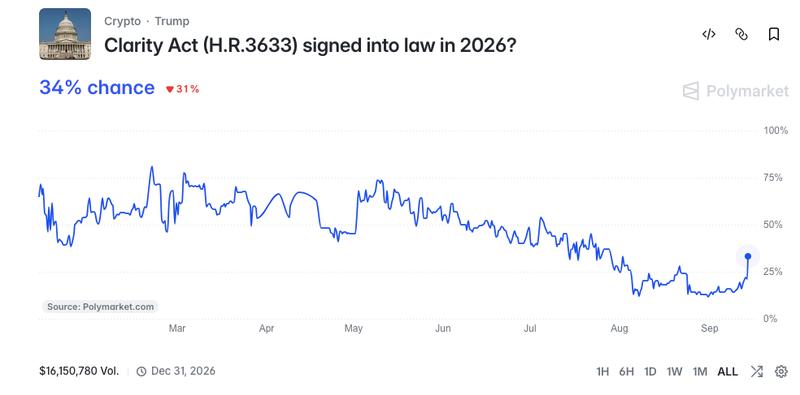
Among participants on Polymarket, betting odds for CLARITY becoming law during 2026 remain subdued. Current data shows just 34% probability for that scenario. More favorable odds were last observed in early August.
Market Participants Reduce Exposure Ahead of Federal Reserve and CLARITY Decisions
Current market analytics suggest traders are actively reducing risk exposure in anticipation of Tuesday's and Wednesday's significant events.
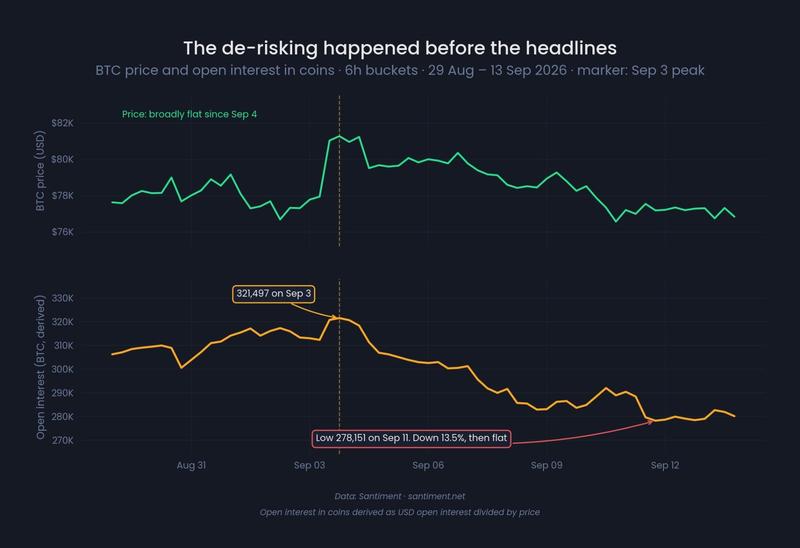
Through analysis of open interest (OI) fluctuations across trading platforms, crypto sentiment analytics platform Santiment contends that markets have already positioned for volatility surrounding both the CLARITY Act vote and the Fed's interest rate decision.
Everyone is watching Tuesday's cloture vote and Wednesday's Fed. The positioning data says the market already made its move.
According to Santiment metrics, OI measured in BTC terms, derived by dividing USD-denominated OI by Bitcoin's price, declined 13.5% during the week ending Sept. 11, dropping from 321,497 BTC to 278,151 BTC, with only modest recovery thereafter. Concurrently, spot pricing itself decreased by 5%.
"Positioning sits about 20% below where it was before the mid-August rally," Santiment noted.
Funding Rate Patterns Echo Previous Bullish Cycles
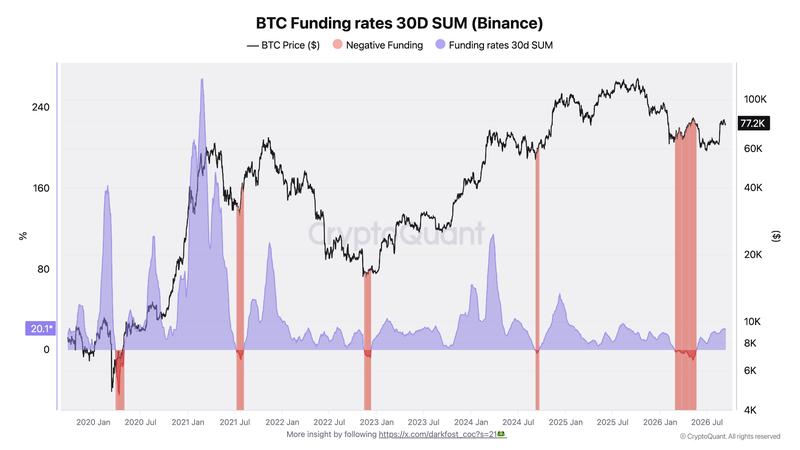
As BTC/USD hovers near $80,000, funding rates continue signaling bullish sentiment formation, according to fresh analysis from blockchain analytics platform CryptoQuant.
Beginning in late May, aggregate funding rates across trading venues have progressively risen, marking the conclusion of a negative-rate period that commenced in early March. These funding rates mirror the equilibrium between long and short positions among market participants.
After a disbelief phase, during which funding rates reflected one of the most bearish sentiments ever seen in Binance derivatives, the buildup of shorts that followed a -52% drawdown ended up fueling May's rally,
CryptoQuant
"It's particularly interesting to observe how this bearish consensus has consistently shown up whenever Bitcoin was nearing the end of a correction."
Data from CryptoQuant demonstrates that negative cumulative 30-day funding rates on Binance have historically coincided with concluding phases of Bitcoin bear markets, as well as significant corrections occurring within bull market cycles.
In earlier reporting, Cointelegraph highlighted the persistent absence of spot market engagement in Bitcoin's recent price appreciation, with analysts cautioning that derivatives-driven market momentum may prove unsustainable.
Critical Weekly Support Level Lost for Bitcoin Bulls
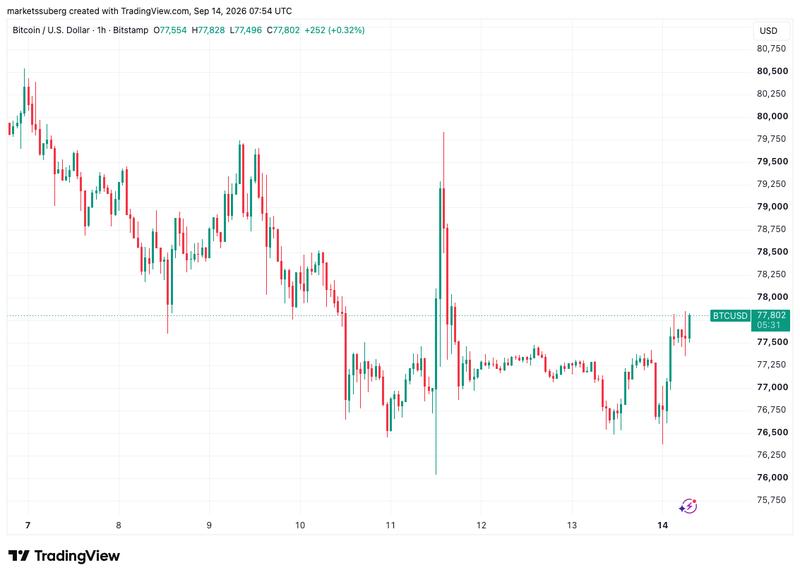
During Sunday's weekly close, Bitcoin's price failed to maintain a crucial support threshold, settling near $76,800.
In Sunday commentary, trader and market analyst Rekt Capital emphasized that maintaining $78,300 through the weekly close was essential. Without holding this level, he cautioned, Bitcoin risks duplicating its unsuccessful breakout attempt from early May.
An accompanying technical chart illustrates BTC/USD persistently establishing a sequence of descending highs, preserving the longer-term bear market framework.
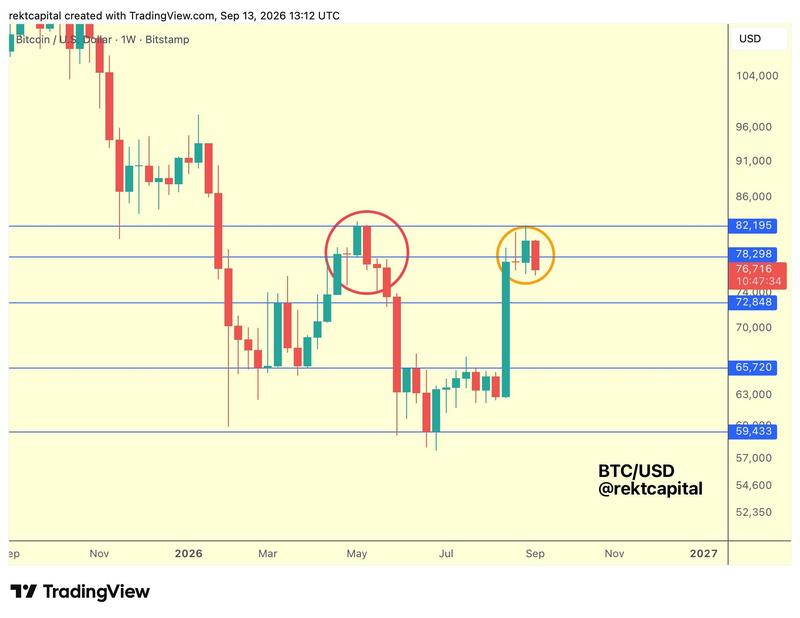
Bitcoin additionally settled beneath its 50-week exponential moving average (EMA) positioned at $77,380, a critical trendline requiring reclamation to establish a durable bullish trend reversal. Rekt Capital identified the 21-week EMA at $72,270 as the subsequent critical defense level for bullish market participants.
Both of these EMAs tend to act as support in a Bull Market. So if they can't hold sustainably as support then that would be a confirmation of the trend not being in a full-blown Bull Cycle yet.
Despite this, the weekly close maintained a bullish divergence pattern on Bitcoin's relative strength index (RSI), which continues displaying higher lows throughout 2026.