Bitcoin ETFs in US see strongest weekly performance since April with $1B in fresh capital
Bitcoin exchange-traded funds delivered their third most impressive weekly performance since October, with institutional investors demonstrating signs of reinvigorated interest.

Interest in United States spot Bitcoin exchange-traded funds (ETFs) experienced a significant resurgence during the current week, indicating a revival of investor enthusiasm following several months of inconsistent capital flows, despite ongoing ambiguity surrounding cryptocurrency regulation and concerns about digital asset self-custody security.
This past Saturday, Eric Balchunas, an ETF analyst at Bloomberg, reported that the spot products drew in approximately $1 billion in net inflows throughout the week, representing their most robust performance since April and ranking as the third-strongest weekly result since October of last year — a timeframe he characterized as Bitcoin's "silent IPO."
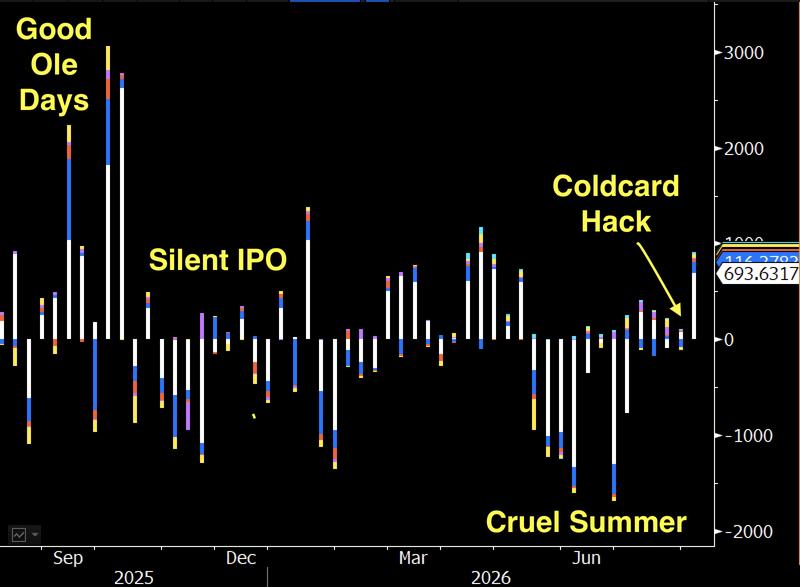
This terminology gained traction through investor Jordi Visser in November, who used it to characterize what he perceived as a transition in Bitcoin ownership patterns. According to this hypothesis, original Bitcoin holders were liquidating their positions to meet increasing demand from ETFs and additional institutional purchasers, generating sufficient supply to maintain Bitcoin's price stability notwithstanding the substantial influx of new investment capital.
This distribution phase aligned with a decline in ETF flows when compared to earlier stretches of more robust demand, which makes the current week's recovery especially significant.
Coldcard hack puts self-custody in focus
This resurgence has also come on the heels of a significant security breach affecting Coldcard, a widely-used Bitcoin hardware wallet manufactured by Coinkite, which led to the theft of approximately $116 million worth of Bitcoin. The security compromise was traced to a vulnerability in the manner that impacted devices created wallet keys, enabling malicious actors to access funds stored in wallets generated using compromised firmware.
This past Friday, Balchunas indicated that the security incident might eventually enhance the attractiveness of spot Bitcoin ETFs among market participants who feel uneasy about the technical expertise and security obligations that come with self-custody. He referenced the spike in ETF inflows that occurred after the hack as a possible, albeit unconfirmed, connection.
Despite recognizing that correlation does not imply causation, Balchunas stated, "long-term I can't imagine there aren't some who migrate over," alluding to investors who may potentially transition from cold storage solutions to ETFs.