Bitcoin Breaks Away from Tech Stocks as Correlation Hits Lowest Point Since 2018
Bitcoin's value significantly outpaces the technology-focused Nasdaq index during US-Iran tensions, though downside risks targeting $51,000 remain present.

Bitcoin (BTC) severed its historically strong relationship with technology equities as military conflict between the United States and Iran entered its third consecutive week.
Key takeaways:
- Bitcoin is demonstrating superior performance compared to technology equities during the US-Iran military conflict, suggesting its increasing appeal as a hedge against geopolitical uncertainty.
- Arthur Hayes, co-founder of BitMEX, cautions that Bitcoin's recent upward momentum could prove to be a temporary dead cat bounce phenomenon.
BTC correlation with Nasdaq flips negative
Measured on a 52-week rolling calculation, the correlation between BTC and the technology-heavy Nasdaq Composite Index (IXIC) registered at -0.06, representing the weakest reading observed since December 2018. This development represents a dramatic shift from the multi-year pattern where correlations typically ranged between 0.60 and 0.92.
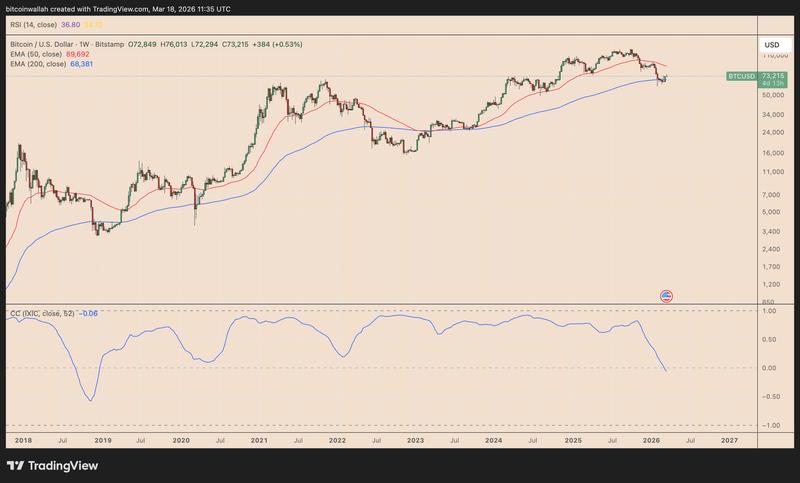
The relationship turned negative during late February, aligning with the commencement of US and Israel's military operations against Iran.
Beginning Feb. 28, marking the war's onset, the BTC/USD pair has climbed more than 15%, whereas the Nasdaq has declined approximately 2%.
This performance gap indicates that market participants are progressively viewing Bitcoin as protection against geopolitical uncertainty instead of merely a technology-linked risk asset.
Why is Bitcoin decoupling from tech stocks?
A primary catalyst behind Bitcoin's resilience seems to be Strategy's intensive BTC acquisition campaign.
During the most recent two-week period, the company led by Michael Saylor purchased 40,331 BTC, with a portion of this acquisition financed through at-the-market (ATM) offerings of its STRC preferred stock.
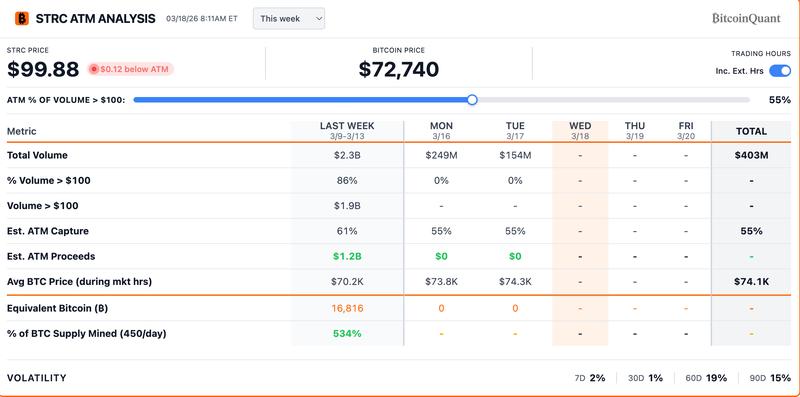
This purchasing activity represented approximately 9 to 10 times the volume of Bitcoin mined over the identical timeframe, indicating that market demand substantially exceeded freshly created supply.
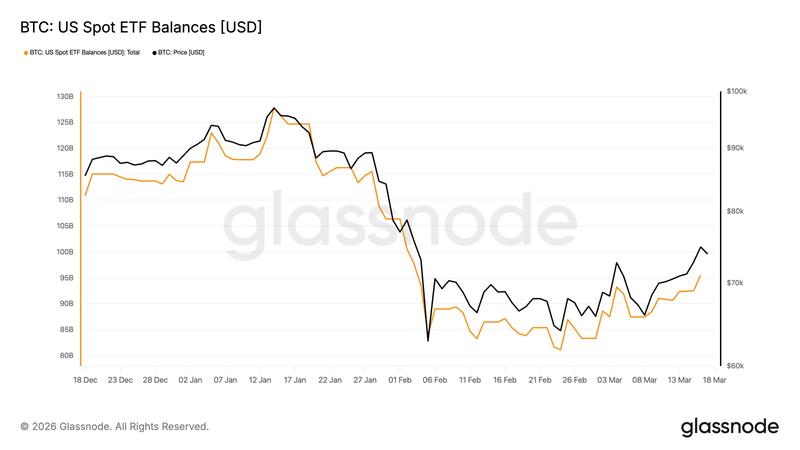
Simultaneously, United States spot Bitcoin ETFs attracted over $12.22 billion in net inflows, providing yet another powerful demand catalyst.
An additional element supporting the bullish narrative is the expansion in stablecoin liquidity connected to Middle Eastern demand throughout the military conflict. The market capitalization of USDC has surged to an all-time high approaching $79.57 billion, advancing from approximately $70 billion recorded in early February.
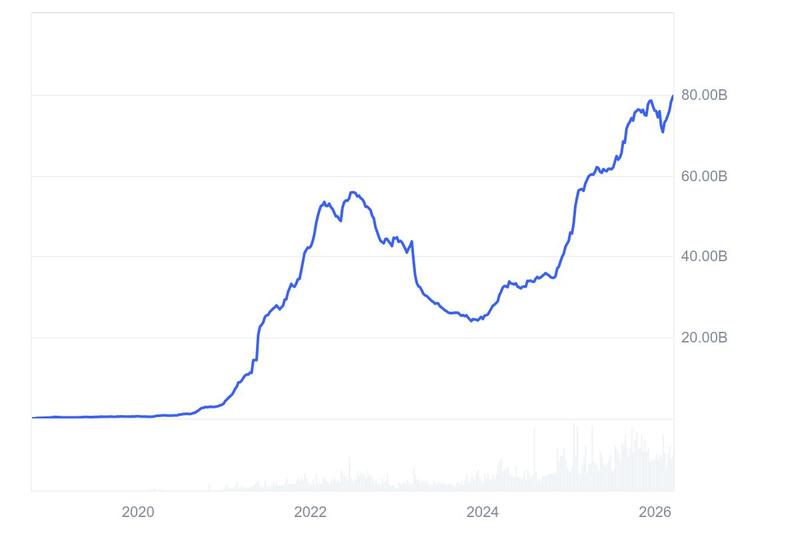
This growth emerges as appetite for dollar-pegged stablecoins has allegedly intensified in financial centers including Dubai throughout the US and Israel-Iran military engagement.
Expanding USDC circulation suggests strengthening dollar liquidity flowing into cryptocurrency markets, contributing to Bitcoin demand precisely as Strategy's aggressive purchasing activity constrains accessible supply.
Joe Consorti, who serves as head of growth at Bitcoin equity firm Horizon, stated that Bitcoin is successfully navigating its "geopolitical stress test," with certain macroeconomic frameworks suggesting the asset's price could achieve $100,000 during upcoming months.
Arthur Hayes warns of "dead cat bounce"
Notwithstanding the recent performance divergence, not every market observer believes Bitcoin has fundamentally separated from equity markets.
In a March 5 post, Arthur Hayes, co-founder of BitMEX, suggested Bitcoin's recent advance toward the mid-$70,000 territory might constitute a "dead cat bounce," cautioning that persistent weakness across SaaS equities amid more restrictive financial conditions would probably pull BTC prices lower.
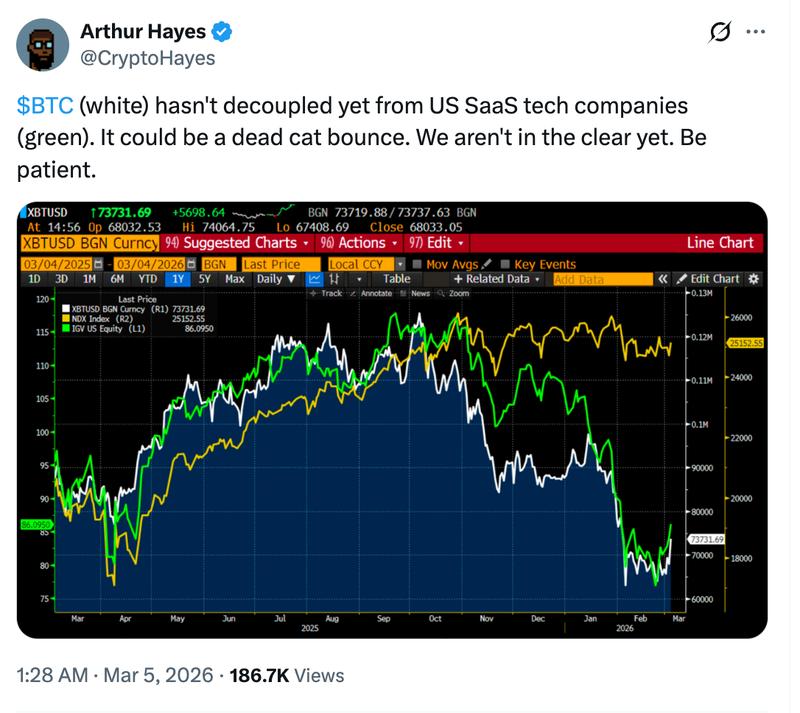
Bitcoin maintains a stronger connection to United States SaaS equities compared to the wider Nasdaq index.
In contrast to the Nasdaq, which encompasses defensive and varied sectors, SaaS enterprises, including companies like Salesforce, Adobe, and Zoom, represent high-growth, liquidity-dependent holdings that have predominantly tracked macro conditions comparable to cryptocurrency.
Hayes's skepticism now appears reflected in available market metrics.
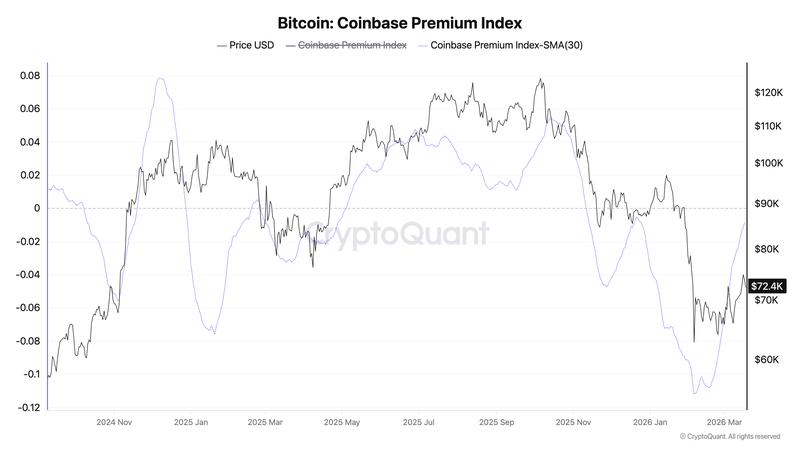
The Coinbase Premium Index has maintained negative territory on a 30-day rolling measurement, indicating insufficient US spot market demand and implying that the latest price rally lacks robust institutional continuation.
Additionally, Bitcoin's latest rejection from the $76,000 resistance zone, which simultaneously corresponds with the upper boundary of its ongoing bear flag formation, increases the probability of a retreat toward the lower boundary positioned around $68,000.
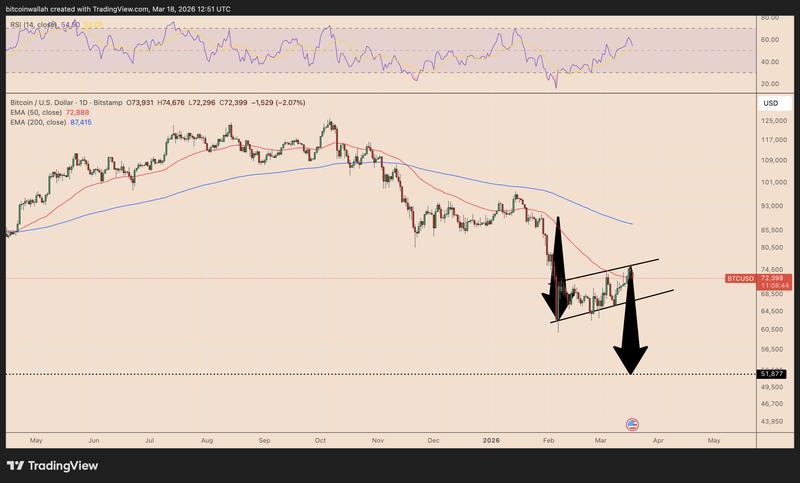
A conclusive breakdown beneath the $68,000 level risks sending the BTC price tumbling toward the calculated downside objective positioned around $51,000.
This article does not contain investment advice or recommendations. Every investment and trading move involves risk, and readers should conduct their own research when making a decision. While we strive to provide accurate and timely information, Cointelegraph does not guarantee the accuracy, completeness, or reliability of any information in this article. This article may contain forward-looking statements that are subject to risks and uncertainties. Cointelegraph will not be liable for any loss or damage arising from your reliance on this information.