BIP-110 collapses in spectacular failure, CLARITY Act delayed: Hodler's Digest, Aug. 9
BIP-110 self-destructs with only a "2-block chain" to show for its efforts, while CLARITY secures a September Senate vote. Prospects for passage remain bleak.

Bitcoin 'anti-spam' BIP crashes and burns
Those backing the BIP-110 soft fork had ambitions to eliminate spam from the blockchain, yet following an extended and contentious discussion, the proposal has been declared Dead On Arrival. Having garnered a mere 2.5% backing prior to commencing mandatory signaling on Saturday, it diverged into a minority chain that produced only two blocks across an eight-hour period before grinding to a halt.
The outcome was hardly unexpected considering mining on the alternative chain proved equally challenging and costly as Bitcoin mining — yet lacking any possibility of liquidating the block reward to offset expenses. Had miners succeeded in processing another 2,014 blocks, the difficulty would have adjusted downward accordingly.
The objective of BIP-110 was to purge Bitcoin of non-financial transactions, including Ordinals, yet critics characterized it as implementing censorship on the blockchain, and it encountered resistance from well-known Bitcoin proponents. Strategy's executive chairman Michael Saylor acknowledged sharing the proposal's goals but contended that its methodology jeopardized Bitcoin's neutral governance and consensus mechanisms.
Blockstream's CEO Adam Back issued warnings that the consensus-level modification could undermine Bitcoin's reputation and potentially render specific unspent transaction outputs unusable. In the aftermath, Bitcoin Core developer Murch has put forward a proposal to strip BIP-110 supporter Luke Dashjr of his role as a BIP Editor.

Clarity vote pushed back to September
Senator Tim Scott, serving as chair of the Senate Banking Committee, stated on Thursday that a procedural vote regarding the CLARITY Act ought to occur prior to the August recess "without any question."
Senator Cynthia Lummis similarly stoked expectations of an eleventh-hour vote. However, notwithstanding hopes that Senators would be confined to a chamber and compelled to reach agreement before departing for the August break, Senate Majority Leader John Thune chose not to press the matter and subsequently scheduled the cloture vote for September 15.
"The Dems are insistent on no Clarity vote," Thune informed Cointelegraph. "I worked with sponsors of the bill. Senator Lummis was great, and we're getting that queued up first thing when we come back."
Until that date, crypto lobbyists must work to secure the 60 votes necessary through negotiations concerning ethics regulations, the stablecoin yield matter, and safeguards for developers within the BRCA. The genuine question, however, is whether this represents a legitimate effort to enact the legislation, or if the vote has been scheduled merely "to get people on the record" in advance of the mid-term elections as Lummis indicated.
Bitcoiners establish 'red team' to combat AI-assisted hacks
A Bitcoin security collective consisting of 16 volunteers announced mid-week that it had identified nearly 5,000 potential vulnerabilities during a swift AI-assisted examination of projects within the Bitcoin ecosystem.
By week's end, that figure had expanded to 7,958 issues, including 168 critical vulnerabilities and 1,120 high severity problems.
Bitcoin Red Team represents a volunteer security initiative that encompasses Rob Hamilton, CEO of AnchorWatch, and Bitcoin developer Calle, which has been utilizing AI tools alongside human analysis to scrutinize open-source Bitcoin-related repositories for security weaknesses.
"We're averaging on the order of 1 critical exploit per hour per person," said Calle in a post.
The team mobilized in response to the Coldcard hardware wallet breaches, which developer Coinkite proposed resulted from an AI examination of its source code. In excess of $100 million has been pilfered by 7300 wallets, attributable to defects in the random number generator employed to create seed phrases. The incident has emerged as the third largest crypto breach in 2026 and contributed to pushing July's crypto theft total to $247 million.
The breach served to illuminate the trust necessary when utilizing a hardware wallet, and prompted numerous Bitcoiners to question whether any wallet was genuinely secure?
Many have now resolved to employ at least 100 manual dice rolls to create their own seed phrase.

Ethereum researchers propose limiting staking; detractors warn of unintended consequences
A coalition of Ethereum researchers and developers have put forth modifications to the network's issuance policy aimed at reducing validator rewards more dramatically as the share of staked ETH increases.
Tapered Issuance Burn (AKA EIP-8363) would eliminate rewards entirely once the percentage of supply staked exceeded the 50% threshold. It's presently at 34% with a substantial queue of ETH awaiting entry, and concerns exist that this trend may continue to accelerate while delivering progressively diminished benefits for network security.
Notwithstanding some persuasive arguments supporting the proposal, it has encountered vigorous opposition, particularly from DeFi protocols. Ether.fi founder Mike Silagadze indicated Ether.fi would exit staking completely should it be implemented. He said:
"This is so disappointing on every level. [...] This is bad for decentralization, this is bad for Ethereum adoption, and this is bad for the credibility of the network."
Optimism returns as Bitcoin ETFs post best week in four months
The spot Bitcoin exchange-traded funds recorded their third-strongest performance since October as institutional interest exhibited signs of revitalized momentum.
The influx of $853.54 million in inflows was five times the quantity they accumulated throughout all of July, and marked the strongest week since April. The Ether ETFs attracted an additional $243.7 million.
Certain industry participants believe the substantial inflows may correlate with the Coldcard breach, which has enhanced the appeal of institutional custody relative to employing a potentially compromised hardware wallet. Bloomberg ETF analyst Eric Balchunas posited there may be a correlation, while Binance co-founder Changpeng "CZ" Zhao declared outright: "It is statistically safer to store coins on exchanges than to self custody."
Winners and Losers
At the end of the week, Bitcoin (BTC) is up 2% to trade at $64,814, Ethereum (ETH) is up 1.7% to trade at $1,908 and XRP (XRP) is down 5% to $1.02. The total market cap is at $2.21 trillion according to CoinMarketCap.
Among the biggest 100 cryptocurrencies, the top three altcoin winners of the week are Pump.fun (PUMP) with a 27.6% gain, LayerZero (ZRO) on 17.6%, and Curve DAO (CRV) on 16.2%.
The top three altcoin losers of the week are Injective (INJ) which was down 15.1%, Canton (CC) down 13.8% and Cronos (CRO) down 13.7%.
Prediction of the Week
Bitcoin will never fall below $60K again: Nansen founder
Nansen founder and CEO Alex Svanevik contends the Bitcoin market may be nearing a bottom, proposing that the present level around $60,000 could represent Bitcoin's cycle low.
"My personal view is that I don't think Bitcoin's gonna go back below $60,000," Svanevik says. "I think that's the past… I think forever," he says.
He grounds this perspective in the conviction that Bitcoin functions as a hedge against central bank money creation, and he doesn't foresee the global monetary expansion cycle concluding anytime soon.
Top FUD of the Week
Crypto wrench attacks net more than $30M so far in 2026
Criminal elements have stolen in excess of $30 million through physical assaults on crypto holders during the first six months of this year, positioning 2026 to potentially exceed the record $58 million stolen in 2025.
Chainalysis reports that 46 violent crypto-related incidents have been documented globally through late June, an increase from 40 during the corresponding period in 2025. The incidents encompass kidnappings, home invasions and hostage scenarios, collectively referred to as "wrench attacks."
A mere 12 of the 46 attempts culminated in payment, providing attackers with a 26% success rate, a decline from 49% in 2025.
ElizaOS token sinks 19% to record low after founder declares it 'dead'
ElizaOS declined 19% over 24 hours to an all-time low following Eliza Labs founder Shaw Walters announcing the token was "dead" and that the Eliza Foundation was shutting down operations.
CoinGecko data revealed the token now possesses a market capitalization of $2.1 million.
"The token is dead. Completely," Walters said, adding that he no longer owned or supported the token.
The downturn represents a dramatic turnaround for one of the AI-agent sector's previous breakout tokens. Prior to the project rebranding as ElizaOS, the token, formerly known as AI16Z, attained a peak market capitalization of $2.5 billion in January 2025, according to CoinGecko.
Walters stated the development of the open-source Eliza software would persist without the token or the foundation.
CEX perpetual futures volume falls to $4T, lowest since late 2023
Crypto perpetual futures trading volume on centralized cryptocurrency exchanges (CEXs) dropped to $4 trillion in July, representing a 31-month low.
Binance dominated CEXs with $1.4 trillion in monthly perpetual futures volume, trailed by OKX with $607 billion and Bybit with $300 billion, analytics platform CryptoRank said in a Friday X post.
Perpetual trading volume on decentralized exchanges (DEXs) descended to $531 billion in July, the lowest level since June 2025, and a 21% decline from the $676 billion observed in June 2026, according to data aggregator DefiLlama.
Best Magazine Features of the Week
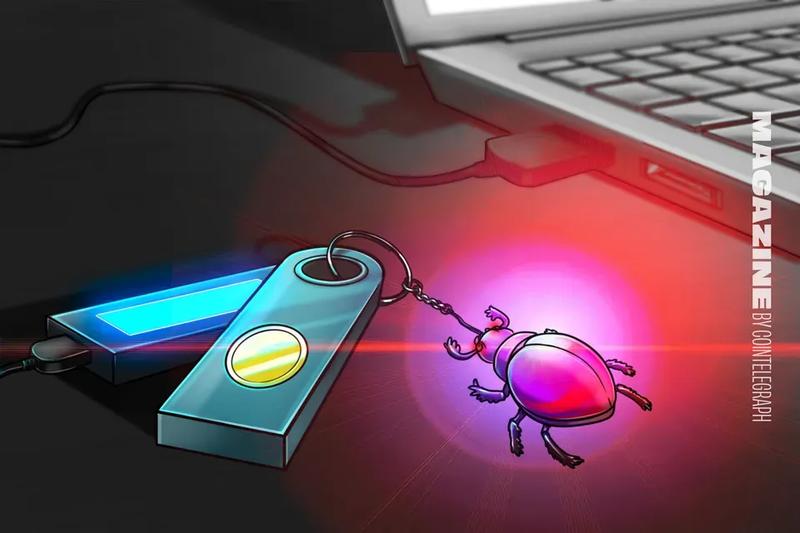
Do the Coldcard attacks mean all hardware wallets are now insecure?
The Coldcard entropy flaw caused a crisis of confidence in hardware wallets. Here's the details you need to know before you entrust Ledger, Trezor or Foundation with your Bitcoin.
10 weirdest things ever tokenized... including farts
Tokenized cows may have gone viral, but they're just the latest in a long line of strange things to find a home onchain, from farts, to human skin and destroyed artworks
Fierce backlash to Ethereum's EIP-8363 staking proposal
Ethereum's proposed EIP-8363 staking overhaul aims to reduce issuance, but critics say it could hurt DeFi, decentralization and institutional adoption.