Beijing alerts foreign operatives on blockchain surveillance, Singapore leads regional crypto growth: Asia Express
The city-state's digital asset sector expands by 55%, the Republic of Korea prepares to legitimize cryptocurrency market making activities, while China's intelligence apparatus alerts potential foreign operatives that blockchain transactions are under surveillance.

CHINA
China's security apparatus identifies digital currencies as espionage 'accomplices'
The Ministry of State Security in China has intensified its messaging regarding cryptocurrency risks, emphasizing their involvement in criminal activities and underscoring that transactions lack genuine anonymity.
The South China Morning Post reported that intelligence officials released a social media statement indicating that digital currencies facilitate money laundering operations and cyber-offensive activities, functioning as "accomplices" in intelligence gathering operations.
According to the MSS, cryptocurrency is frequently utilized by "overseas anti-China hostile forces" to undermine financial stability and threaten national security interests.
The cautionary message that digital currencies don't provide the anonymity many users believe appeared to target potential foreign intelligence assets who incorrectly assume they can transmit or receive funds without detection by authorities:
"Overseas intelligence agencies would try to dispel the concerns of people they were trying to recruit as spies by claiming that the circulation of virtual currencies was hard to verify, according to the Ministry."
The underlying message was clear: blockchain surveillance is ongoing. Although this warning applies to the majority of digital currencies such as Bitcoin and Ethereum, privacy-focused alternatives like Monero or Zcash remain completely private when properly utilized.
The Chinese government has instituted multiple cryptocurrency prohibitions, including a comprehensive exchange ban implemented in 2017 and a subsequent mining prohibition in 2021. Additionally, all cryptocurrency-related enterprises have been deemed illegal operations.
SINGAPORE
City-state's cryptocurrency sector expands 55% while surrounding region sees decline
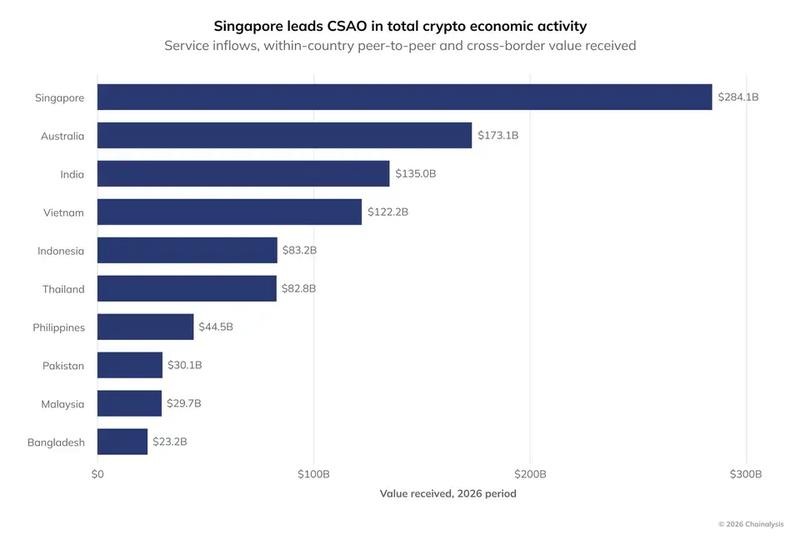
Cryptocurrency activity within Singapore increased by 55.4% to reach $284 billion during the twelve-month period ending June 2026, defying regional decline trends and reclaiming its status as the dominant crypto economy across Central and Southeast Asia and Oceania (CSAO), data from Chainalysis reveals.
The expansion was primarily driven by institutional platform operations, which surged 94% to $60 billion, with activity concentrated among a limited number of market making entities, over-the-counter trading operations, and institutional brokerage services. According to Chainalysis data, the wider CSAO crypto economy decreased by 6.8% during the identical timeframe.
"The growth in Singapore's institutional platform ecosystem was very concentrated and marked by mostly high-volume activity by existing platforms rather than the dynamic entry of new services," Chainalysis told Cointelegraph.
SOUTH KOREA
Republic of Korea poised to authorize cryptocurrency market making operations
The Financial Services Commission of South Korea announced it is evaluating the implementation of a market-making framework for digital assets, following an incident where a stablecoin pegged to the Japanese yen value traded at up to four times its intended peg on a prominent South Korean cryptocurrency exchange this month.
The cryptocurrency exchange Upbit initiated trading for JPYC, a stablecoin backed by the yen, on Sept. 17, with the market commencing at 12 Korean won per JPYC token before climbing to a peak of 37.6 Korean won within just one hour, exceeding its market value by more than four times. This price surge was blamed on insufficient liquidity available on Upbit.
"We will also review the need to introduce systems such as market-making activities to increase the efficiency and stability of the digital asset landscape," Yoo Young-joon, director of digital finance policy at the FSC, said.
The Virtual Asset User Protection Act currently in force in South Korea lacks provisions exempting market-making activities from its market manipulation regulations, effectively blocking market makers from supplying liquidity to the nation's digital asset markets.
MoonPay establishes Korean presence
The United States-based payments and infrastructure company MoonPay has established a subsidiary in South Korea. The entity will collaborate with domestic financial institutions on remittance services, payment processing, settlement operations and digital asset distribution channels. However, necessary regulatory approvals remain pending.
JAPAN
Overseas visitors can use Binance Pay to spend digital currencies at Japanese PayPay merchants
Qualified international users traveling to Japan will be able to utilize Binance Pay to spend over 100 different cryptocurrencies at the overwhelming majority of merchants accepting PayPay, with the service commencing Wednesday.
The payment capability will operate via HIVEX, a payment interoperability platform that bridges overseas QR-based payment systems with PayPay-accepting merchants throughout Japan. Binance Pay utilizes Tether USDt (USDT) for its backend settlement infrastructure, with HIVEX conducting settlements with PayPay and PayPay subsequently settling merchants in Japanese yen.
Binance informed Cointelegraph that it represents the first cryptocurrency payment solution to gain access to PayPay-accepting merchants via HIVEX. According to the company, merchants will not be required to separately opt into the service.
PayPay is a Japanese digital payment platform accepted across millions of locations throughout the country, encompassing major retail chains, independent retailers, vending machines, taxi services and public transit systems. The platform currently lists nine additional overseas payment platforms supported via HIVEX, predominantly originating from China, Hong Kong and Taiwan.

HONG KONG
Regulatory authorities in Hong Kong extend financial disclosure supervision to authorized cryptocurrency entities
Regulatory bodies in Hong Kong have executed an agreement to broaden their collaborative oversight of financial reporting and audit processes for licensed cryptocurrency companies.
The Securities and Futures Commission (SFC) and the Accounting and Financial Reporting Council (AFRC) have committed to collaborative efforts on audit and assurance functions and created a structure for information exchange, case referrals, reciprocal assistance and coordinated inspection and investigation activities for licensed cryptocurrency enterprises.
HSBC names Hong Kong dollar stablecoin RedCoin
HSBC is planning a gradual deployment of RedCoin, its newly developed Hong Kong dollar-pegged stablecoin, initially focusing on person to person transactions and merchant payment applications, before extending into corporate and institutional applications. The bank is simultaneously launching an educational initiative to protect the public from falling victim to cryptocurrency scams.