Banks and Credit Unions in Minnesota Gain Authority to Offer Cryptocurrency Custody
Starting August 1, financial institutions and credit unions operating in Minnesota will gain the legal right to offer custody services for digital assets in a nonfiduciary role.

Financial institutions and credit unions headquartered in Minnesota will gain the ability to deliver cryptocurrency custody solutions starting this August.
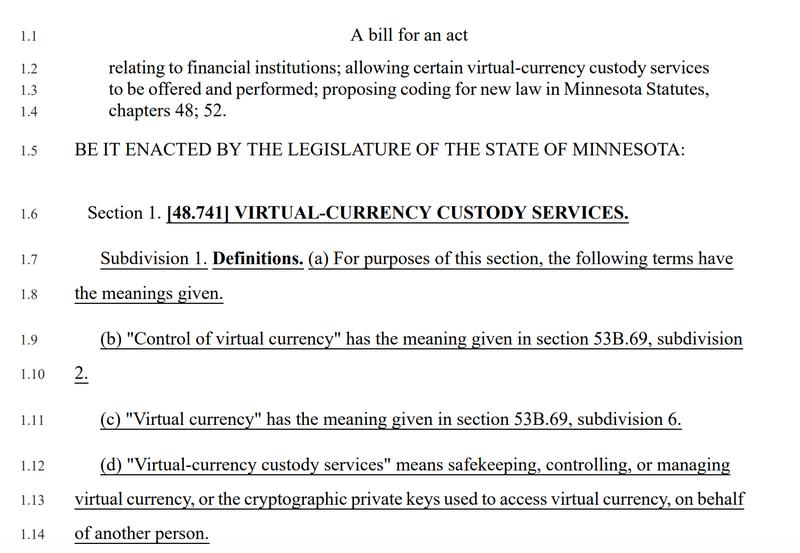
Governor Tim Walz put his signature to House File (HF) 3709 on Friday, enabling "certain virtual-currency custody services to be offered and performed" by the state's financial services providers.
According to Bernie Perryman, one of the initial sponsors of the legislation in the Minnesota House of Representatives, the measure was designed in March to guarantee that "Minnesota-based financial institutions are allowed to evolve alongside their customers and members rather than forcing Minnesotans to rely on unregulated, out-of-state or offshore providers for services."
Under the freshly enacted legislation, credit unions and banks will be permitted to deliver virtual-currency custody solutions in a nonfiduciary role starting Aug. 1. Minnesota's existing statutes were modified by the law to permit these financial services organizations to utilize "third-party service providers or subcustodians to facilitate virtual-currency custody services," with the requirement that such funds remain "legally and operationally segregated" from the assets of the bank or credit union and are not regarded as their property.
This new legislation governing cryptocurrency custody services has the potential to impact the operations of every financial institution throughout the state.
Data from the state's government information portal indicates that, as of May 2025, Minnesota was home to 240 commercial insured banking institutions with approximately $128 billion in combined assets, along with 82 member-owned credit unions affiliated with the Minnesota Credit Union Network. Notably, U.S. Bancorp, which ranks as the nation's seventh-largest bank by total assets, maintains its headquarters in Minneapolis.
Beyond the cryptocurrency custody legislation, state legislators in Minnesota also moved forward with a proposal aimed at prohibiting digital asset kiosks and ATMs throughout Minnesota, a measure prompted by multiple cases of state residents falling victim to scams.
Crypto companies look to federal regulators for banking, custody services
Earlier this month, Payward, which serves as the parent organization of the Kraken cryptocurrency exchange, announced that it had submitted an application to the US Office of the Comptroller of the Currency (OCC) seeking a national trust company charter. The company stated its intention to create Payward National Trust Company offering "fiduciary custody and other services primarily for digital assets" contingent upon regulatory approval.
The application submitted by Payward represents just one example among numerous efforts by cryptocurrency-focused enterprises seeking to obtain federal regulatory approval during the Trump administration. In December, the OCC granted approval or conditional approval to similar charter applications submitted by Ripple Labs, BitGo, Circle, Fidelity Digital Assets and Paxos, and is currently reviewing a charter application from World Liberty Financial, the enterprise co-founded by US President Donald Trump and his sons.