Banking sector faces minimal stablecoin disruption in immediate future, says Moody's expert
US restrictions preventing interest-paying stablecoins combined with strong domestic payment systems will shield banks from losing significant market position.

At the present stage of mainstream acceptance, stablecoins appear to pose only "limited" disruption to traditional banking institutions, though financial institutions may encounter heightened competitive pressures and declining market position as stablecoin markets and tokenized real-world assets (RWAs) continue expanding their total valuation.
"While stablecoin usage currently remains constrained, their total market capitalization surpassed $300 billion by the conclusion of last year," Abhi Srivastava, associate vice president of Moody's Investors Service Digital Economy Group, stated in comments to Cointelegraph.
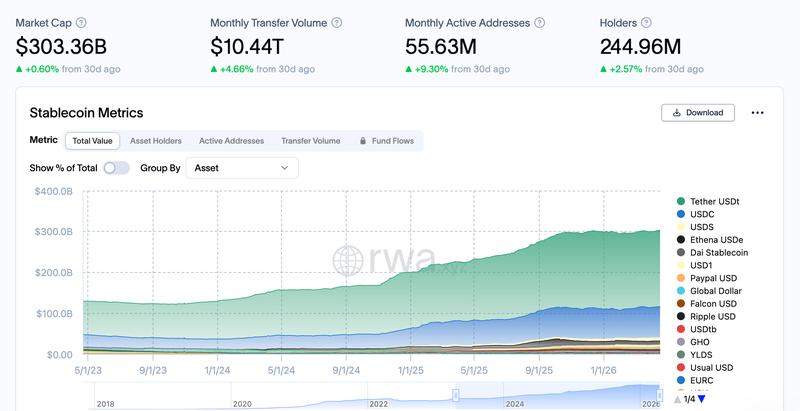
According to Srivastava, the function of stablecoins in payment processing, international trade and blockchain-based finance is "expanding," notwithstanding their presently constrained influence, while noting that current payment infrastructure in the United States already offers services that are "fast, low-cost and trusted." His remarks included:
"For the banking sector, at this stage, disruption risk appears limited. In the near term, US rules that prohibit stablecoins from paying yield mean they are unlikely to replace traditional deposits at scale domestically."
Nevertheless, as time progresses, increased utilization of stablecoins and tokenized RWAs, which are conventional or tangible financial assets that exist on a blockchain through tokenization, may exert "pressure" on traditional banking institutions, resulting in deposit withdrawals and diminished capacity for loan origination, according to his analysis.
Regulatory frameworks governing stablecoins have emerged as a contentious topic among cryptocurrency sector leaders and traditional banking representatives, with concerns that interest-generating stablecoins might diminish banking industry market position serving as an obstacle for the CLARITY crypto market structure legislation currently before Congress.
CLARITY Act stalled, as banks fight yield-bearing stablecoins
Known as the CLARITY Act, the Digital Asset Market Clarity Act of 2025 represents a wide-ranging regulatory blueprint for crypto markets that creates an asset classification system, defines regulatory authority and establishes supervision mechanisms over cryptocurrency trading platforms.
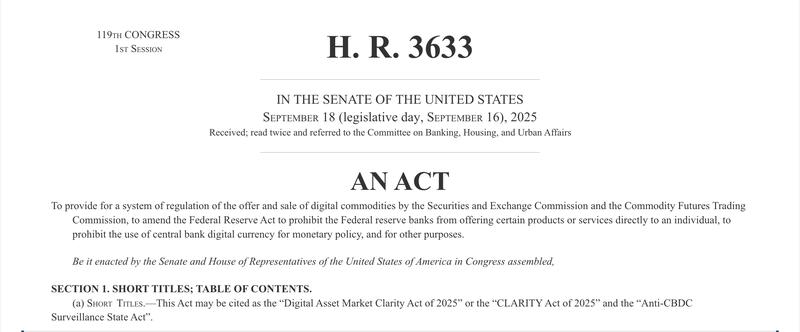
The legislation has encountered obstacles in Congress following public opposition from a coalition of cryptocurrency sector businesses, with cryptocurrency exchange Coinbase taking a leadership role in expressing concerns about previous versions of the proposed law.
Among the most controversial elements highlighted by cryptocurrency industry critics of the bill were inadequate legal safeguards for developers working on open-source software platforms and restrictions preventing stablecoins from offering yields to holders.
Multiple efforts have been undertaken by United States legislators and the White House administration to broker legislation that would satisfy both cryptocurrency sector stakeholders and banking industry representatives.
At the beginning of this month, Senator Thom Tillis of North Carolina announced his intention to publish a revised draft of the bill designed to gain approval from both constituencies; nevertheless, according to reporting from Politico, the proposal has allegedly encountered resistance and remains unpublished.
Meanwhile, other leaders in the cryptocurrency sector and market observers have cautioned that should the CLARITY Act not advance through the legislative process, it may leave the cryptocurrency industry vulnerable to subsequent regulatory enforcement actions by antagonistic policymakers and government authorities.