Banking Regulators in South Korea Examine Hana Bank's Major Dunamu Investment: Sources
Financial regulators in South Korea are examining whether Hana Bank's planned $668 million investment in Dunamu complies with regulations governing "banking-commerce separation" that restrict financial institutions' stakes in cryptocurrency companies.

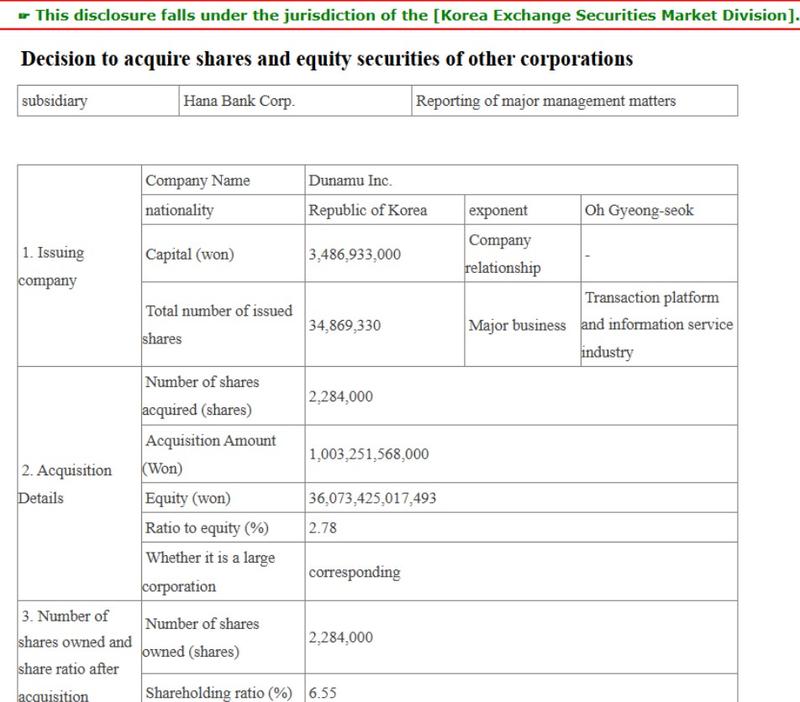
Financial authorities in South Korea are examining Hana Bank's intended acquisition of a 6.55% ownership interest in Dunamu—the company behind Upbit, the nation's biggest cryptocurrency exchange—in a deal valued at $668 million, according to reports.
According to iNews24, a local news publication, an unnamed source from the Financial Services Commission indicated that authorities are analyzing whether the bank's acquisition of shares from Kakao Investment, as opposed to purchasing them directly from Dunamu itself, is subject to the wider regulations known as "banking-commerce separation."
According to the source, the investment by Hana would be evaluated using identical criteria as if the bank had taken a direct ownership position in the cryptocurrency exchange operator.
The banking division of Hana Financial Group entered into an agreement on Friday to acquire approximately 2.2 million shares of Dunamu from Kakao Investment at a price of 1 trillion won (approximately $668 million).
South Korea scrutinizes bank ties to crypto firms
The cryptocurrency sector in South Korea has historically functioned under a regulatory guideline referred to domestically as "banking-commerce separation," a framework designed to restrict ownership connections between conventional banking entities and commercial enterprises outside the financial sector.
Companies in the cryptocurrency space like Dunamu exist in an ambiguous position within this regulatory structure since virtual asset service providers have not been designated as conventional financial entities.
According to the Maeil Business Newspaper, a local publication, on Monday, a senior official at the FSC was quoted stating that limitations related to "banking-commerce separation" as they apply to cryptocurrency operations are not clearly codified in existing statutes and instead function through administrative policy and regulatory oversight.
Certain limitations regarding bank involvement in the cryptocurrency sector function through regulatory oversight practices and interpretive guidance from authorities rather than through codified legal provisions.
During April, the ruling Democratic Party in South Korea put forward the Digital Asset Basic Act, an extensive cryptocurrency legislative proposal that would create a comprehensive legal structure governing cryptocurrencies, stablecoins and providers of virtual asset services.
Broader finance push into South Korea's crypto market
The transaction by Hana arrives during a period when financial conglomerates are making increasingly aggressive moves into South Korea's heavily regulated cryptocurrency sector.
During February, Mirae Asset reached an agreement to purchase a 92.06% ownership stake in the cryptocurrency exchange Korbit through Mirae Asset Consulting for approximately 133.5 billion won (around $93 million), opting not to use its securities division for the acquisition.
According to local news sources on Friday, OKX and Korea Investment & Securities are currently engaged in negotiations to each acquire approximately 20% ownership stakes in the domestic cryptocurrency exchange Coinone through a newly issued share offering.