Balancer Labs Closes Operations Following $116M Security Breach, Protocol Set to Persist
Four months following a devastating $116 million security exploit, Balancer Labs announces its closure, with leadership planning to maintain protocol operations through a streamlined, financially sustainable framework.
The development team operating behind Balancer, a decentralized finance protocol, has announced the closure of Balancer Labs following intense financial strain and a November security breach that resulted in $116 million in losses, with company leadership now proposing the protocol's continuation through a restructured, more financially efficient operational model.
"Following extensive deliberation, I've made the choice to close down Balancer Labs. This decision weighs heavily on me," Fernando Martinelli, one of the founding members of Balancer Protocol, announced on Monday, further stating that Balancer Labs has transformed into a "burden instead of a benefit to the protocol," given its operation without generating revenue.
Marcus Hardt, serving as CEO of Balancer Labs, emphasized that the organization's expenditure on attracting liquidity far exceeded the protocol's revenue generation, representing a strategic approach that resulted in the dilution of Balancer (BAL) token holders' stakes.
During the 2020–2021 cryptocurrency bull run, Balancer stood among the most prominent DeFi protocols, achieving a maximum of $3.3 billion in total value locked (TVL) during November 2021.
That number, however, declined to $800 million by October 2025, with the security incident triggering an additional $500 million decrease in TVL throughout the subsequent two-week period. The TVL for Balancer has subsequently dropped to $158 million, demonstrating the significant difficulties DeFi protocols face when attempting to bounce back from major security breaches.
According to Martinelli, the November security breach "generated substantial and continuing legal liability" and that sustaining a corporate structure bearing the responsibility of historical security failures was no longer viable.
Balancer Labs executives outline restructuring plan
Looking ahead, both Hardt and Martinelli are advocating for the future management of Balancer to transition to the Balancer Foundation alongside the protocol's decentralized autonomous organization.
Martinelli promoted the adoption of a more "streamlined continuation strategy" for Balancer, encompassing the elimination of BAL emissions entirely, reorganizing fee structures to allow Balancer's DAO to generate increased revenue, minimizing team size to the greatest extent feasible and pursuing reduced operational expenditures.
"There remains genuine value in Balancer from which to build forward. Should we successfully execute this transition, we possess a legitimate opportunity to construct a more robust and sustainable protocol emerging from this situation," Hardt stated.
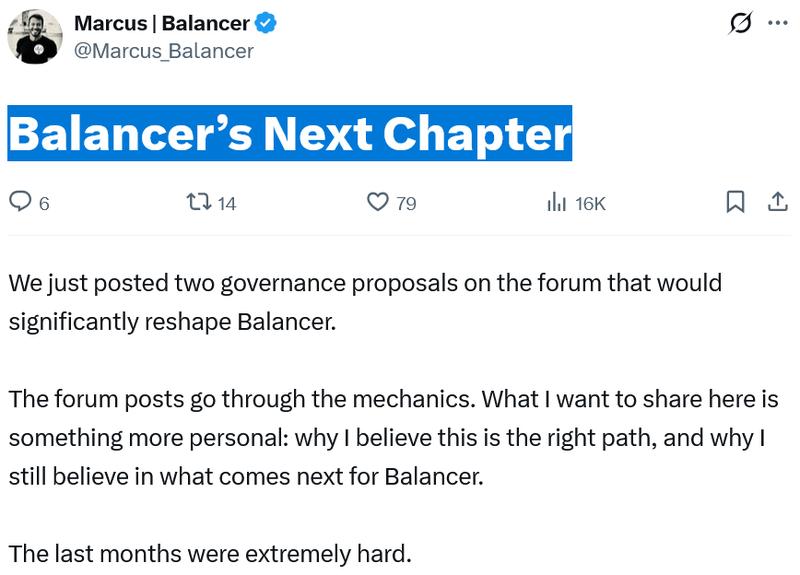
Members of the Balancer DAO have received requests to cast votes on two separate proposals that represent potential modifications to Balancer's operational reorganization and the tokenomics of BAL.
Notwithstanding the tokenomics challenges, Martinelli observed that Balancer continues to be "generating actual revenue" exceeding $1 million throughout the previous three months:
"That represents a significant amount — it demonstrates a working protocol concealed beneath a dysfunctional tokenomics framework and an excessive cost structure," he stated.
"The issue isn't that Balancer is non-functional. The issue is that the economic model surrounding Balancer is failing. These are problems that can be resolved."