Anchorage unveils AI agent banking platform in potential trillion-dollar market shift
The crypto banking firm's innovative platform provides AI agents with regulatory-compliant capital access spanning both conventional financial systems and cryptocurrency payment networks.
Digital asset bank Anchorage has introduced an innovative agentic banking platform designed to empower AI agents with the capability to handle and transfer funds autonomously — a burgeoning sector that its co-founder believes could reach trillion-dollar valuations.
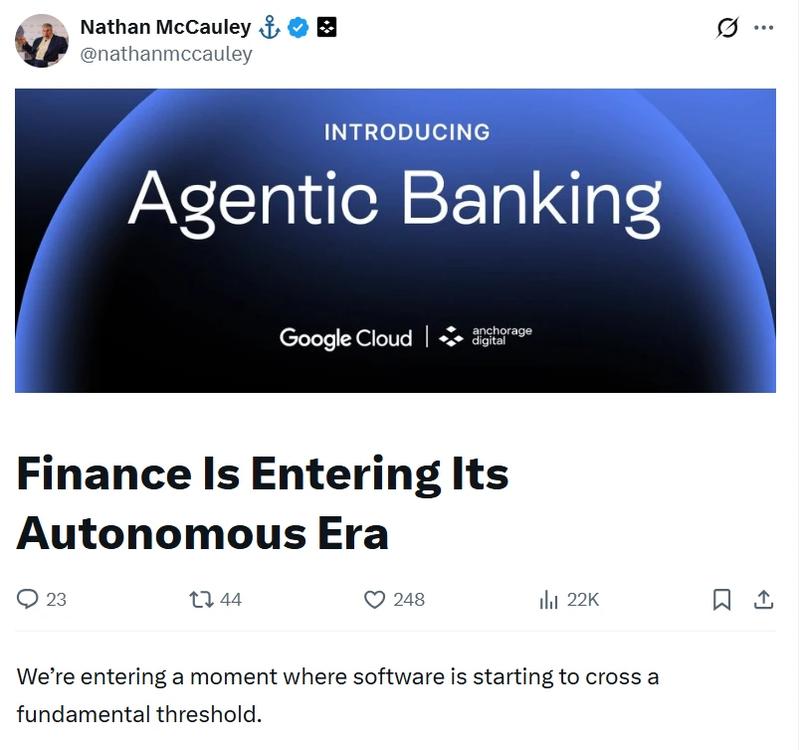
Through a Tuesday announcement on X, Nathan McCauley, who co-founded Anchorage and serves as its CEO, revealed that the company's newly developed agentic banking framework provides AI agents with capabilities to operate within both conventional financial systems and cryptocurrency payment networks.
Technology and blockchain enterprises have been accelerating their preparations for the emergence of agentic commerce. Companies like Stripe suggested in February that blockchain networks will ultimately need to achieve processing capabilities ranging from 1 million to 1 billion transactions per second to accommodate the network requirements generated by AI agents.
Institutions are experimenting with automation across treasury, payments, and procurement, but they're doing it on top of systems that were never designed for non-human actors.
Nathan McCauley, Anchorage co-founder and CEO
The innovative banking platform would furnish AI agents with verifiable identification for conducting transactions, along with predetermined spending thresholds, authorization protocols and operational policies, complemented by audit trail capabilities to ensure adherence to regulatory requirements.
The product introduction coincided with a collaborative agreement with Google Cloud, which will supply the intelligence infrastructure enabling AI agents to "discover, negotiate and coordinate" amongst themselves.
Oliver Segovia, a researcher at Ripple Labs and former head of product marketing, noted that the partnership also represents an evolving pattern where technology laboratories and regulated financial institutions are forging closer collaborative relationships.
Hyperscalers typically viewed banks as tier 1 enterprise customers, but moving forward, we'll start seeing more alliances as labs get deeper into regulated infrastructure and banks build intelligence on top of core systems.
Oliver Segovia, Ripple Labs researcher
During his appearance at the Consensus 2026 conference held in Miami on Tuesday, McCauley contended that this sector will emerge as among the most significant "trends of the next decade."
This is, in my view, set to be a trillion-dollar industry where we are going to have agents paying each other, agents paying merchants, and agents getting paid.
Nathan McCauley
This development represents just one among several agentic finance solutions that have emerged within the cryptocurrency space in recent times.
Also on Tuesday, the Solana Foundation unveiled a new gateway service in collaboration with Google Cloud, facilitating AI agents' ability to compensate for any APIs using stablecoins operating on Solana.
On April 30, Oobit, a cryptocurrency wallet startup backed by Tether, introduced a Visa-supported virtual card that empowers AI agents to execute online transactions with USDT on behalf of businesses without necessitating human involvement.
The virtual cards receive funding with USDT directly sourced from Tether's treasury, permitting agents to continue utilizing capital without requiring replenishment through fiat on-ramps or currency conversions.