Analysts: Bitmine's $257M Annual Staking Returns Bridge Operating Costs, Fund Stock Repurchases
According to analysts speaking with Cointelegraph, Bitmine's revenue from Ether staking serves as a crucial financial cushion, bridging operational expenses and delivering consistent income independent of ETH market value fluctuations.

On Monday, Bitmine Immersion Technologies—which holds the distinction of being the world's biggest corporate Ether stakeholder—announced it has crossed the threshold of 5 million staked Ether tokens, positioning the company to earn approximately $257 million in projected annual revenue from this activity.
The practice of staking Ether (ETH) is becoming a critical income generator for the company, with exchange analysts from Bitfinex revealing to Cointelegraph that staking accounted for approximately 98% of Bitmine's total revenue during the fiscal quarter that concluded on May 31. This translates to $45.7 million out of the company's overall $46.5 million in quarterly revenue. The analysts further elaborated:
"It funds operations and its share buyback program: 19.1 million shares repurchased since July against a $4 billion authorisation, without Bitmine having to sell any Ether."
Companies maintaining Ether treasuries are confronting increased unrealized losses as profit margins come under pressure from declining Ether spot prices, with the cryptocurrency experiencing an approximate 23% downturn throughout 2026's second quarter.
The second quarter of 2026 saw SharpLink, which holds the position of second-largest Ether treasury corporation, post a net loss totaling $394 million, with the overwhelming majority—$391 million—attributable to unrealized losses on cryptocurrency holdings.
Holding the top position as the biggest corporate Ether holder, Bitmine possesses 5.54 million ETH with a present valuation of $9.4 billion. In the runner-up spot, SharpLink maintains 863,000 Ether tokens with a current market value of $1.46 billion, based on information compiled by StrategicEthReserve.
Ether emerges as new treasury asset despite staking revenue risk
According to Alvin Kan, chief operating officer at Bitget Wallet, Bitmine's achievement in reaching this staking milestone illustrates Ether's capability to produce native yield when utilized as a treasury asset, contrasting with Bitcoin (BTC), which companies primarily regard as an asset for balance sheet value appreciation.
Though Bitmine's staking revenue generation might inspire additional crypto-focused companies to embrace Ether for treasury purposes, Kan cautioned Cointelegraph that this income stream doesn't come without risks, further noting:
"The revenue is annualized, depends on ETH price and staking yield, and comes with operational, liquidity, validator and regulatory considerations."
According to Kan's analysis, these factors position Ether staking more appropriately as a yield-generating supplement to treasury management approaches, rather than serving as a "replacement" for rigorous and disciplined capital oversight practices.
Nevertheless, the predictable nature of staking income functions as a "buffer" against Ether's volatile price movements and guarantees "topline predictability that can be valued without regard to spot ETH price," according to a July 28 analysis authored by Yiannis Zourmpanos, a Seeking Alpha contributor.
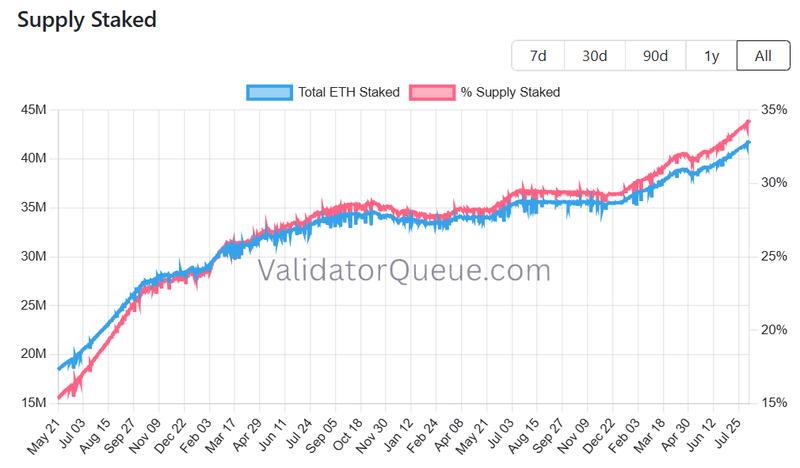
At present, Ether staking delivers a 2.61% annual percentage rate (APR). Data from the Validatorqueue dashboard indicates that more than 34% of the entire Ether supply is presently locked in staking across a network of 897,064 validators.