AI Push Drives Bitcoin Mining Firms to Invest Billions Despite Revenue Lag of 15-to-1
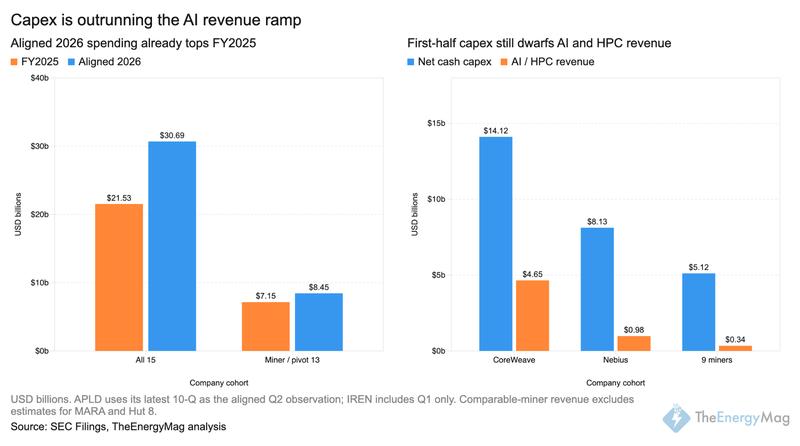
During the initial six months of 2026, Bitcoin mining firms invested $5.11 billion in capital assets while collecting $341.2 million from AI and HPC operations, creating approximately a 15-to-1 disparity, data from Blocksbridge Consulting reveals.

Publicly traded Bitcoin mining companies are investing billions of dollars in pursuit of artificial intelligence and high-performance computing opportunities, yet the financial returns have not matched the pace of investment, highlighting the substantial initial capital required to expand operations beyond traditional Bitcoin mining activities.
When examining Bitcoin mining companies in particular, the disparity between capital expenditure and AI-generated revenue continues to be substantial. Nine comparable mining operations invested $5.11 billion in capital assets throughout the first six months of 2026 while producing only $341.2 million in directly attributed AI and HPC revenue — creating approximately a 15-to-1 ratio of capital expenditure to revenue.
BlocksBridge determined capital expenditure by analyzing cash purchases and allocations toward hardware, property, equipment and additional productive assets, following adjustments for proceeds and refunds received from asset sales.
Notwithstanding the disparity, AI and HPC revenue streams are showing acceleration. The nine mining companies produced $205.8 million from these business operations during the second quarter, representing a 52% increase quarter-on-quarter, with Core Scientific, TeraWulf and Bitdeer positioned among the companies documenting improvements.
The steep cost of pivoting to AI
Artificial intelligence and data center operations have been promoted as a diversification strategy for Bitcoin mining enterprises facing difficult conditions within the mining industry, however BlocksBridge's data demonstrates that this strategic shift requires considerable upfront financial commitments.
Power contracts and available land may give miners a starting advantage, but converting those assets into AI-ready capacity requires substations, buildings, cooling systems, networking equipment and, in some business models, GPUs.
BlocksBridge
Whether Bitcoin's most recent price recovery will deliver financial relief for companies that continue to operate substantial mining operations remains uncertain.
Bitcoin has experienced a surge exceeding 13% during this week and has returned above $72,000 following the US Treasury's announcement that it would minimally double the maximum scale of its long-term bond buybacks to $4 billion per operation, an initiative designed to enhance liquidity within the Treasury market that initially reduced yields and strengthened risk appetite.
Demonstrating the strategic shift toward AI and HPC, CoinShares announced this week a strategy modification for its industry tracking exchange-traded fund.
Currently rebranded as the CoinShares Bitcoin Mining and Digital Power ETF (WGMI), featuring $222.4 million in assets under management, the fund's portfolio encompasses 29 holdings selected from bitcoin mining companies, data center operators, AI semiconductors, power generation, and HPC, which Coinshares characterizes as "the businesses powering the digital economy."