AI and Cryptocurrency Industries Face Reputation Crisis Heading Into 2026 Elections
American voters show unfavorable opinions of cryptocurrency and artificial intelligence sectors, and increased scrutiny of their political spending could drive them further away before the 2026 midterm elections.

Over the last year, the artificial intelligence and cryptocurrency sectors have garnered significant attention due to the substantial financial resources accumulated by their corporate political action committees (PACs).
Massive expenditures during the most recent federal election cycle in the United States have resulted in unprecedented policy shifts benefiting the cryptocurrency sector, with signs pointing toward a comprehensive legislative framework known as the CLARITY Act approaching passage into law.
However, these developments haven't won over the hearts of American voters. Fresh polling data from Politico reveals skepticism toward the cryptocurrency sector, while the public remains unconvinced about artificial intelligence's advantages.
"Concerns are being voiced by voters spanning the entire ideological spectrum," Michael Beckel, director of money in politics reform at Issue One, explained to Cointelegraph. "Candidates from both political parties are attempting to channel that frustration and anger."
Public skepticism toward crypto persists while AI benefits questioned
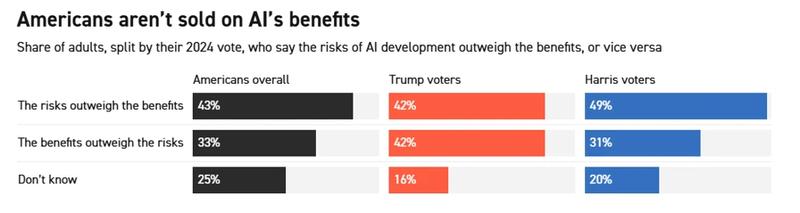
Based on recent polling conducted by Public First for Politico, the majority of Americans express distrust toward cryptocurrency and doubt the advantages of AI technology.
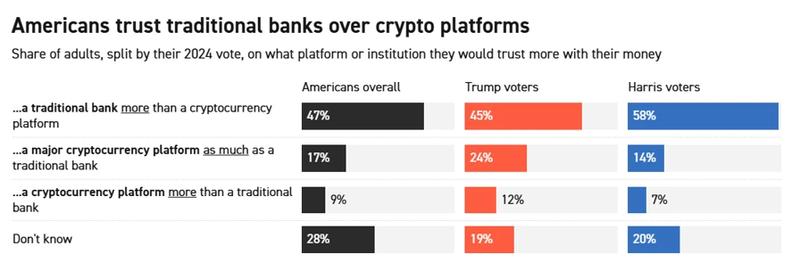
Although Republican-leaning voters show marginally higher trust levels in cryptocurrency, 47% of all Americans express greater confidence in traditional banking institutions compared to crypto platforms, with just 17% placing equal trust in cryptocurrency platforms and conventional banks.
Public sentiment regarding AI technology shows similarly concerning trends. Approximately 43% of Americans across the board believe the risks associated with AI outweigh potential benefits, compared to 33% who hold the opposite view.
At present, the majority of Americans remain unaware of the prominent cryptocurrency and AI lobbying organizations. Politico reports that merely nine percent have knowledge of AI Super PAC Leading the Future. Just three percent are familiar with pro-crypto PAC Fairshake.
These awareness levels pale in comparison to public recognition of major lobbying groups such as the National Rifle Association or the Planned Parenthood Action Fund, which have achieved near-universal name recognition.
Nevertheless, connections to cryptocurrency could pose significant challenges. Ohio Republican Representative Jim Renacci shared with Politico, "I do think if they see somebody is backed by crypto, that's always going to be a problem, because, let's face it, the people that I talk to in Ohio, they don't understand crypto, and most say they're not comfortable with [it]."
Greater public awareness of cryptocurrency lobbying efforts might not benefit these organizations. Rick Claypool, research director at Public Citizen, explained to Cointelegraph:
"Generally speaking, voters are against corporate money influencing politics."
"Even after Citizens United, the norm had been for big, brand-name corporations not to engage directly. Or when they did engage, they would often contribute through dark money groups that obscure their funding source."
From this perspective, the cryptocurrency industry's spending spree in 2024 was somewhat unusual. Major contributors like Coinbase or a16z weren't shy about the millions of dollars they put into campaigns.
But even then, "the voter-facing message from Fairshake was never about crypto, which voters never really cared about." Mailers and ad buys reflected the supported candidates' positions more broadly, or sometimes attacked those of the perceived anti-crypto candidate.
Overall, "candidates who are seen as not beholden to corporate interests have an electoral edge," said Claypool. This was true for populist candidates like US Senator Bernie Sanders and even US President Donald Trump, who claimed during his 2016 campaign that "he was so rich he could not be bought, which is laughable in hindsight."
Should public awareness regarding cryptocurrency — along with the sector's coordinated attempts to shape policy — grow among voters, the outcome may prove unfavorable.
Issue One's Beckel said, "If voters view an industry as toxic, that can have serious implications for candidates who don't want to be perceived as too close to a controversial company or industry."
Community movements emerge against AI while crypto gains Washington influence
Public dissatisfaction toward particular industries has manifested in tangible political action.
Beckel highlighted a recent case where voter sentiment regarding the oil and fossil fuel lobbying sector prompted certain Democratic candidates to pledge rejection of any financial contributions from those sources. Beckel mentioned that several organizations are currently encouraging lawmakers to refuse contributions from AI lobbying groups.
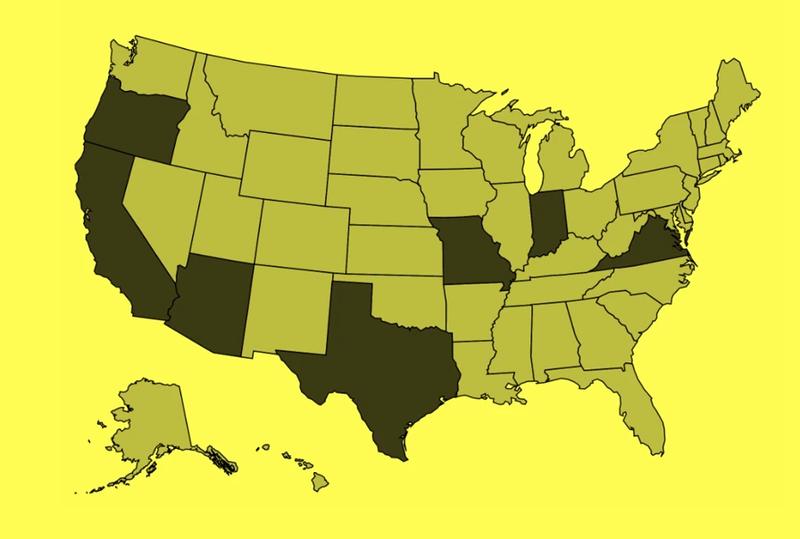
In fact, a grassroots resistance movement has been developing against the AI industry more specifically, particularly concerning the development of extraordinarily expensive and resource-demanding data centers. Community-level initiatives across seven states have successfully blocked or postponed more than $64 billion worth of data center development. One state, Maine, is poised to introduce a state-wide ban.
According to Claypool, this situation could represent an excellent opportunity for Congressional candidates "to seize the grassroots momentum against data centers and Big Tech for Democrats in particular, but not exclusively, since the tech sector has so fully enmeshed itself with the Trump administration."
This growing partisan alignment may also influence voter perceptions of these industries.
Jason Thielman, former executive director of the National Republican Senatorial Committee, said that the crypto industry has attempted to "maintain a degree of bipartisanship and identify people whom they think will be champions on these issues."
Despite the lobby's claims of bipartisanship — Coinbase CEO Brian Armstrong called crypto "the most bipartisan issue" in DC — its priorities like deregulation and withdrawn enforcement lean mostly, but not exclusively, Republican, said Claypool.
Claypool said that "crypto billionaires have tried to present themselves as scrappy underdogs against Wall Street."
"But that's a less compelling argument now that crypto allies run, in addition to the White House, the DOJ, SEC, CFTC, the Treasury Dept., and the Commerce Dept."
Additionally, the cryptocurrency sector has developed deep connections to Trump personally following the president's complete endorsement of the industry throughout 2024, along with pardons granted to convicted crypto executives and his exploitation of crypto for his own personal enrichment.
Given Trump's declining popularity stemming from geopolitical mishandling, an uncertain economic forecast and divisive domestic policies, maintaining associations with him and his political party may involve considerable political liability.
During a Democratic Illinois Senate primary race, Illinois Lieutenant Governor Juliana Stratton accused her opponent Representative Raja Krishnamoorthi of being backed by big money from "MAGA-backed crypto bros." She won by seven points.
These dynamics could also shape future policymaking decisions. Said Beckel, "If an industry is viewed as a friend of one party and enemy of another, it may be more likely to be in the crosshairs or under the microscope when the other party is in power."
For cryptocurrency and artificial intelligence sectors, that critical moment may arrive as early as Nov. 4.