Aave governance tensions rise as dueling transparency reports emerge from ACI and Aave Labs
Two opposing reports present divergent perspectives on funding accountability, protocol development and revenue attribution.

Internal governance tensions within the Aave ecosystem reached new heights following the publication of two comprehensive reports that presented competing narratives regarding the protocol's historical funding decisions and contributions, emerging just before a critical vote on a proposed $50 million funding package designated for Aave Labs.
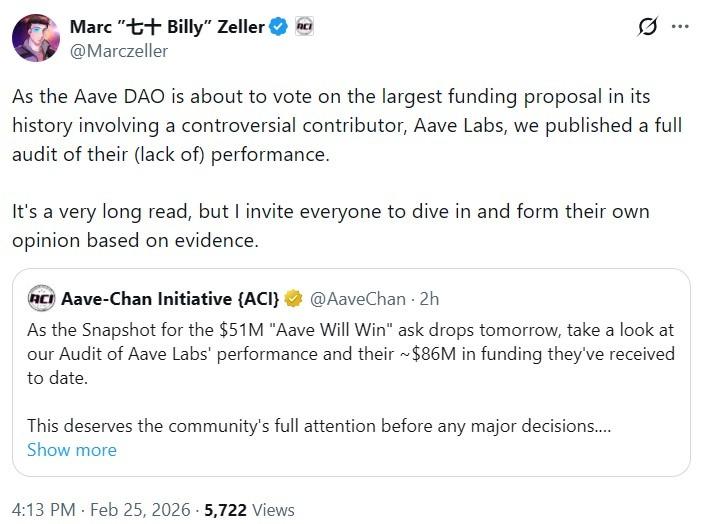
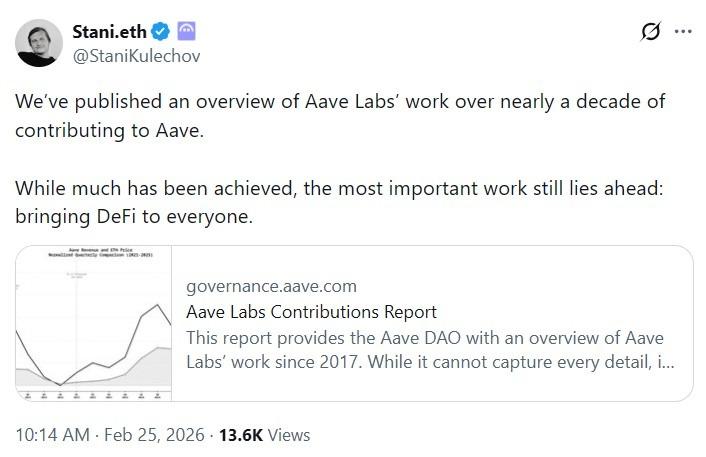
Marc Zeller, founder of the Aave Chan Initiative (ACI), released on Wednesday what he characterized as a transparency-focused report examining Aave Labs' funding history while introducing a return-on-investment analytical framework for evaluating previous DAO grants. This publication came mere hours after Aave Labs had released its own comprehensive contributions report, which detailed the organization's involvement in protocol development dating back to 2017.
At the heart of this dispute lies the "Aave Will Win" framework, a comprehensive proposal requesting tokenholder authorization for funding that could reach $42.5 million in stablecoins plus 75,000 AAVE (AAVE) tokens. As part of this arrangement, Aave Labs has committed to directing 100% of revenues generated from Aave-branded products into the Aave DAO treasury while operating under a DAO-funded model, as detailed in the proposal and associated forum discussions.
The conversation has expanded well beyond simply questioning the magnitude of the requested funding to encompass broader concerns regarding accountability frameworks, how revenue should be attributed, and which entities bear responsibility for maintaining the protocol's fundamental infrastructure.
These developments come on the heels of BGD Labs' recent declaration that the core technical contributor will be ending its participation with the DAO effective April 1.
Contrasting perspectives on capitalization and contributions
According to Zeller's analysis, Aave Labs has accumulated approximately $86 million in total lifetime capitalization, a figure that encompasses proceeds from its 2017 initial coin offering (ICO), capital raised from venture investors, and various payments received from the DAO.
His position emphasized that any future grants distributed by the DAO ought to undergo evaluation based on quantifiable revenue generation and adherence to more rigorous disclosure requirements.
ACI, operating as a service provider to the Aave DAO rather than a neutral observer in this discussion, raised questions about whether governance decisions should be separated into distinct votes addressing funding, revenue alignment mechanisms, and V4 ratification independently.
In Zeller's view, expressed through his written analysis, funding determinations should be explicitly connected to performance metrics and transparent reporting obligations.
In contrast, Aave Labs used its contributions report to emphasize the organization's central involvement in designing and deploying Aave V1, V2 and V3, while spotlighting specific features that the company maintains form the foundation of the protocol's existing revenue generation model, including innovations such as flash loans, the Safety Module implementation and Efficiency Mode functionality.
The position advanced by Aave Labs contends that simply tallying governance proposals or forum contributions fails to capture the complete picture of research efforts, development work, security implementations and infrastructure maintenance essential to operating a protocol that serves millions of users globally.
The substance of the tokenholder decision
The "Aave Will Win" framework would facilitate Aave Labs' transition toward a DAO-funded operational structure while simultaneously requiring the organization to channel product-level revenues, including those generated through aave.com and future consumer-oriented products under development, directly to the DAO.
Additionally, the proposal requests formal ratification of Aave V4 to serve as the protocol's enduring technical infrastructure and includes provisions outlining plans for establishing a new foundation entity responsible for stewarding the Aave brand identity.
Various community members have previously voiced apprehensions regarding both the overall magnitude of the requested funding package and specifically the inclusion of 75,000 AAVE tokens, which inherently convey voting authority within the governance system.
As of Feb. 13, those expressing criticism have advocated for more precise definitions surrounding what constitutes revenue and have pushed for enhanced transparency concerning governance-related token holdings.