Aave DAO approves V4 mainnet deployment with overwhelming majority
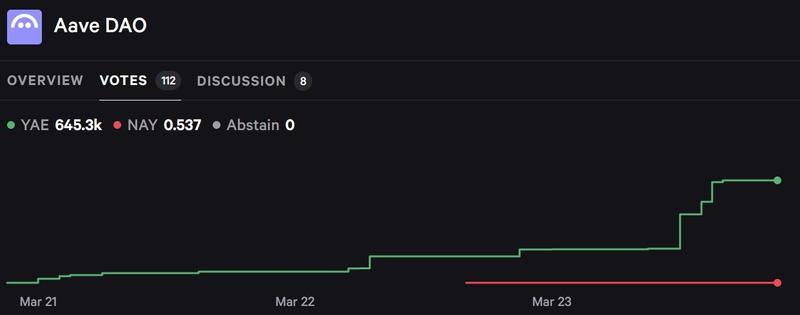
The proposal received backing from over 645,000 votes, encountering virtually zero opposition or abstentions through the Snapshot platform.

The decentralized autonomous organization governing Aave has approved a proposal advancing its V4 protocol toward deployment on the Ethereum mainnet, demonstrating widespread community support for the upgrade following a period marked by governance conflicts and the departure of key contributors.
The proposal seeking to deploy Aave V4 on Ethereum's mainnet received overwhelming support from the DAO on Monday, attracting more than 645,000 affirmative votes against fewer than one opposing vote, with zero abstentions recorded, based on information from Snapshot, the offchain voting platform.
This voting outcome represents a departure from previous disagreements that had divided members of the Aave community, demonstrating widespread consensus regarding the protocol's future trajectory as it progresses toward officially implementing V4's deployment.
Stani Kulechov, the founder of Aave, stated that the proposal is set to progress to an Aave Improvement Proposal (AIP) vote, which constitutes a binding onchain vote that would enable the protocol to officially deploy and activate V4 on the Ethereum network.
Aave V4 introduces a modular architecture for on-chain credit markets
The V4 version of Aave, which was proposed by Aave Labs on March 19, represents a transition toward a protocol design that is more modular in nature. The proposal encompasses architectural elements intended to create separation between liquidity and risk that is specific to individual markets.
Within this framework, shared pools of liquidity known as "Hubs" supply capital, whereas "Spokes" establish distinct borrowing environments featuring customized risk parameters and limits on exposure. As stated by Aave Labs, this design approach "preserves the depth and efficiency of unified liquidity while allowing for more precise risk management."
According to Aave Labs, the newly proposed structure has been designed with the goal of supporting an expanded range of financial applications, encompassing assets that have varying risk profiles, different maturities, or dependencies on offchain elements.
The proposal indicates that V4 would facilitate the emergence of new types of collateral and structured credit markets while simultaneously maintaining unified liquidity across the platform.
Near-unanimous vote follows exit of key Aave contributors
The substantial support demonstrated for Aave V4 arrives following a stretch of governance-related tensions that resulted in multiple core contributors withdrawing from participation in the DAO.
BGD Labs, which had served as a longtime technical contributor, announced on Feb. 20 that it would be terminating its involvement with Aave following four years of participation, pointing to an "asymmetric organizational scenario" and what the organization characterized as an "adversarial position" directed toward its contributions to the protocol's current version.
The Aave Chan Initiative, functioning as both a major governance delegate and service provider, similarly announced intentions to exit on March 3 following a dispute concerning a proposed funding package. The founder of ACI, Marc Zeller, indicated that the organization would be winding down its operations after expressing concerns regarding governance standards and the dynamics of voting processes.