$344M in Iranian-Linked Cryptocurrency Assets Seized by United States
Following sanctions imposed on digital wallets allegedly connected to Hizballah and the Islamic Revolutionary Guard Corps, the United States Treasury Department has successfully frozen $344 million in cryptocurrency assets.

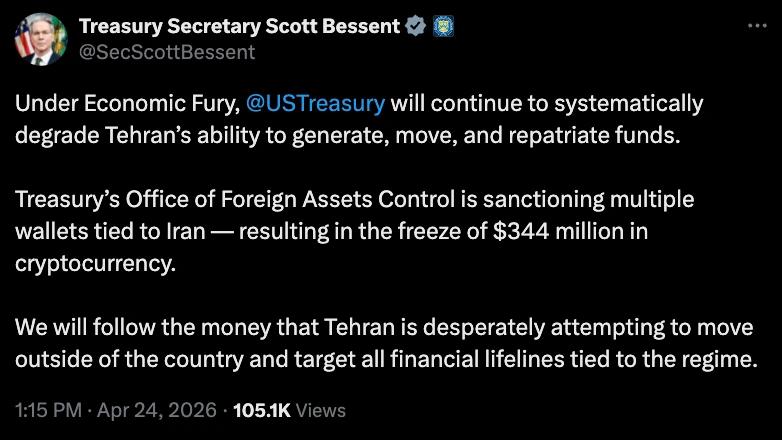
Treasury Secretary Scott Bessent of the United States revealed that the department's Office of Foreign Assets Control (OFAC) has imposed sanctions on multiple cryptocurrency wallets with alleged connections to Iran, leading to the freezing of $344 million worth of digital assets by federal authorities.
Through a post published on X this past Friday, Bessent explained that OFAC's action represents a component of Washington's broader strategy to "systematically degrade Tehran's ability to generate, move, and repatriate funds." The announcement follows joint military strikes conducted by the United States and Israel against Iranian targets during the final days of February.
"We will follow the money that Tehran is desperately attempting to move outside of the country and target all financial lifelines tied to the regime,"
said Bessent.
Bessent's public statement followed by merely twenty-four hours an announcement from Tether, the stablecoin-issuing company, which disclosed that it had frozen in excess of $344 million worth of its USDt (USDT) tokens following a formal request from United States government authorities concerning "activity tied to unlawful conduct." At that particular time, the firm made no explicit reference to Iran in its statement.
Within a Friday posting on OFAC's official list of Specially Designated Nationals, the federal agency placed sanctions on a pair of cryptocurrency addresses operating on the Tron blockchain network, which together held a total of $344 million. Government officials from the Treasury Department asserted that these digital wallets had direct ties to both the Islamic Revolutionary Guard Corps and Hizballah, the Islamist political organization.
Iran reportedly pocketing crypto tolls for Strait of Hormuz passage
The announcement regarding these sanctions came on the heels of emerging reports suggesting that Iran had begun implementing a policy requiring vessels to pay passage fees in Bitcoin (BTC) for transit through the strategically important Strait of Hormuz, which serves as a vital chokepoint for the transportation of petroleum and various other commodities. On Thursday, Forbes published a report indicating that Iran had already begun collecting revenue through these cryptocurrency-based toll payments.
Despite public statements from United States President Donald Trump this week claiming that the United States had entered into a ceasefire agreement with Iran, regional tensions surrounding the Strait continue to intensify. According to reports, Iranian forces conducted attacks on three commercial vessels utilizing the waterway for passage, while United States naval forces have responded by establishing a blockade in the area.