Young UK Voters Elevate Cryptocurrency to Major Political Influence with 80% Support
New research from the Coinbase Institute reveals that digital currencies have emerged as the primary financial gateway for British youth aged 16-25, transforming crypto literacy into a crucial benchmark for evaluating political party credibility.

A fresh survey disclosed to Cointelegraph reveals that the United Kingdom's decision to temporarily halt cryptocurrency political donations is creating friction with the increasing digital asset engagement among the nation's youth demographic.
A collaborative study conducted by Coinbase Institute alongside JL Partners, which was shared exclusively with Cointelegraph, discovered that digital currencies, with Bitcoin (BTC) at the forefront, have now surpassed conventional banking instruments as the primary gateway through which young individuals first comprehend concepts of money, financial risk, and investment possibilities. Only 43% demonstrate familiarity with a Stocks & Shares Individual Savings Account, while merely 20% recognize a Help to Buy ISA, a pattern the research characterizes as a fundamental "crypto first, TradFi second" transformation in how financial knowledge is acquired.
These survey results emerge at a time when the United Kingdom is moving forward with proposals to implement a moratorium on cryptocurrency-based political contributions, underscoring a concerning gap between the way younger generations interact with financial systems and the regulatory framework being developed by Westminster.
Tom Duff Gordon, who serves as Coinbase's vice president of international policy, shared with Cointelegraph that the UK finds itself "sitting on an estimated 1.3 million new voters" given that the government is pursuing legislative measures to reduce the minimum voting age to 16, further noting that cryptocurrency issues are increasingly becoming essential topics that political parties must address in their platforms.
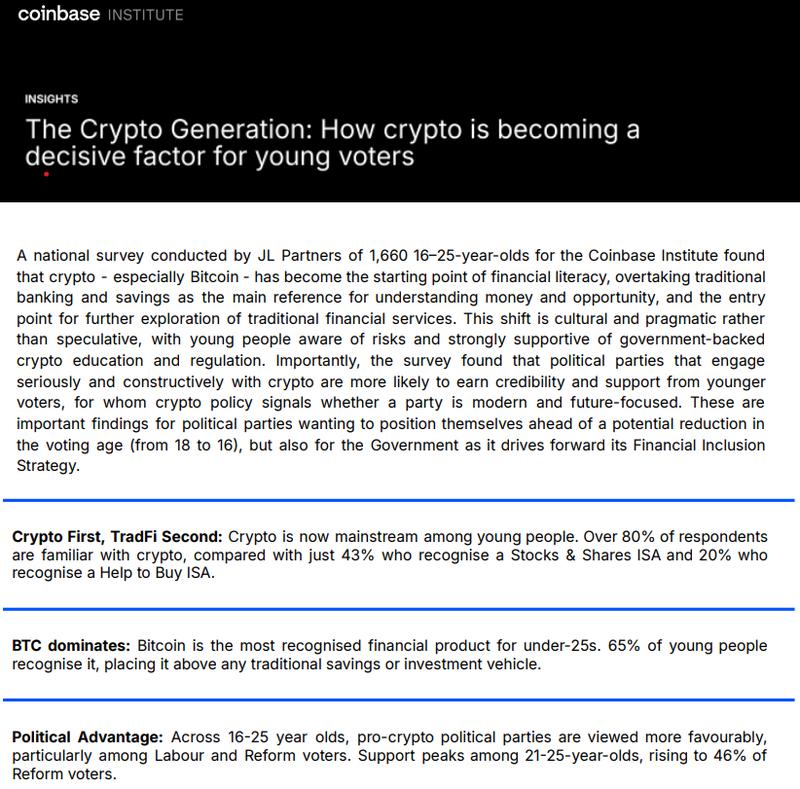
Close to half of the surveyed young individuals indicated they would have greater confidence in a political party that demonstrated genuine comprehension of cryptocurrency and blockchain technology, with 26% stating they would be more inclined to throw their support behind one that championed pro-innovation cryptocurrency policies. Among those under 25 years old, more now identify Bitcoin than any ISA, savings bond, or other traditional savings vehicle, with 65% awareness positioning BTC as the single most widely recognized financial product within this demographic segment.
Crypto donations pause jars with traceability claims
This reality positions cryptocurrency policy on what could become a significant conflict trajectory with the existing donations moratorium. In a post published on LinkedIn during the previous week, Duff Gordon contended that digital assets "hold out the prospect of perfect traceability," given that all transactions are permanently documented onchain and could potentially offer substantially greater transparency compared to traditional fiat currency systems.
He pointed out that the UK Financial Conduct Authority has already established and currently manages a registration framework for cryptocurrency firms designed to enforce Anti-Money Laundering (AML) and Counter-Terrorist Financing (CTF) regulations, and he proposed mandating that political cryptocurrency donations must be channeled through FCA-registered companies, applying the identical contribution caps and permissibility standards that currently govern cash donations. From his perspective, the moratorium creates a risk of reinforcing negative perceptions surrounding cryptocurrency while simultaneously postponing the implementation of a more balanced and proportionate regulatory framework.
Parties ignore young crypto voters at their peril
From the political establishment's standpoint, the implications are becoming increasingly difficult to dismiss. The right honourable Alun Cairns, a former Cabinet minister who also serves as vice-chair of the Blockchain All Party Parliamentary Group, conveyed to Cointelegraph that an entirely new generation of voters is emerging with "fundamentally different expectations about money, technology and opportunity," and these young voters will "reward those who understand that shift."
He emphasized that digital assets alongside financial innovation are evolving into central considerations for successfully appealing to emerging generations of voters, stating that "as a Conservative, my party needs to keep pace with changing demographics."
The research additionally revealed that approximately two-thirds of young respondents desire the government to provide comprehensive financial education specifically addressing cryptocurrency, while 43% indicated they would place greater trust in a political party that genuinely embraced emerging technologies such as crypto, with that figure climbing to 58% among Reform supporters and 46% among Labour voters.
Cryptocurrency advocates, Duff Gordon emphasized, represent an "influential constituency," and political parties that choose not to meaningfully engage with this group face the very real prospect of forfeiting relevance among the voters who will shape future elections.