User-driven demand, not institutional capital, may shape the future of blockchain FX
The evolution of blockchain-based foreign exchange could emerge through grassroots adoption, with stablecoin exchanges and algorithmic liquidity pools addressing real-world currency exchange requirements.

Opinion by Michael Egorov, founder of Curve Finance and Yield Basis
Historically, the most intuitive approach to considering blockchain-based foreign exchange (FX) was to begin at the institutional level. Traditional banks would tokenize national currencies, major financial players would migrate their FX operations onto blockchain infrastructure, and institutional capital would organically emerge as a consequence.
The anticipated outcome? FX markets built on blockchain technology would eventually expand sufficiently to mirror their conventional equivalents. However, that may not be the path forward.
Indeed, mounting evidence suggests that blockchain-based FX will emerge through precisely the inverse approach — originating from grassroots adoption.
Digital currencies such as Brazilian Digital (BRZ) or Monerium's EURe offer rapid onchain redemption capabilities and seamless transfer functionality from cryptocurrency wallets to traditional banking accounts. These assets drive substantial transaction volumes as decentralized finance (DeFi) participants exchange them within decentralized exchange (DEX) liquidity pools.
These marketplaces evolve organically in response to genuine user requirements, specifically the need to transition directly between blockchain-based currencies and traditional fiat money.
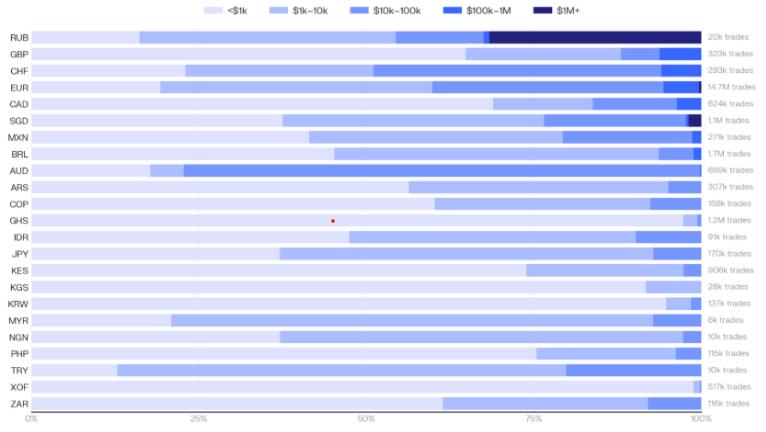
While this remains merely an emerging example, both the application and the underlying demand are sufficiently tangible. Research from Keyrock demonstrates that most onchain stablecoin transactions connected to emerging market currencies range between $1,000 and $10,000 — relatively small volumes when measured against institutional standards — but that observation reinforces the central argument.
It demonstrates how the marketplace is naturally evolving toward blockchain-based FX solutions to satisfy concrete payment requirements, rather than exclusively catering to high-volume institutional participants.
Limited scale doesn't equal limited utility
Individuals and commercial entities require the ability to transfer funds across different currencies, and evidently, they're unwilling to wait for established traditional finance (TradFi) players to migrate their FX infrastructure onto blockchain technology.
A widespread belief about blockchain-based FX holds that markets require substantial liquidity before achieving meaningful utility. In reality, however, this assumption doesn't entirely hold up.
When authentic demand exists from parties needing to convert dollars to euros, Swiss francs or alternative currencies, even more modest liquidity pools can facilitate these exchanges and fulfill a legitimate economic function.
Blockchain-based FX doesn't require massive scale to deliver value; rather, it can expand precisely because actual users are engaging with it.
In reality, this closely resembles the developmental trajectory of stablecoins. They originated as a comparatively specialized cryptocurrency application, yet today we recognize them as components of significantly broader financial infrastructure.
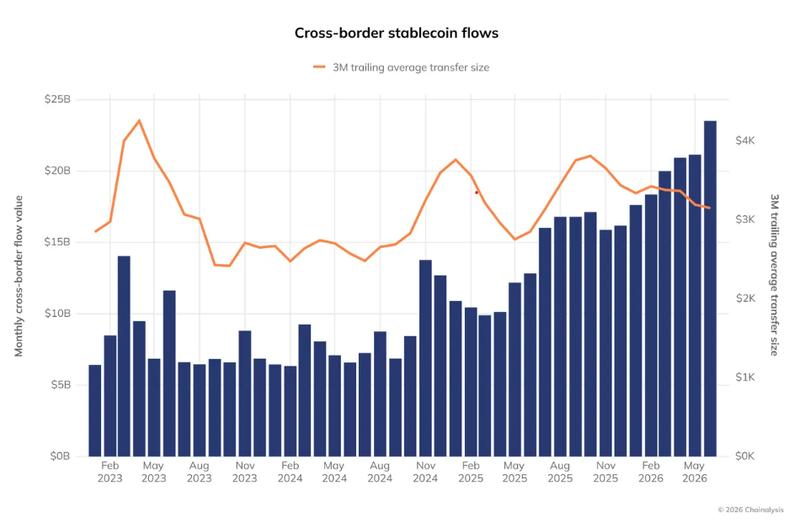
Recent data released by Chainalysis demonstrates that cross-border stablecoin transactions increased to exceed $220 billion by mid-2026. That represents nearly 80% expansion over a twelve-month period, confirming that both demand and activity continue their upward trajectory. No fundamental reason exists why blockchain-based FX cannot progress along a comparable pathway.
Market size is irrelevant from the user's perspective
This represents the most pragmatic dimension of this discussion. Blockchain-based FX certainly cannot rival the complete global foreign exchange marketplace in the immediate future; that remains years ahead. But the more compelling inquiry concerns which problems it can address for individuals who already maintain funds on blockchain networks.
Currently, exchanging a USD stablecoin for a EUR stablecoin (or another available option) onchain and utilizing those funds for payments involves relatively minimal friction. In practice, this method frequently proves both quicker and more economical than traditional international banking transfers.
Identical reasoning extends to blockchain-based FX. A financial technology provider or crypto-linked payment card business doesn't need to replicate the complete institutional marketplace; their requirement is efficiently moving customer funds between different currencies.
When individuals need to execute payments in alternative currencies, the conversion process can introduce additional expenses to the transaction, as it typically requires routing through Visa or Mastercard, which impose approximately 1% in transaction processing charges.
Blockchain-based exchanges present a superior alternative here. If customer funds already exist on blockchain infrastructure, exchanging USD stablecoins for EUR stablecoins can occur directly, bypassing any additional intermediary parties, delivering both speed and cost advantages.
Traditional banks will probably continue serving as critical entry and exit infrastructure where digital currency needs to interface with conventional financial systems. Functions including issuing and redeeming local currency denominations, providing bank account access, managing compliance obligations and similar responsibilities are domains where banks will maintain leadership roles.
However, once funds exist onchain, numerous traditional intermediary stages can be eliminated to enhance operational efficiency.
From the standpoint of users seeking to execute financial transactions with minimum complexity, that represents a substantially beneficial enhancement. The overall market's magnitude becomes largely irrelevant under these circumstances.
User demand addresses only half the equation
There exists, naturally, a complication.
Genuine demand remains essential, but it doesn't automatically resolve liquidity challenges. The difficulty lies not merely in establishing a EUR/USD or CHF/USD pool; it's ensuring they remain economically viable.
This is the domain where automated market makers can deliver meaningful impact. Conventional market-making organizations may find little appeal in supplying liquidity for smaller FX markets; insufficient transaction volume may exist to warrant the operational expenditures.
Algorithmic liquidity provision transforms this calculation because software systems can deliver liquidity on a continuous basis without necessitating that market-making firms manually oversee individual transactions.
Consider two dollar-denominated stablecoins, USDC and Tether. Through the lens of a conventional trading platform, converting from one dollar stablecoin to another might appear as relatively mundane activity. Both assets theoretically maintain approximately $1 valuations, so minimal price volatility exists to capitalize upon.
Yet if genuine demand persists for users to transition between such stablecoins, an automated market maker can establish a liquidity pool enabling users to execute that exchange directly. Every transaction produces a modest fee for liquidity contributors, and when sufficient participants require the identical conversion, a viable market can materialize even when it doesn't appear particularly attractive to traditional market makers.
This variety of adoption doesn't exactly qualify as rapid expansion, admittedly, but gradual, organic development carries its own merits. Occasionally, emerging markets simply require a modest community of participants facing problems that existing infrastructure doesn't address particularly effectively. If those users can render the market economically sustainable, liquidity can expand organically from that foundation.
About the author: Michael Egorov is the founder of Curve Finance and Yield Basis. He is also a physicist, entrepreneur and crypto maximalist. Michael transitioned from the scientific field to the crypto industry and holds a bronze medal from the International Physics Olympiad and a PhD in ultracold atoms.