US Liquidity Shortage Behind Cryptocurrency Market Decline, Expert Claims
An analyst contends that Bitcoin's recent downturn parallels Software as a Service equities, indicating the selloff isn't driven by cryptocurrency-specific factors.

The substantial market decline that resulted in cryptocurrency markets shedding $250 billion in overall market capitalization throughout the weekend stems from a United States liquidity shortage, not from any issues specific to the crypto sector, according to Raoul Pal, founder and CEO of Global Macro Investor.
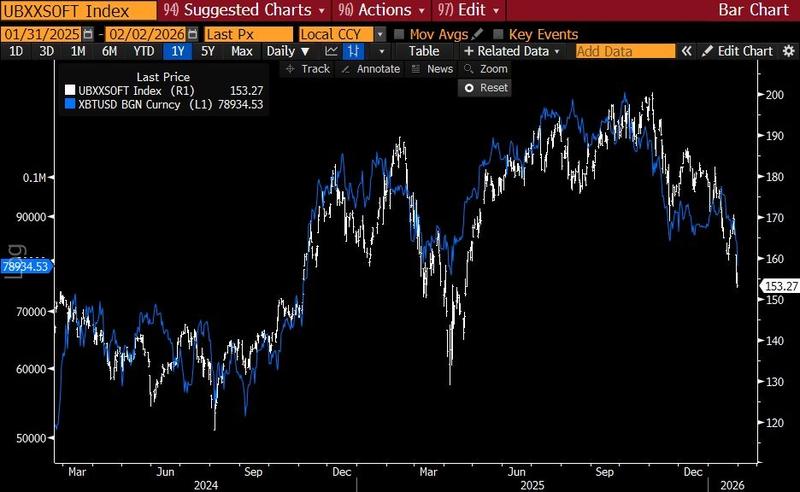
"The big narrative is that BTC and crypto are broken. The cycle is over," Pal stated on Sunday, noting that this interpretation is incorrect because Software as a Service (SaaS) stocks have experienced parallel declines.
Bitcoin (BTC) and SaaS stocks have demonstrated synchronized movement in recent periods, with both experiencing substantial drops, which is particularly significant given that both qualify as "long-duration assets," meaning their valuation depends substantially on anticipated future cash flows and widespread adoption, rendering them highly susceptible to liquidity conditions and interest rate fluctuations, according to his analysis.
This indicates the same underlying narrative is at play, with observers claiming "crypto is dead" and artificial intelligence displacing software companies.
It further demonstrates the same fundamental cause, given that two entirely distinct asset categories are exhibiting identical price movements, which strongly suggests the actual catalyst is macroeconomic liquidity dynamics, rather than issues specific to individual sectors.
"The rally in gold essentially sucked all marginal liquidity out of the system that would have flowed into BTC and SaaS. There was not enough liquidity to support all these assets, so the riskiest got hit."
Government shutdowns add to liquidity drain
The transient shortage of US liquidity has been intensified by the dual government shutdowns and "issues with US plumbing." The depletion of the Reverse Repo was fundamentally completed during 2024, Pal noted.
The Reverse Repo Facility (RRP) serves as an overnight parking mechanism where banks and money market funds deposit cash with the Federal Reserve.
In the past, whenever the US Treasury replenished its cash account (TGA), the adverse liquidity effects were balanced by the drainage of the RRP. However, given that the RRP has now been depleted, no offsetting mechanism remains available, meaning TGA replenishments now function as absolute liquidity drains, according to his explanation.
Raoul Pal dismisses recent Fed chair narrative
Jeff Mei, chief operations officer at the BTSE exchange, informed Cointelegraph that cryptocurrency values are declining "because investors now are under the impression that new Fed chair, Kevin Warsh, may not cut interest rates as fast or as much as they expected, given his tough stance on inflation and quantitative easing."
Nonetheless, Pal rejected apprehensions regarding Trump's Federal Reserve selection being hawkish, maintaining that "Warsh's job and his mandate are to run the Greenspan era playbook."
This entails reducing interest rates while permitting the economy to operate at elevated temperatures, relying on AI-driven productivity improvements to manage inflation.
"Warsh will cut rates and do nothing else. He will get out of the way of Trump and Bessent, who will run liquidity via the banks," he said.
Pal concluded with an optimistic outlook, declaring that the liquidity drainage is nearing its end.
"We just can't get every moving part right, but we now have a better understanding, and we remain HUGE bulls for 2026 because we know the Trump/Bessent/Warsh playbook."