Tokenized Real-World Assets Defy DeFi Decline with Strong Growth: CoinShares Report
Real-world asset tokenization has evolved past initial issuance stages, with RWA deposits surging more than threefold to reach $7.4 billion, accompanied by growing lending and trading volumes amid widespread industry contraction.

The tokenization of real-world assets (RWAs) is experiencing significant growth as digital representations of traditional investment vehicles transition beyond mere issuance to become integral components of blockchain-based financial ecosystems.
Deposits of real-world assets on decentralized finance platforms surged by more than 300% on a year-over-year basis, reaching $7.4 billion during the second quarter of 2026, even as overall DeFi deposits contracted by approximately 15%, based on findings from a collaborative report released Thursday by CoinShares and Token Terminal.
According to CoinShares CEO Jean-Marie Mognetti, this marked divergence demonstrates that demand for RWAs is fueled by genuine functional applications rather than general market sentiment.
When an asset class grows through a downturn in its host ecosystem, demand is being driven by financial utility, not by market cycles.
The analysis indicates that the real-world asset market has transitioned into a fresh development stage, characterized by investors deploying these assets as collateral backing, instruments for yield generation, and tradable products throughout blockchain-based marketplaces.
Yield-bearing stablecoins and Treasuries lead RWA deposits
Interest-generating stablecoins and digitized Treasury instruments have risen to prominence as the dominant segments of RWA assets deployed throughout the DeFi landscape, the report findings reveal.
During the second quarter, Sky Protocol's sUSDS dominated this category, providing participants with access to an interest-accruing variant of its USDS stablecoin.
Digitized Treasury fund products, such as BlackRock's USD Institutional Digital Liquidity Fund (BUIDL), have similarly established themselves as a significant provider of blockchain-based collateral, with market participants leveraging these yield-producing assets within decentralized lending protocols.
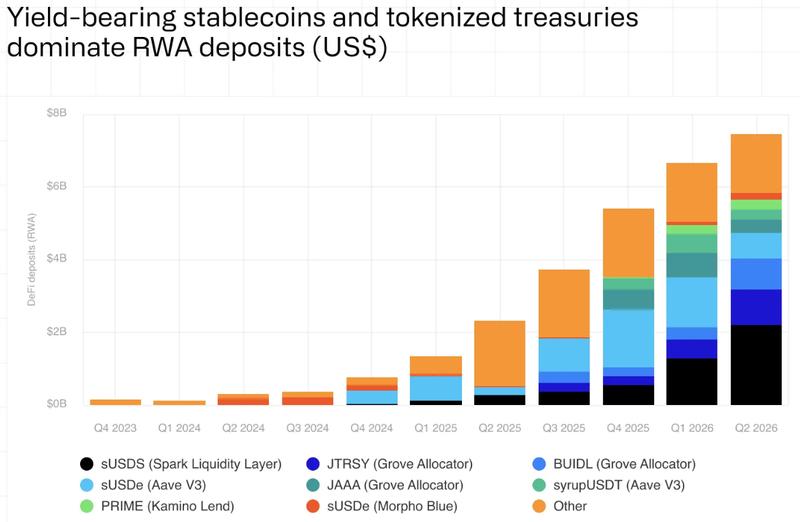
According to the report's findings, RWA products presently deliver returns spanning approximately 3.2% to 5.5%, with more conservative Treasury-based products positioned at the lower end of this spectrum and elevated-yield approaches incorporating supplementary risk factors.
Gold and yield-bearing dollars drive RWA volumes
Tokens backed by physical gold and interest-bearing dollar instruments represented a substantial portion of the RWA trading activity occurring on decentralized exchange platforms (DEXs).
Within its comprehensive RWA framework, CoinShares categorized gold-pegged stablecoins including Tether Gold (XAUt) and Paxos Gold (PAXG) as tokenized precious metal products.
These particular assets produced considerable trading volumes as market participants capitalized on fluctuations in gold valuations, while yield-generating dollar instruments like Ethena's sUSDe similarly added to overall RWA spot market activity.
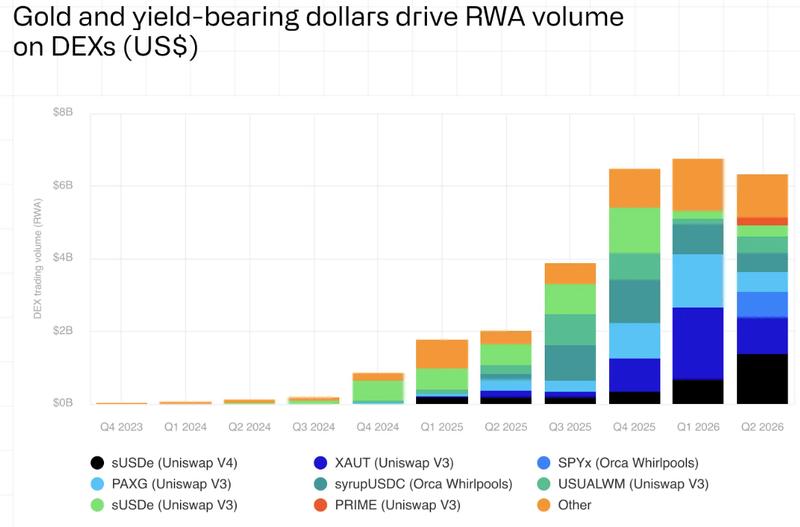
Trading volumes for RWA spot markets climbed approximately 220% compared to the previous year, while aggregate DEX volumes simultaneously declined by roughly 70%. This contrasting trend indicates that tokenized assets are establishing themselves within secondary trading venues, enabling market participants to exchange ownership stakes instead of exclusively acquiring assets through direct issuer purchases.
RWAs expand into leveraged markets
Blockchain-based access to RWAs is simultaneously extending into derivatives trading arenas, where market participants can establish leveraged exposure without direct ownership of the underlying instruments.
Trading activity in RWA perpetual futures contracts has maintained upward momentum notwithstanding a broader deceleration across crypto-native derivatives sectors. According to the report, on tradeXYZ, a perpetual futures platform focused on RWAs and developed on Hyperliquid infrastructure, trading volume has expanded by roughly 20 times since its initial launch.
Market participation has primarily clustered around commodity products, major equity indices including the S&P 500 and Nasdaq-100, along with technology sector equities, while aggregate open interest levels have similarly demonstrated sustained growth.