Tokenized Payment Settlement in Seconds Demonstrated by BIS Project Agorá
A two-year initiative involving the Bank for International Settlements, seven central banks, and over 40 financial institutions has produced a working prototype capable of settling wholesale payments within seconds.

On Wednesday, the Bank for International Settlements (BIS) published findings from Project Agorá, a prototype system designed for cross-border wholesale payment operations.
According to the BIS, the findings demonstrate that seven central banks working alongside more than 40 regulated financial institutions can achieve cross-border wholesale payment settlement within seconds after liquidity becomes locked, simultaneously minimizing credit and settlement risk via atomic settlement utilizing tokenized central bank reserves alongside commercial bank deposits.
This initiative represents among the most extensive partnerships to date involving central banks and private financial institutions, investigating tokenization's potential to transform the global payments infrastructure landscape.
Jointly convened by the BIS alongside the Institute of International Finance, the project addresses the persistent challenges of sluggish and expensive international transactions that hamper worldwide trade and financial operations. According to FXC Intelligence data referenced in the report, cross-border payments reached $195 trillion during 2024 and are forecast to climb to $320 trillion by 2032.
A two-layer blockchain architecture forms the foundation of Project Agorá, merging tokenized central bank reserves housed on jurisdictional ledgers with tokenized commercial bank deposits residing on a unified shared ledger, facilitating what is termed atomic settlement wherein all balance modifications happen simultaneously or fail to occur altogether.
According to the BIS, this methodology maintains the "two-tier banking system" while protecting the "singleness of money," characterized as "fundamental to financial stability," setting the project apart from stablecoin alternatives currently available.
Additionally, the platform enables institutions to perform anti-money laundering, sanctions, and fraud screening processes concurrently instead of consecutively, which according to the BIS could diminish the elevated false-positive rates that afflict contemporary cross-border payment systems.
Project Agorá moves to real-value testing
Real-value testing involving actual transactions with specific currencies and participants represents the next phase for the project, although the BIS did not disclose an implementation timeline.
Several areas necessitating additional development were highlighted in the report, encompassing liquidity saving mechanisms, cybersecurity positioning, and governance frameworks addressing settlement finality, data governance, and risk management protocols.
Once funds become locked, settlement completion takes mere seconds, with the platform engineered for continuous around-the-clock operation, eliminating delays stemming from incompatible operating hours across different jurisdictions.
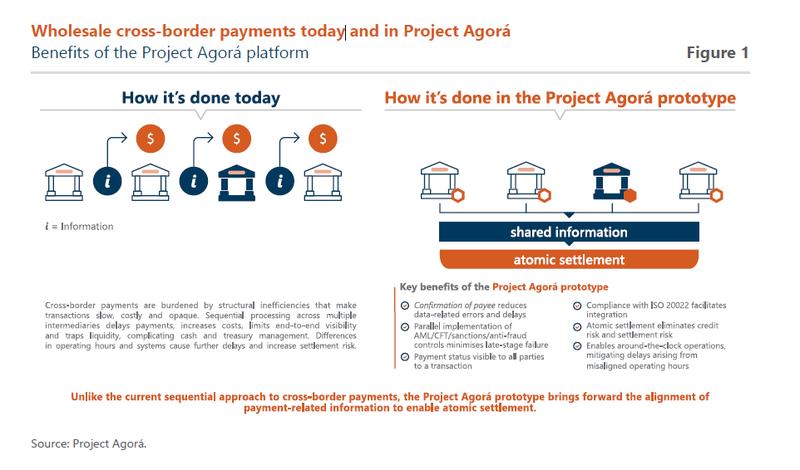
"The prototype also enhances transparency. All parties to a transaction have access to real-time payment status, while maintaining privacy from non-participating entities,"
BIS report
The BIS indicated in the report, noting that future iterations could extend such visibility to end users, encompassing both debtors and creditors.
Central banks participating in the initiative include the Banque de France representing the Eurosystem, the Bank of Japan, the Bank of Korea, the Bank of Mexico, the Swiss National Bank, the Federal Reserve Bank of New York via its New York Innovation Center and the Bank of England.
Earlier this month, the Bank of England put forward proposals to extend settlement hours for its RTGS and CHAPS systems as part of a comprehensive initiative toward near-24/7 settlement capabilities.
Deputy Governor Sarah Breeden also said shared ledgers and tokenization could make payments and settlement faster and cheaper, with fewer intermediaries and shorter settlement windows.
Cointelegraph reached out to the BIS media team for comment on implementation timelines and governance plans, but had not received a response by publication.