The Most Bizarre Assets Ever Put on the Blockchain: A Journey Through Digital Farts and Beyond
Digital cows captured the internet's imagination recently, but they represent just one entry in an extensive catalog of peculiar assets that have found their way onto blockchain ledgers, spanning everything from bottled flatulence to patches of human epidermis and deliberately destroyed works of art
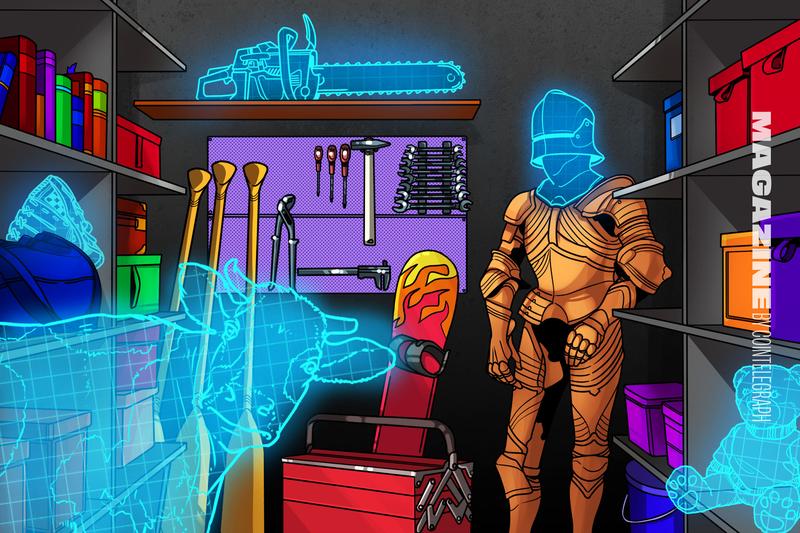
Last month, Brazil's B3 stock exchange captured worldwide attention after its experiment with tokenized cattle became an internet sensation.
In southern Brazil, an agricultural producer successfully leveraged 10 head of cattle as security for a loan worth 100,000 Brazilian reals ($19,600) by digitally corralling them into a blockchain-powered virtual enclosure, showcasing how agricultural workers can effectively extract liquidity from their livestock holdings to obtain financing.
This development prompts a compelling inquiry: if bovine animals can undergo tokenization, what remains beyond the realm of possibility?
From lactating cattle to twelve months' worth of intestinal gas, the following represents 10 of the most peculiar assets to achieve blockchain immortality.
1. A year's worth of farts
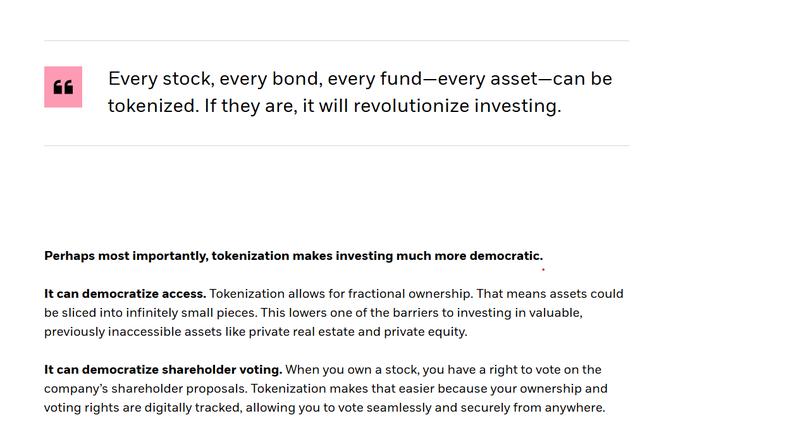
When Larry Fink, the chief executive of BlackRock, proclaimed that every conceivable asset would ultimately be tokenized, intestinal gas likely didn't feature in his projections. Nevertheless, that's precisely what transpired in this instance.
Rivaling the appeal of, well, an entire year's collection of flatulence, this entry must surely rank among the most bizarre items ever recorded on a blockchain.
During the global pandemic, while countless individuals occupied themselves with sourdough experiments or advancing through language learning applications, filmmaker Alex Ramírez-Mallis began documenting his own bodily emissions and converting each instance into a nonfungible token (NFT).
There's a saying that flatulence resembles offspring in that people exclusively appreciate their own. However, the curiosity factor enabled Ramírez-Mallis to command 0.05 ETH apiece (approximately $85 during that period), demonstrating that literally every asset carries a market valuation.
2. Cows
Traditionally recognized as a favored protein source among Bitcoin enthusiasts, the concept of transforming 10 Brazilian bovines into digital collateral... or rather, tokenized security, represents an unconventional application.
Brazilian investment fund Target FIDC orchestrated the transaction, assigning each bovine animal an exclusive digital token connected to an encrypted digital identification system.
While the initial loan amounted to merely $19,600, it functioned as a proof of concept demonstrating capabilities to ultimately facilitate approximately $80 million in livestock-secured financing throughout its agricultural operations.
Though the concept may initially appear unusual, the agricultural sector contributed roughly $4 trillion in global value addition during 2023, suggesting that tokenized ovine, caprine and avian assets as security instruments could be forthcoming.
3. Whiskey barrels
When contemplating whiskey sharing, you likely envision the amber liquid itself, yet whiskey casks present themselves as ideal tokenization candidates.
The reason stems from the fact that, similar to premium artwork and collectible items, Scotch whisky characteristically appreciates in monetary worth throughout its aging process — truly an uplifting prospect!
Multiple initiatives are exploring blockchain integration for whisky barrels, enabling investors to acquire complete units or partial ownership stakes in tokenized whisky residing in bonded storage facilities.
Bear in mind, however, that should the marketplace collapse, consuming a digital JPEG representation of a barrel remains impossible.
4. Racehorses
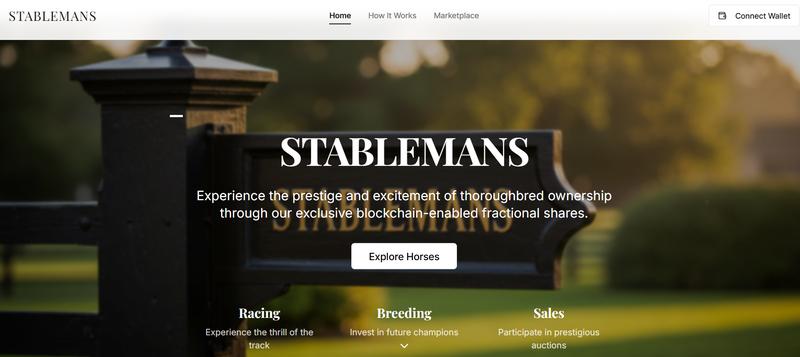
Ownership of racing thoroughbreds has historically remained the exclusive domain of the extraordinarily affluent, individuals possessing sufficient financial resources to absorb hundreds of thousands of dollars in bloodline development, professional training and maintenance expenses, plus appropriate headwear for track attendance.
However, tokenization is progressively dismantling these exclusionary boundaries, fragmenting ownership of genuine thoroughbred racing animals into digital fractional shares.
Participants can acquire equity in an animal and participate in any competition earnings, reproductive income, or eventual sales revenue, without the necessity of purchasing a complete horse.
A cautionary note for prospective participants in this category of investment, however, regardless of whether the assets are timepieces or aged spirits or substantial quadrupedal creatures, from Chris Turner, co-founder of impact investment firm KULA:
"Putting a collectible or luxury item on a blockchain doesn't automatically make it more liquid or valuable if the legal rights, transfer process, and market structure remain unchanged."
5. Uranium
Should your thoughts gravitate toward government bonds and private lending when contemplating tokenized real-world assets (RWAs), considering uranium, the radioactive element primarily recognized for nuclear energy applications, might require a mental adjustment.
Yet that's precisely the direction Tezos-backed metals.io has pursued. Arthur Breitman, Tezos co-founder, contends that blockchain technology demonstrates excellence in establishing "reliable, auditable and cost-efficient financial rails for any asset," though it proves particularly compatible with "technology-flavored commodities" such as uranium.
Breitman reports trading activity between November 2024 and July 2026 reached $21.5 million across roughly 18,200 individual trades and approximately 7,400 distinct wallets.
He concedes that expansion continues at a moderate pace, informing Magazine that institutional participants have expressed curiosity but remain "still shy about tokenized rails."
6. Fishy revenue
Among the most unconventional proposals tokenization platform Brickken encountered originated from a Chilean aquatic-processing enterprise seeking to distribute tokenized debt instruments with yields connected to the monetary value of their seafood sales.
"The token represented the lender's contractual claim, while the interest payable adjusted according to the company's verified sales performance. In effect, it was a tokenized, revenue-linked debt instrument," clarifies Edwin Mata, chief executive of Brickken.
Mata contends that this concept underscores a significant principle:
"Almost any cash flow can support a tokenized financial instrument, provided the underlying rights and data can be independently verified."
Ultimately, the seafood venture never achieved blockchain implementation. The fundamental fish sales continued depending on financial audits, business reporting and contractual agreements that couldn't yet undergo automation, establishing that, occasionally, the greatest impediment to tokenization isn't the distributed ledger technology; it's the physical world.
7. Music royalties
Musical royalties have likewise discovered their pathway onto blockchain networks, with among the earliest prominent instances occurring in 2021, when disc jockey and music producer 3LAU granted enthusiasts 50% of the streaming entitlements to his composition Worst Case via his blockchain platform Royal.
Subsequently, during 2022, hip-hop artist Nas utilized Royal to distribute streaming royalty entitlements to a pair of his compositions, Ultra Black and Rare.
Although the concept of blockchain-based royalties attracted considerable interest throughout the NFT surge, tokenized musical royalties haven't yet evolved into a conventional investment category. Perhaps this relates to the minimal compensation streaming platforms provide.
Few things communicate "financial independence" quite like possessing 0.001% of a musical track and discovering it requires five million plays merely to afford a single cup of coffee.
8. Human Skin
Should tokenizing intestinal gas and livestock prove insufficiently peculiar, consider portions of your physical body? That's precisely the path Croatian tennis professional Oleksandra Oliynykova pursued in 2021, when she offered the promotional entitlements to a 15-by-18-centimeter section of epidermis on her right arm as an NFT.
The successful purchaser remitted 3 Ether (roughly $5,400 during that timeframe) for the privilege to select which permanent marking she would display throughout competitive matches for a year.
Professional athletes have traditionally marketed sponsorship real estate on jerseys, protective headgear and racing vehicles. Oliynykova simply advanced the concept an additional step, providing an entirely novel interpretation to possessing skin in the game.
9. A Burned Banksy
Most art enthusiasts attempt to safeguard masterworks; cryptocurrency collectors incinerate them to articulate a position regarding "digital ownership." During 2021, a collective identifying as Burnt Banksy acquired a Banksy print entitled Morons (White) for approximately $95,000. They broadcast the incineration live, subsequently minting the act of destruction.
Should this leave you perplexed, there existed reasoning within the apparent insanity; the underlying concept suggested that although the tangible artwork ceased to exist, ownership would persist indefinitely via the blockchain.
The NFT transacted for roughly $382,000, igniting intense discussion over whether the collective had demolished a precious artistic creation or merely metamorphosed it into something unprecedented. This probably marked history's inaugural instance of someone generating a 300% return from a "fire sale."
10. The first tweet
Also during the year of our NFT Lord, 2021, Jack Dorsey, Twitter co-founder, tokenized his inaugural tweet — "just setting up my twttr" — and transferred it as an NFT to cryptocurrency entrepreneur Sina Estavi for $2.9 million, rapidly becoming emblematic of the NFT phenomenon.
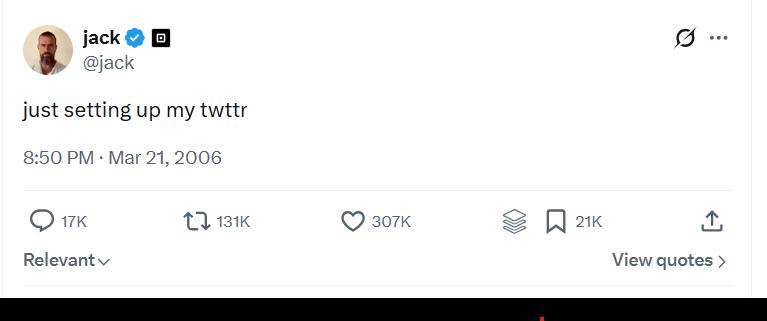
Twelve months subsequently, Estavi attempted reselling it for $48 million, though received only offers representing a minuscule portion of the requested amount, with the maximum reported proposal arriving at merely $6,800.
While the tweet remains publicly accessible on X, exclusive ownership of the blockchain certification connected to it belongs to a single individual. Whether this carries significance remains debatable. As Mata observes:
"Tokenization can improve access, administration, settlement and transferability, but it cannot transform a poor investment into a good one."