Research partnership launched to examine Americans' perspectives on financial privacy
The research collaboration emerges amid regulatory enforcement measures and proposed legislation that have sparked debate over the treatment of privacy-focused technologies and their developers.

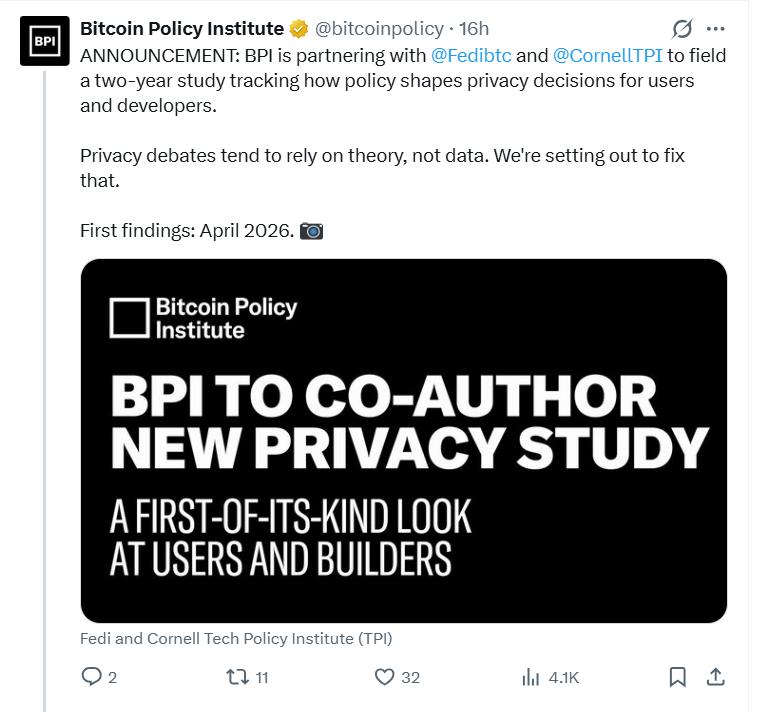
A collaborative two‑year research project examining American perspectives on financial privacy is being initiated by the Bitcoin Policy Institute (BPI), Fedi and Cornell University, exploring what compromises citizens are willing to make and how regulatory frameworks influence their conduct.
The collaborative effort unites a Bitcoin (BTC) wallet provider with a university research center and a think tank focused on policy matters, seeking to bridge the gap between the development, academic study and regulatory oversight of privacy-enhancing technologies.
As outlined by Fedi and BPI, the study will employ both quantitative survey methods and qualitative interview techniques to analyze public sentiment regarding financial privacy and how these views shift over time.
The academic component will be handled by Cornell's Brooks School Tech Policy Institute, with Fedi contributing expertise in product development and user engagement patterns, and BPI concentrating on policy analysis and public communications.
Over the course of the two-year initiative, special emphasis will be placed on understanding American perspectives about privacy in routine financial transactions and their confidence in established institutions, with four reports to be published every six months, beginning with the inaugural release in April 2026, designed to introduce empirical data into policy discussions and the regulatory environment confronting software developers.
Growing anxiety over data collection practices
Anxiety among the public regarding data collection practices continues to intensify. Research conducted by Pew Research Center in 2023 revealed that 71% of adults in the United States reported being very or somewhat worried about governmental use of collected personal information, representing an increase from 64% recorded in 2019. Approximately two‑thirds of respondents indicated they had minimal or no understanding of how corporations utilized their personal information.
Concurrently, governmental bodies worldwide are investigating initiatives including central bank digital currencies (CBDCs) and digital identity systems that have the potential to increase official oversight of payment transactions and digital activities, contributing to an expanding dialogue about whether financial privacy ought to be maintained, restructured or limited in the contemporary digital landscape.
Regulatory environment for developers and privacy technologies
Within the cryptocurrency sector, the regulatory environment surrounding open‑source development and privacy‑enhancing technologies has become increasingly stringent.
Criminal prosecutions have been initiated by US authorities targeting creators of non‑custodial platforms including Samourai Wallet and Tornado Cash, with allegations that they operated money‑transmitting businesses without proper licensing and facilitated the movement of illegally obtained funds using their software.
Developers in these situations have encountered criminal prosecution, convictions in associated legal proceedings, or continuing legal exposure.
These prosecutions have generated concerns that merely creating or maintaining software code focused on privacy could be characterized as criminal activity, regardless of whether developers maintain direct custody over user assets.
Legislative proposals and decentralized finance developers
Within the nation's capital, the pending legislation addressing crypto market structure has become a critical arena for determining the future treatment of developers and decentralized finance (DeFi).
Trade associations, such as the DeFi Education Fund, have appealed to legislators to establish "robust, nationwide protections" for software creators and non‑custodial infrastructure providers, cautioning that ambiguous regulatory requirements could drive development activity overseas or compel builders to assume traditional financial‑intermediary responsibilities.
Jake Chervinsky, chief legal officer at Variant, characterized DeFi as his "red line" in discussions surrounding market structure legislation, maintaining that the proposed bill must safeguard DeFi developers and cautioning that absent explicit protective measures, a future regulatory authority could still attempt to "kill DeFi" within the United States.
Cointelegraph reached out to the Bitcoin Policy Institute seeking further commentary, but no response had been received prior to publication.