Neo Co-Founder Unveils $461M Treasury Reform Plan to Replace Founder-Led Governance
A comprehensive overhaul proposed for Neo would reorganize its foundation structure, distribute tokens back to holders and establish formal accountability mechanisms amid ongoing disputes between its co-founders over network management.
Da Hongfei, one of Neo's co-founders, has put forward an extensive plan to restructure the Neo Foundation following an extended period of stalemate with his fellow co-founder Erik Zhang that has left the veteran blockchain network in a state of effective paralysis.
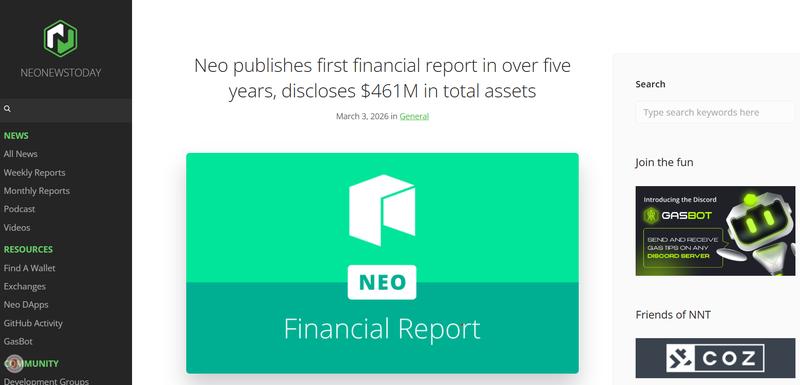
This restructuring initiative comes on the heels of Neo's initial public financial statement since 2019, which revealed approximately $461 million in holdings distributed between the Neo Foundation (NF) and Neo Global Development (NGD) as of the conclusion of 2025.
The restructuring blueprint seeks to dismantle what Hongfei characterized as casual, founder-dominated decision-making processes, with Hongfei suggesting the results might establish a precedent for how mature blockchain platforms handle substantial treasuries and shift away from founder-led governance structures.
Zhang has voiced objections to significant aspects of the restructuring plan, revealing deeper rifts within the project's leadership while drawing heightened attention from the community and investment stakeholders.
In statements to Cointelegraph, Hongfei explained that the fundamental aspect of the restructuring involves departing from the founder-focused framework that characterized Neo's initial ten years of operation.
Under the proposal, the foundation would relocate to the Cayman Islands, establish a board comprising five members alongside an independent Supervisor equipped with authority to prevent bylaw violations, and implement a two-year prohibition preventing either co-founder from serving on the board or in supervisory capacities.
The conflict within Neo has emerged as an instructive example of how established blockchain networks managing significant treasuries face challenges in transitioning beyond founder-dominated governance models, particularly following extended periods of informal oversight and restricted public financial transparency.
Returning NEO tokens to the community
The financial disclosure indicates that NF and NGD presently hold approximately 41 million NEO (31.3%), primarily maintained under single-signature management. Hongfei's "Giveback II" initiative would redistribute 49.5 million reserved NEO tokens to community members and merge NGD-controlled investments back into the foundation, which would function under requirements for yearly financial disclosures, onchain verification for substantial transfers, and complete transparency for multi-signature wallets containing Bitcoin (BTC), Ether (ETH), stablecoins and additional liquid holdings.
Hongfei stated that these modifications are intended to eliminate "trust me" governance practices surrounding treasury management and asset custody, referencing Ethereum creator Vitalik Buterin's approach of exercising influence through research contributions as an exemplary model for founders to follow.
Zhang has not been persuaded, contending that the restructuring plan bases Neo's legitimacy on offchain legal frameworks while maintaining opportunities for unclear third-party verification processes rather than directly confirmable onchain wallet addresses.
Zhang maintained that his 24-month exclusion from board participation deprives Neo of critical technical guidance, characterizing the Cayman Islands "reset" as superficial structural changes that circumvent historical responsibility and outstanding transparency concerns.
Governance woes across decentralized finance
This governance initiative emerges during a period when leadership conflicts and allegations of insider favoritism have become central topics throughout the decentralized finance landscape. Aave's protracted conflict between the founder-supported Aave Chan Initiative and alternative stakeholder groups has sparked discussions about the appropriate level of authority that established service providers should exercise within decentralized autonomous organizations.
World Liberty Financial, which has connections to the Trump family, faced severe backlash from stakeholders during the current week, including criticism from Tron founder Justin Sun, regarding a suggested new release timeline for its WLFI governance token and unrestricted authority over treasury funds.
Neo's bet to revive network relevance
Underlying this governance transformation is an effort to provide Neo with a legitimate renewed value proposition in a marketplace where transaction activity has concentrated on Ethereum, several layer-2 solutions, Solana, and a limited number of additional blockchain platforms.
Hongfei acknowledged that Neo's current user base stands "not where it was in the 2017 to 2021 cycle," with metrics that "reflect a project that has seen better days."
He explained that users have become increasingly concentrated among long-term token holders and dedicated community factions; the Chinese marketplace that previously drove significant activity has contracted due to Beijing's regulatory prohibitions, and Neo failed to capitalize on "DeFi Summer" following postponements in delivering its N3 upgrade.
Hongfei currently maintains that the coming decade of onchain transactions will be propelled more significantly by autonomous AI agents conducting transactions on behalf of humans rather than human users directly, framing Neo X as an "agent-first" blockchain platform engineered for this paradigm shift.
He indicated that the genuine measure of success for both the governance transformation and the AI-focused strategy will depend on whether Neo can, throughout the upcoming 12 to 24 months, finalize its restructuring process and secure a substantial pipeline of agent-native development projects, and whether he would continue to pursue a board position should these objectives remain unachieved.