KB Financial Group Successfully Tests Stablecoin System for Physical Store Transactions in South Korea
South Korea's largest banking institution's parent organization has finalized a stablecoin transaction trial in preparation for the nation's upcoming cryptocurrency regulatory framework.

The parent organization of KB Kookmin, South Korea's biggest banking institution, KB Financial Group, has successfully finalized a pilot program testing stablecoin functionality for physical store transactions and international money transfers via the Kaia blockchain network.
The financial group conducted trials examining the complete lifecycle of a stablecoin pegged to the South Korean won, encompassing token creation, payment processing for businesses, and international fund transfers, working alongside Kaia, digital payment provider KG Inicis, and financial technology company OpenAsset, according to a report from domestic news source Yonhap.
This stablecoin trial represents another addition to the expanding roster of traditional banking organizations throughout South Korea conducting stablecoin experiments. During the final days of April, Shinhan Card, one of South Korea's leading credit card service providers, entered into a memorandum of understanding with the Solana Foundation for the purpose of testing payment systems using stablecoins.
With total assets exceeding 584.9 trillion won ($266.7 billion), KB Kookmin holds the position as South Korea's largest banking institution, based on data from the bank's factbook published for the fourth quarter of 2025.
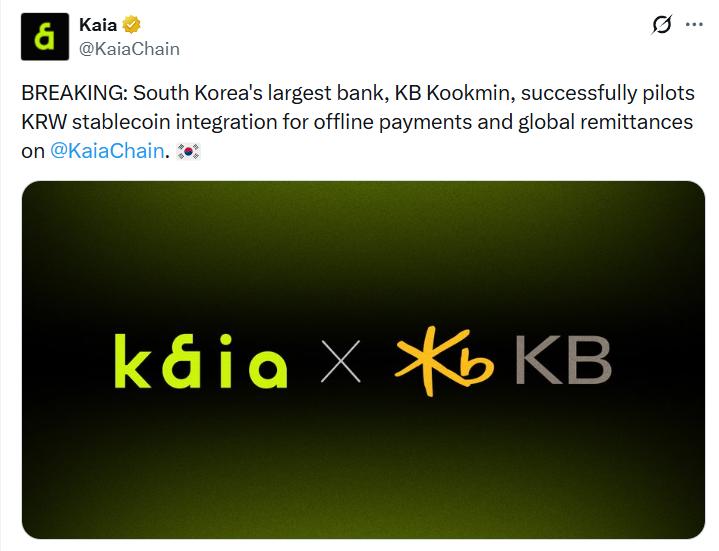
Stablecoin test reduced remittance fees by 87%
During KB Financial's trial operations, a stablecoin denominated in won underwent conversion into a stablecoin denominated in US dollars before being transmitted to a banking account located in Vietnam.
The complete transaction process took less than 3 minutes to finalize, while demonstrating an 87% reduction in fees when compared to an identical transaction processed via the SWIFT network, according to statements provided to Cointelegraph by email from a Kaia spokesperson.
Serving as the messaging infrastructure for cross-border payments, the SWIFT network connects thousands of banking institutions and financial service providers across the globe.
The pilot program for physical store payments was carried out in partnership with Hollys, a coffee shop franchise based in Seoul, allowing customers to complete payments by scanning QR codes, eliminating the requirement to download and install a digital currency wallet.
KB plans stablecoin services launch after regulations take effect
According to reports, KB is making preparations to introduce stablecoin-based services following the implementation of digital asset regulations within the nation.
However, the nation's planned Digital Asset Basic Act has experienced multiple delays stemming from disputes among regulatory bodies regarding which entities should be granted authorization to create stablecoins.
The Bank of Korea, serving as the country's central banking authority, has taken the position that banking institutions should maintain majority ownership stakes in companies that issue stablecoins, whereas the Financial Services Commission has expressed concerns that overly restrictive requirements could hinder innovation and development.
Official discussions and deliberations are not expected to recommence until after South Korea's June local elections have concluded.