Japan enacts comprehensive cryptocurrency legislation bringing digital currencies under financial sector regulations
Through amendments to the Financial Instruments and Exchange Act, Japan establishes insider trading prohibitions for crypto, enhanced enforcement measures and expanded regulatory oversight for digital asset firms.

Japan is poised to transform its digital currency landscape through the implementation of more stringent trading regulations, enhanced consumer safeguards and a regulatory structure that more closely mirrors conventional financial markets.
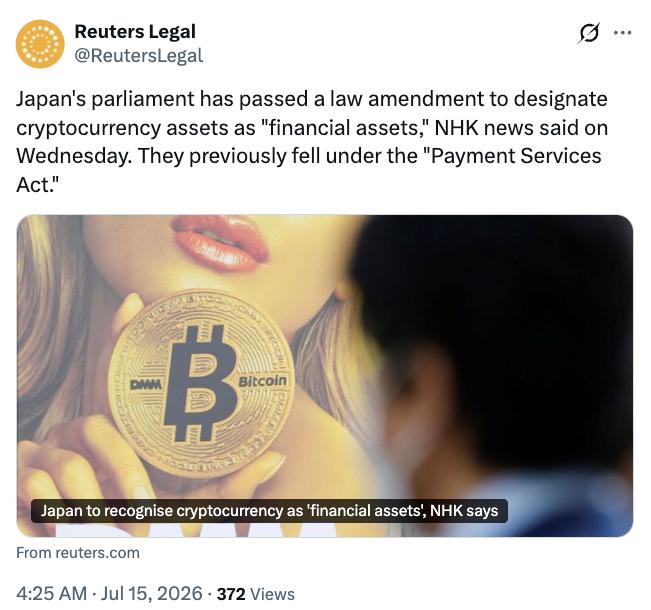
On Wednesday, the nation's legislative body approved amendments that reclassify cryptocurrency holdings as financial assets within the scope of Japan's Financial Instruments and Exchange Act (FIEA), as documented in coverage by Nikkei, a domestic news organization.
These modifications shift Japan's approach to cryptocurrency oversight from the Payment Services Act (PSA), a framework that predominantly categorized digital currencies as means of payment, and establish prohibitions against insider trading alongside enhanced supervision mechanisms for cryptocurrency enterprises.
This comprehensive regulatory reform represents one of the most significant transformations in Japan's approach to digital asset governance, occurring as financial authorities across the globe persist in deliberating the appropriate placement of cryptocurrencies within established financial regulatory frameworks.
Crypto exchanges face tougher oversight
Within the parameters of the amended regulatory structure, cryptocurrency enterprises conducting operations in Japan will encounter heightened compliance responsibilities engineered to enhance market transparency and safeguard consumer interests.
The modernized regulations forbid token issuers, trading platforms and additional market actors from executing transactions while possessing knowledge of non-public material information, establishing insider trading prohibitions comparable to those enforced within traditional finance (TradFi).
The amended regulations escalate enforcement measures for entities conducting business without proper registration, according to reports elevating the maximum incarceration period from three years to 10 years and boosting monetary penalties from approximately 3 million Japanese yen ($19,000) to approximately 10 million yen.
Violations related to insider trading may lead to consequences including imprisonment for up to five years, monetary fines reaching 5 million yen, or a combination of both punishments, according to the report.
Global regulators align crypto with financial rules
Consistent with Japan's initiative to position cryptocurrency more closely alongside TradFi, the updated legislation also purportedly modifies the designation for licensed entities from "cryptocurrency exchange" to "cryptocurrency trading company." This terminological adjustment mirrors the expanded financial responsibilities that regulatory bodies currently attribute to the industry.
Japan's evolving cryptocurrency regulatory landscape exemplifies a wider international movement of financial authorities implementing established financial governance structures to digital assets instead of considering the industry as fundamentally distinct.
South Africa's taxation agency released preliminary guidance during early July detailing the application of current tax regulations to cryptocurrency holdings, meanwhile US financial regulators continue providing clarification regarding the applicability of prevailing securities and commodities legislation to digital assets.