Infrastructure limitations stall autonomous AI agent economy growth: Artemis, Visa report
A collaborative study by Artemis and Visa reveals that infrastructure constraints are hampering widespread commercial deployment of autonomous AI agents in the economy.

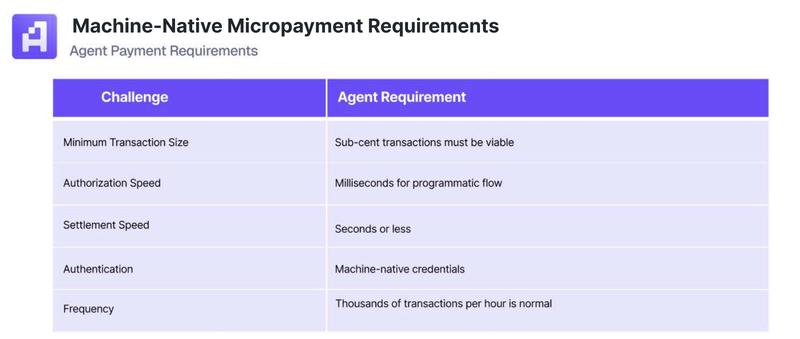
The existing global card payments infrastructure is facing difficulties adapting to artificial intelligence (AI) agents due to its inability to efficiently handle high-frequency micropayments, as revealed in a collaborative study from payment processing leader Visa and investment thesis platform Artemis.
According to the collaborative study made public on Wednesday, conventional card payment systems were designed to accommodate human-driven transactions with lower frequency, making them inadequate for AI agents that require payment infrastructure featuring almost negligible fees and accelerated settlement processes to enable economically viable agentic micropayments.
The demand for innovative infrastructure has become more urgent as AI agents achieved a critical capability milestone during mid-2025, granting them the ability to locate previously unknown APIs, assess pricing structures, and execute independent payment decisions.
According to the findings, AI agents are introducing fundamental shifts in commercial transactions, yet existing infrastructure limitations are constraining their widespread implementation.
Crypto trading platform Swyftx from Australia indicated earlier in the week that microbusinesses powered by AI technology have the potential to generate an extra $262 billion in stablecoin transaction volume by the year 2033, through AI-focused payments processed using stablecoins, calculated using an estimated adoption percentage of approximately 33%.
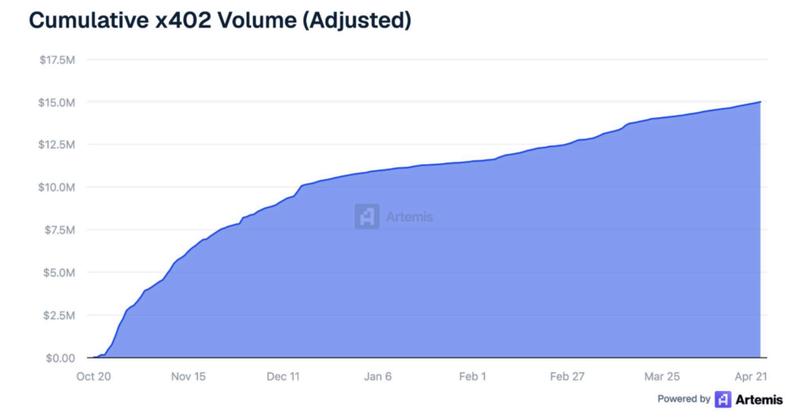
Certain agentic payment frameworks are demonstrating early signs of market traction, including the x402 payment protocol that was created by Coinbase.
Since its May 2025 introduction, the x402 protocol has handled $15 million in adjusted transaction volume spanning more than 109 million adjusted transactions. The protocol experienced significant growth acceleration during October 2025, with monthly transaction volumes jumping from 40,000 to 3.8 million, resulting in 38 million transactions being processed throughout October exclusively.
Stablecoins could stoke machine-native micropayments growth
According to Artemis and Visa, a unified machine-payments infrastructure has the potential to accommodate both traditional card-based transactions and stablecoin payments, with the firms noting:
"The trajectory points toward convergence rather than competition: cards for proxy purchases inside existing merchant networks, stablecoins for machine-native micropayments, and hybrid flows where both are used within the same workflow."
The study indicated that a unified machine payment infrastructure possesses the capability to facilitate both card-based transactions and stablecoin-driven flows, thereby establishing an entry point for card payment networks into agentic payment ecosystems.
Additionally, the report noted that Tempo's Machine Payment Protocol (MPP) currently encompasses both onchain cryptocurrency payments and traditional fiat payments through unified payment tokens. According to Visa, its Card Specification SDK was engineered to integrate the protocol into card-based commerce driven by AI agents.
In March, both Visa's cryptocurrency division and Stripe-supported Tempo introduced AI-powered tools. Visa's solution enables AI agents to execute same-day payment transactions. During the same month, Tempo introduced its Machine Payments Protocol, engineered to streamline the process for AI entities to transmit and receive monetary transfers.