Does Robinhood Chain's Launch Signal Positive or Negative Prospects for ETH?
The substantial debut of Robinhood Chain has rekindled discussions about whether layer-2 solutions on Ethereum will generate sustained demand for ETH tokens.

The dramatic debut of Robinhood Chain earlier this month has brought back to life one of the most enduring questions surrounding Ethereum: Does the success of layer-2 networks drive up demand for ETH as an asset, or do these emerging platforms retain all the economic value within their own ecosystems?
The layer-2 solution built on Arbitrum technology by the retail trading platform has emerged as one of the most active rollups in the Ethereum ecosystem since going live on July 1.
In the initial fourteen days following launch, over $141 million worth of Ether was transferred onto the network via bridges. Data from DeFiLlama indicates that more than half a million cryptocurrency wallets currently store ETH on this platform, while a surge in memecoin trading activity propelled Robinhood Chain ahead of both Ethereum's primary layer and Coinbase's Base layer-2 solution in terms of 24-hour decentralized exchange transaction volumes.
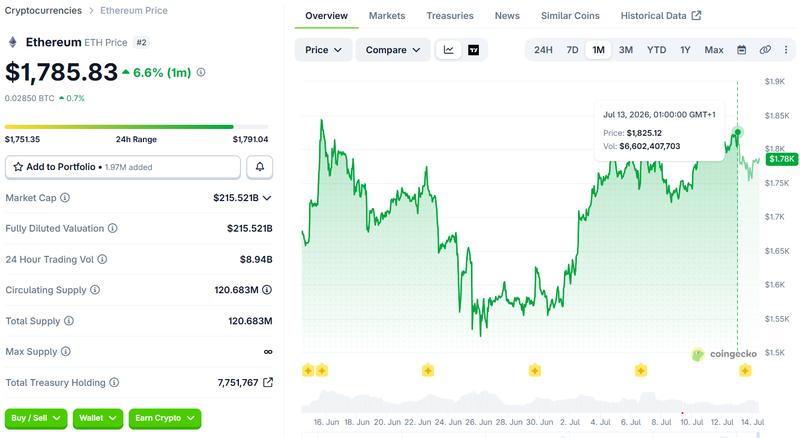
The price of Ether experienced upward momentum following these developments, appreciating approximately 15% from $1,582 on July 1 to reach $1,825 by July 13, based on data from Coingecko, accompanied by numerous optimistic market observations.
Eric Trump from World Liberty Financial shared on July 11, "ETH is pumping hard! Great to see!" Meanwhile, Tom Lee, who serves as chairman of BitMine Immersion Technologies, contended that the chain's debut strengthens the argument that "ETH is money," highlighting the cryptocurrency's function as the network's native token for gas fees and the layer-2's settlement finality on Ethereum's primary blockchain.
Those invested in Ethereum are familiar with these types of claims.
Networks like Arbitrum, Optimism and Base individually generated substantial user adoption and transaction activity within Ethereum's layer-2 infrastructure, yet none succeeded in creating a significant lasting impact on Ether's market valuation, given that the majority of economic transactions stayed confined to the individual rollup platforms.
The introduction of Robinhood Chain presents a potentially different scenario. In contrast to earlier rollups created by companies native to the cryptocurrency industry, this particular network was constructed by a publicly traded retail brokerage platform serving tens of millions of individual users to facilitate tokenized equities and additional real-world asset categories.
Just days after going operational, the platform was already responsible for 6.9% of the entire tokenized stockholder market, based on analytics from Token Terminal.
Furthermore, should Robinhood's approach prove successful, it has the potential to motivate traditional financial institutions including banks, brokerage firms and investment management companies to develop their own layer-2 solutions, effectively establishing Ethereum as the preferred blockchain infrastructure for traditional finance integration. Deutsche Bank is currently in development stages of building DAMA 2, a zero-knowledge-powered Ethereum layer-2 network designed specifically for institutional financial services.
Why Robinhood could be a turning point
Layer-2 networks on Ethereum leverage rollup technology to execute transactions off of Ethereum's primary blockchain and subsequently batch-settle those transactions back to the main network at regular intervals. Robinhood Chain utilizes Arbitrum's underlying technology and maintains full compatibility with the broader Ethereum application ecosystem.
However, what has captured the cryptocurrency industry's focus isn't the technical infrastructure as much as the identity of those implementing it.
"It's a real milestone," Alex Gluchowski, founder and chief executive of Matter Labs, the development team behind Ethereum layer-2 zkSync, told Cointelegraph.
"It shows Ethereum L2s have gone from something crypto-native teams experiment with to infrastructure a regulated, publicly listed company will run its business on."
Instead of constructing a completely new blockchain infrastructure from the ground up, which is the path Stripe has chosen with Tempo, Robinhood made the strategic decision to customize an Ethereum rollup solution to align with its specific operational requirements "for privacy, compliance and performance, while still inheriting Ethereum's security and connecting to its liquidity," he added.
Max Shannon, senior research analyst at Bitwise, told Cointelegraph that the achievement of Robinhood Chain carries greater weight than earlier layer-2 implementations.
"It represents the growth of the Ethereum ecosystem, particularly among major institutions," he said. "It also arrives at a time when Ethereum has more broadly repositioned itself toward institutions through Eth Labs and Ethereum Institutional."
Does Robinhood Chain change the investment case for ETH?
From Shannon's perspective, the introduction of Robinhood's network enhances the investment argument for Ethereum by solidifying the blockchain's status as the preeminent platform for institutional integration.
According to him, ETH possesses the "network characteristics" necessary to emerge as the foundational reserve asset for an expanding ecosystem of institutional layer-2 platforms. However, similar to many industry observers, he maintains that Ethereum's token economics require enhancement to ensure that heightened network utilization translates more directly into elevated demand for ETH.
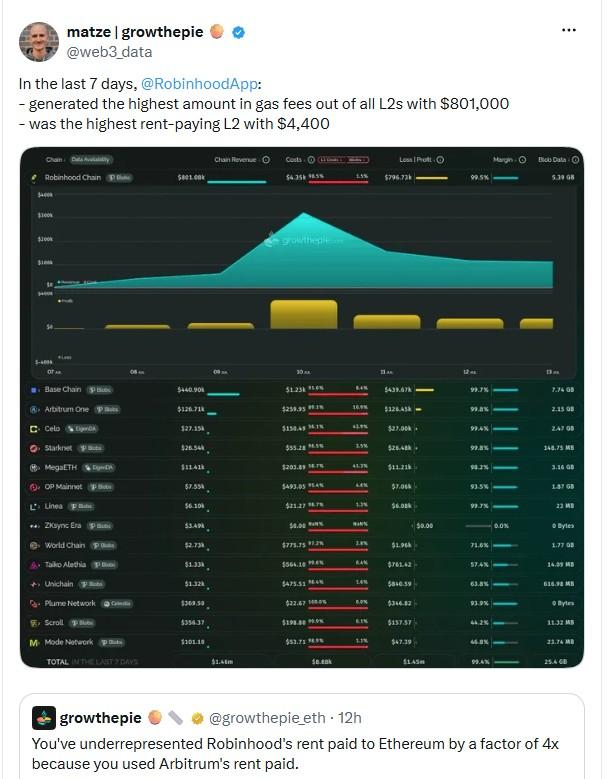
Ethereum has faced repeated criticism regarding its strategic choice to reduce transaction costs for layer-2 solutions as a mechanism to stimulate widespread adoption and achieve network effects. Lorenzo Valente of Ark Invest posted on July 14 that Robinhood Chain had produced $816,000 in total revenue since its inception, with Arbitrum receiving a 10% commission, while merely 0.15% of the aggregate amount was remitted back to Ethereum.
"If your thesis is 'ETH is money,' Robinhood building here is ultra bullish. More activity, more ETH collateral, more lindyness. If your thesis is 'ETH is a revenue generating asset,' this is the ultra-bear case."
GrowThePie said that Valente's figures for Eth's share of the revenue were off by a factor of four and argued "0.6% of revenue is the correct figure." But even the higher figure is not a meaningful driver of revenue to the L1. Robinhood Chain generated more gas fees than any other L2 in the past week, but Ethereum only saw $4,400 of that.
Gluchowski said ETH's appreciation would not be based on fee revenue, but would likely come from becoming widely accepted money throughout the L2 ecosystems.
"People might pay fees in stablecoins or never think about gas at all," he said. "But as more value settles through Ethereum, ETH starts to look less like a fee token and more like a base monetary asset for this system."
Even ETH bears like Mike Dudas from 6th Man Ventures, have described Robinhood Chain as "the single most bullish thing I've seen in eth-land in years."
But after Dudas saw Valente's post, he added the proviso that "Eth cooked unless 'eth is money' takes off or the price of l1 settlement increases."
The value accrual question remains
While the successful launch of Robinhood may have strengthened the argument supporting Ethereum's scaling approach, it has not yet resolved one of the blockchain's most significant outstanding challenges: through what mechanism does expanding layer-2 activity ultimately convert into tangible value for ETH tokens?
Shannon said that recent upgrades like Fusaka have improved Ethereum's scaling capabilities, but despite transaction activity reaching record levels, demand has yet to translate into meaningfully higher fees or increased ETH burn.
"Robinhood will not solve this problem," Shannon said, "and the collective growth of L2s will likely not either… It requires a wholesale change in developer mindset and in ETH's token economics."
An additional area of uncertainty involves the question of how much ETH traditional financial institutions will actually maintain in direct holdings. Given that tokenized equities and other real-world assets increasingly conduct trades denominated in stablecoins, numerous users may seldom engage directly with ETH, despite its role as the foundational infrastructure supporting network operations.
Robinhood may have demonstrated that a prominent financial services company is prepared to construct operations on top of Ethereum's technical infrastructure, but the question of whether this development ultimately generates increased demand for ETH as an asset continues to be an open matter.