CryptoQuant: Sub-1 BTC Transactions Hit Post-FTX Record Amid Coldcard Security Breach
A total of 39,600 BTC changed hands through small-scale transactions while the Coldcard security breach persisted, with security experts cautioning that the threat continues to be active.
Bitcoin transactions involving amounts under 1 BTC have surged to their highest point since the FTX cryptocurrency exchange implosion, occurring alongside a continuing suspected security breach affecting Coldcard hardware wallets.
On Friday, Bitcoin transfers involving less than 1 BTC surged to their most elevated daily total since November 2022, with a volume of 39,600 BTC changing hands, based on information released by Julio Moreno, CryptoQuant's head of research, on Saturday.
This number fell short by merely 300 BTC of the 39,900 BTC that was transferred on Nov. 16, 2022, just days following FTX's bankruptcy filing. "The Bitcoin plebs had not moved this amount of BTC in a day since the FTX collapse," Moreno said, adding that he was encouraged to see users "taking action."
While the suspected Coldcard security breach continues to develop, this event has evolved into a more comprehensive examination of Bitcoin self-custody practices, sparking renewed discussion about whether users achieve greater security through maintaining control of their own assets or by depending on third-party service providers.
Incident ongoing as Galaxy tracks three attack waves
The spike in smaller Bitcoin transactions occurred while security researchers kept discovering additional victims of the suspected Coldcard security breach, which initially emerged in late July and seemed to be continuing at the time this article was published.
On Saturday, Galaxy Research, which operates as the research division of cryptocurrency investment firm Galaxy Digital, disclosed that the most recently identified wave resulted in the theft of an additional 207.7 BTC, valued at approximately $13.2 million. This latest theft elevated the total estimated losses to 1,367 BTC ($88.6 million) distributed across 4,585 addresses.
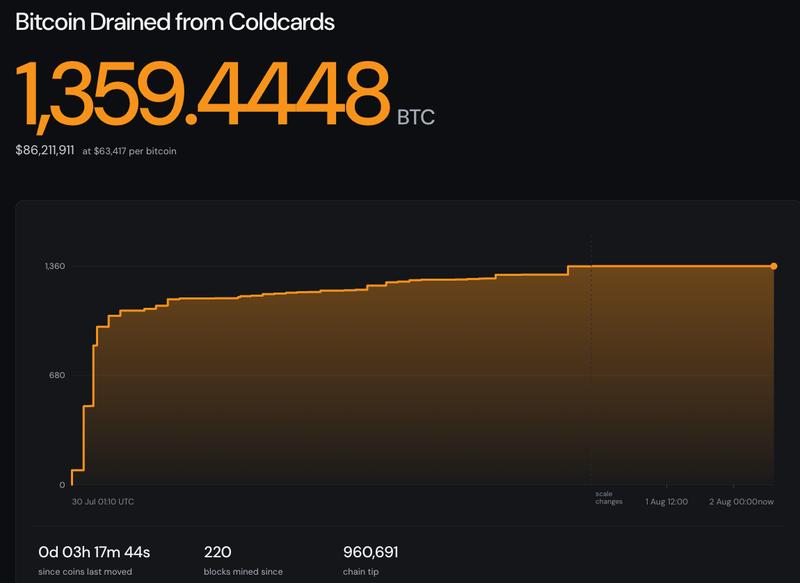
In an X post published on Sunday, Alex Thorn, Galaxy Digital's head of firmwide research, issued a warning that the attack was still ongoing and urged users to move funds from Coldcard-generated addresses immediately if they had not already done so.
According to Thorn, his research team was still uncovering new victim and attacker addresses, noting that user-submitted reports had proven valuable in helping researchers and law enforcement authorities track stolen funds.
Coldcard incident reignites self-custody debate
The suspected Coldcard security breach has rekindled discussions surrounding the advantages and disadvantages of Bitcoin self-custody, a fundamental tenet of cryptocurrency that enables users to maintain control over their assets without depending on intermediary parties.
Casa CEO Nick Neuman, whose company specializes in Bitcoin security solutions, challenged assertions that "self-custody is over," contending that its distributed nature gave users time to react. According to his calculations, the amount of Bitcoin that was potentially secured through self-custody practices could be as much as 10 times greater than the volume that was stolen and identified in the attack so far.
The discussion has also attracted commentary from advocates of traditional finance systems. Bloomberg's senior ETF analyst Eric Balchunas argued that Bitcoin exchange-traded funds (ETFs) provide a safer and more convenient alternative for many users, pointing to the long operating history of the ETF industry. However, others countered these claims, maintaining that the Coldcard incident represented a failure of one wallet provider rather than a failure of self-custody itself.