Cryptocurrency: The double-edged sword that built and dismantled Incognito's $100M dark web empire
A sprawling illicit drug marketplace on the dark web relied on cryptocurrency for operations, but that very same technology enabled federal investigators to track down and apprehend its operator, who is now looking at three decades of imprisonment.

The individual behind Incognito Market, a digital black market platform that relied on cryptocurrency as its financial backbone, has received a 30-year prison sentence following blockchain forensics work that guided American law enforcement directly to the operation's administrator.
According to a Wednesday announcement from the Justice Department, a court in Manhattan handed down a three-decade sentence to Rui-Siang Lin for running and managing Incognito, a platform responsible for facilitating $105 million in illegal drug transactions from its October 2020 inception through its March 2024 shutdown.
After entering a guilty plea to his involvement in December 2024, Lin received sentencing on charges including conspiracy to distribute controlled substances, laundering of money, and conspiracy to distribute misbranded pharmaceuticals.
The Incognito platform enabled participants to conduct drug transactions utilizing Bitcoin (BTC) and Monero (XMR) while extracting a 5% commission, and Lin's eventual capture occurred when federal investigators successfully tracked the platform's cryptocurrency movements to an exchange account registered under Lin's identity.
Today's sentence puts traffickers on notice: you cannot hide in the shadows of the Internet. Our larger message is simple: the internet, 'decentralization,' 'blockchain' — any technology — is not a license to operate a narcotics distribution business.
Manhattan US Attorney Jay Clayton
Beyond the custodial sentence, Lin received an additional five years of supervised release and must forfeit over $105 million.
Blockchain forensics directed FBI directly to Lin's doorstep
According to the Justice Department's March 2024 statement, Lin shuttered Incognito and made off with no less than $1 million that platform users had placed in their accounts.
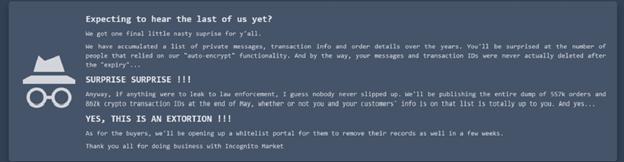
Operating under the pseudonym "Pharoah," Lin subsequently launched a blackmail campaign targeting Incognito's user base, threatening buyers and sellers that unless they paid him, he would expose their transaction histories and cryptocurrency addresses to the public.
Several months afterward, in May 2024, law enforcement took Lin, a citizen of Taiwan, into custody at John F. Kennedy Airport in New York following the FBI's successful connection of him to Incognito through partially tracking the platform's cryptocurrency transactions to an exchange account bearing Lin's name.
According to the FBI, a cryptocurrency wallet under Lin's control received transfers from a wallet known to belong to Incognito, with those funds subsequently being transmitted to Lin's account at the exchange.
Investigators indicated they successfully traced no fewer than four separate transactions demonstrating that Lin's cryptocurrency wallet transmitted Bitcoin originating from Incognito to a "swapping service" for conversion into XMR, which was subsequently deposited into the exchange account.
The cryptocurrency exchange provided federal agents with a photograph of Lin's Taiwanese driver's license that had been used during account registration, accompanied by an email address and telephone number, and investigators connected the email and phone number to an account registered at Namecheap, a web domain registration service.
Federal investigators further noted that the magnitude of Lin's exchange deposits expanded in parallel with Incognito's growth, beginning at approximately $63,000 in 2021 and escalating to nearly $4.2 million throughout 2023, while a secondary account at a different exchange received $4.5 million in deposits during the period spanning July through November 2023.