Bybit's Rwandan Franc P2P Service Faces Central Bank Rejection
Following Bybit's Friday launch of peer-to-peer crypto services supporting the Rwandan franc, the nation's central bank issued a warning declaring that cryptocurrency transactions and payments involving the local currency violate existing regulations.

Following Bybit's announcement on Friday that it would enable Rwandan franc support on its peer-to-peer trading platform, the National Bank of Rwanda (NBR) issued a public warning declaring that cryptocurrency transactions and payments involving the nation's official currency continue to be prohibited under existing laws.
In a Sunday message posted on X, the central bank declared that "Crypto-assets are NOT authorized for payments, FRW conversion, or P2P trading involving FRW under the current framework," and warned citizens to stay away from cryptocurrency investments due to "serious financial risks and no recourse in case of loss."
The National Bank of Rwanda's statement came as a direct response to Bybit's Friday announcement on X, which informed users that the Rwandan franc (FRW) had been added as a supported currency for purchasing and selling cryptocurrencies via the Bybit P2P service.
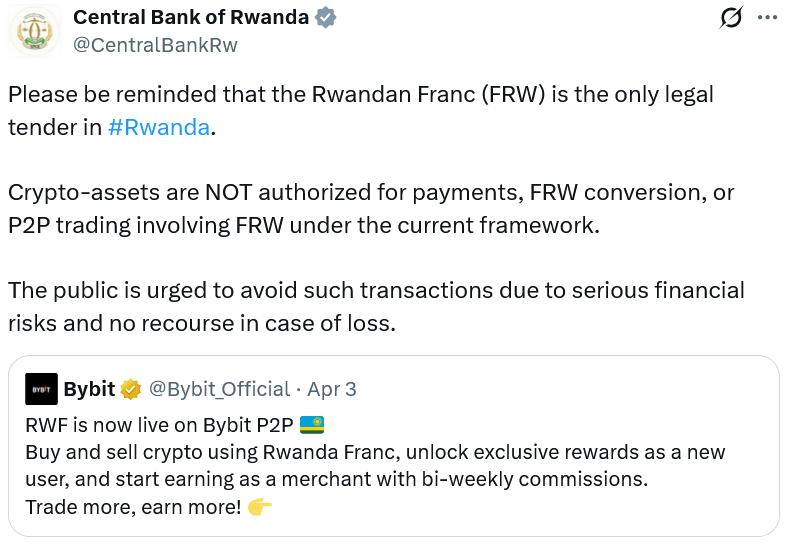
Through an additional post on X, the NBR emphasized that the FRW "remains the only legal tender in Rwanda" and clarified that "NBR-licensed financial institutions are prohibited from converting FRW into crypto-assets or vice versa."
A request for comment was sent to Bybit by Cointelegraph, though no immediate reply was provided.
The East African nation has been working to bolster the domestic usage of the FRW through the development of a central bank digital currency known as the e-franc rwandais, which remains in the proof-of-concept phase with potential plans to advance toward a pilot implementation.
Among numerous nations worldwide, Rwanda has taken a stance against cryptocurrency services as part of efforts to maintain monetary sovereignty and exercise greater oversight of its domestic financial infrastructure, implementing restrictions on crypto usage beginning in 2018.
Incoming crypto regulation seeks to further restrict crypto
Nevertheless, Rwanda's Capital Market Authority unveiled a draft regulatory framework in March designed to govern virtual asset service providers, describing the initiative as a measure that would encourage "responsible innovation."
The proposed legislation, currently advancing through Rwanda's parliamentary process, aims to prevent cryptocurrency from being recognized as legal tender while simultaneously banning cryptocurrency mining operations, mixer services and digital tokens that are pegged to the FRW.
The bill would additionally establish a regulatory framework enabling crypto service providers to conduct business operations under official licensing and regulatory oversight.
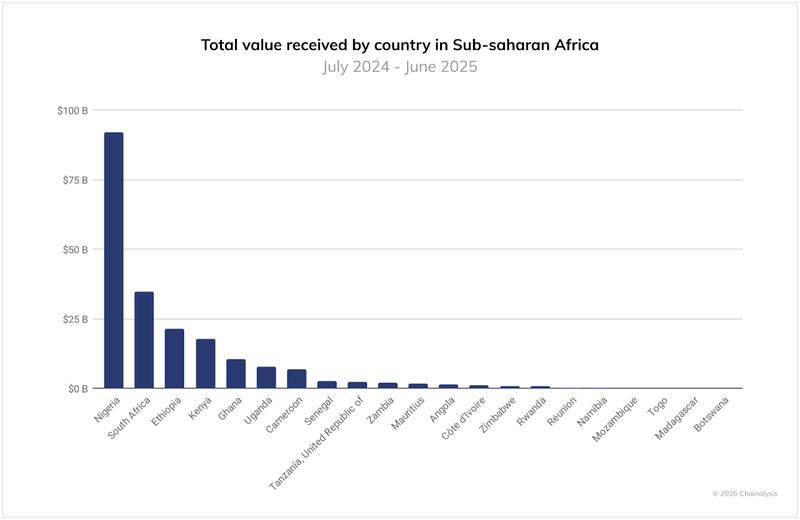
According to information from Chainalysis, a blockchain analytics company, Rwanda demonstrates minimal cryptocurrency adoption rates throughout 2024 and 2025, with residents of the country receiving only a small percentage of the cryptocurrency transaction volume observed in African nations with higher adoption levels, such as Nigeria and South Africa.