BitMine pushes Ethereum reserves toward $10B mark with ongoing bear market buying strategy
Through persistent market weakness, BitMine has accumulated Ether to approach 5% of total circulating supply, simultaneously earning staking rewards despite growing challenges facing the Ethereum ecosystem.

BitMine Immersion Technologies persisted in growing its Ethereum reserves throughout the previous week, purchasing additional quantities of the world's second-largest cryptocurrency by market capitalization even as the extended market decline persists and its substantial staking infrastructure continues producing returns.
The digital asset treasury firm disclosed on Monday that it had purchased 76,881 Ether (ETH) throughout the preceding seven-day period, likely lowering its average acquisition cost as ETH momentarily dropped beneath the $1,600 threshold during that timeframe. The firm has maintained a consistent Ether accumulation strategy throughout the bear market cycle, showing no concern for short-term price fluctuations.
BitMine now holds 5,620,754 ETH acquired at an average price of $1,718.
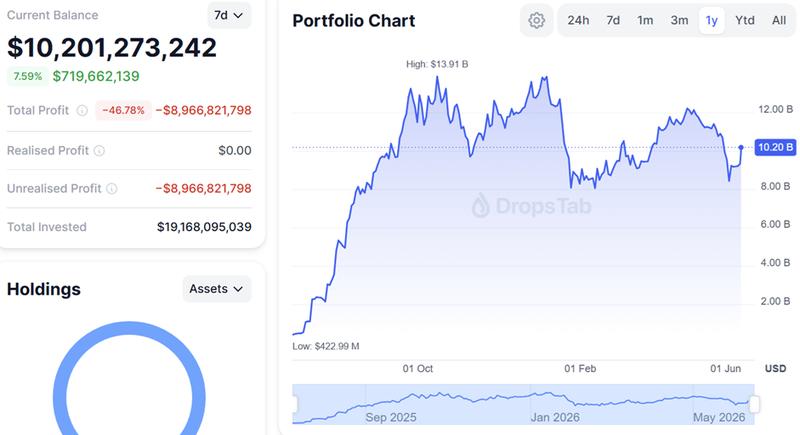
Based on present market valuations, the firm's Ethereum position carries a market value of approximately $10.2 billion, although the company faces an unrealized deficit approaching $9 billion, per information from DropsTab. As of Monday's latest market check, Ether was changing hands at $1,843.69, based on CoinMarketCap information.
Bitmine's latest purchases brings the company closer to its stated goal of owning 5% of Ether's total circulating supply of 120.68 million tokens. The company currently controls approximately 4.66% of all ETH.
Concurrently, BitMine has committed over 4.1 million ETH to staking, representing approximately $8.1 billion based on present market rates. Through staking, the firm generates protocol-based compensation by contributing to Ethereum network validation, establishing a continuous yield stream that persists throughout periods of adverse price movement.
Ethereum faces structural headwinds
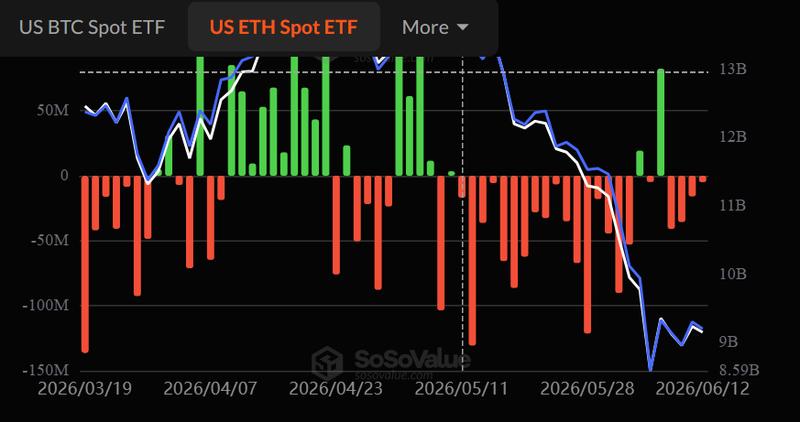
The digital asset treasury business model has encountered significant headwinds throughout the current year as cryptocurrency valuations have experienced sharp declines. This market weakness has similarly affected spot Ether exchange-traded funds (ETFs), which saw four straight days of negative net flows during the previous week.
Selling pressure has persisted since early May, with daily net outflows exceeding $60 million on several occasions.
BlackRock's iShares Ethereum Trust ETF (ETHA) remains the biggest US-traded ETH ETF, with net assets of $4.75 billion. It holds 2.36% of the crypto's circulating supply.
For Ethereum, however, the challenges extend beyond price action.
The blockchain's layer-2 expansion approach, engineered to provide enhanced speed and reduced transaction costs, has become a subject of examination. With increasing transaction volume shifting to layer-2 solutions, the Ethereum base layer generates diminished fee-based income and burns reduced quantities of ETH, possibly undermining the token's deflationary mechanics.
Internal changes at the Ethereum Foundation have added to the uncertainty. At least nine senior leaders, researchers and core contributors have departed the nonprofit so far this year, marking one of the largest waves of talent attrition in its history. The departures have coincided with the foundation's organizational overhaul and renewed community debate over its governance, strategic direction and role in Ethereum's long-term development.