Bitcoin investors should plan for a minimum 3-year hold before expecting returns: Analysis
While Bitcoin's dramatic price swings often discourage potential investors, historical data reveals that those who maintain positions for three years or more significantly improve their odds of achieving substantial gains.

Among certain investors, Bitcoin (BTC) has earned a negative reputation because of its severe double-digit percentage declines that create losses for those purchasing at inopportune times, yet historical data indicates that patience can dramatically alter outcomes.
Historical analysis dating back to 2017 demonstrates that investors who purchased BTC near peak market valuations experienced approximately 40%–50% losses within the following two-year timeframe, yet the same data reveals that many of these same positions converted to profitable status when maintained beyond the three-year threshold.
Conversely, purchase entries executed near the bottom of bear markets have consistently delivered percentage returns in the triple digits across comparable two to three-year timeframes. Additional insight comes from onchain valuation indicators that help pinpoint where these more favorable accumulation opportunities typically emerge.
Bitcoin cycle data reveals how entry timing affects gains
The long-term performance record of Bitcoin (BTC) demonstrates significant volatility when examined through a shorter two-year investment window. However, cycle-to-cycle comparisons reveal dramatic transformations when investment positions are maintained for three years.
Those who entered positions near the 2017 market peak experienced a 48.6% loss after maintaining their holdings for two years throughout the 2018 bear market. However, extending that same holding period to three years transformed that underwater position into a 108.7% gain.
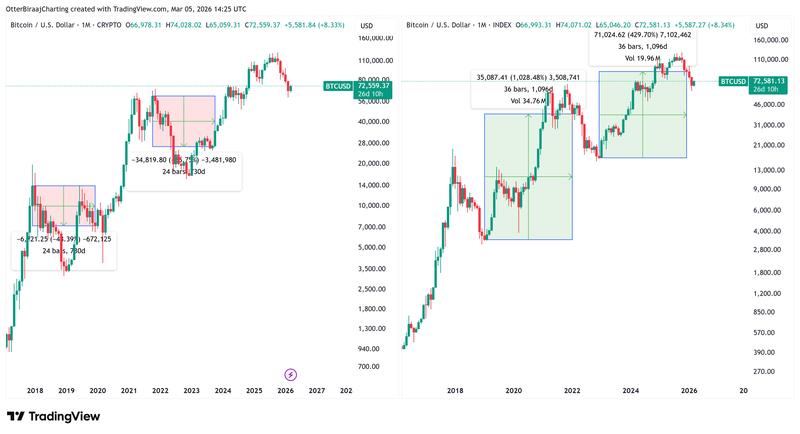
The subsequent market cycle revealed a similar pattern. Those purchasing near the 2021 high registered losses of 43.5% after a two-year holding period. However, by year three, that identical entry point had generated a 14.5% profit.
Positions entered near bear-market bottoms delivered substantially larger returns. Purchases executed close to the 2019 bottom yielded returns of 871% after two years and 1,028% after three years.
A comparable pattern emerged from the 2022 cycle low. Investment positions established during that timeframe delivered approximately 465% returns after two years and roughly 429% after three years.
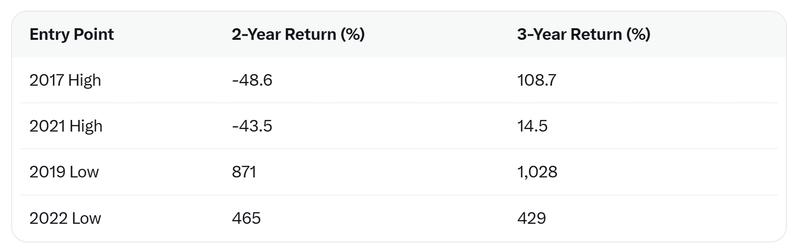
Collectively, this data underscores a persistent pattern. Two-year investment windows subject investors to substantial drawdowns when positions are initiated near cycle peaks. Three-year holding periods have historically converted most entries into profitable positions, while entries near market bottoms capture the most robust price expansion across both holding durations.
BTC realized price zones guide bottom entries
Onchain valuation indicators for BTC provide valuable insight into where these bottom entry opportunities have historically materialized.
The realized price for Bitcoin calculates the average acquisition cost of coins based on their most recent onchain transaction. More significant drawdowns regularly extend down toward the shifted realized price, a metric that smooths the calculation forward in time and identifies the more robust value accumulation zones.
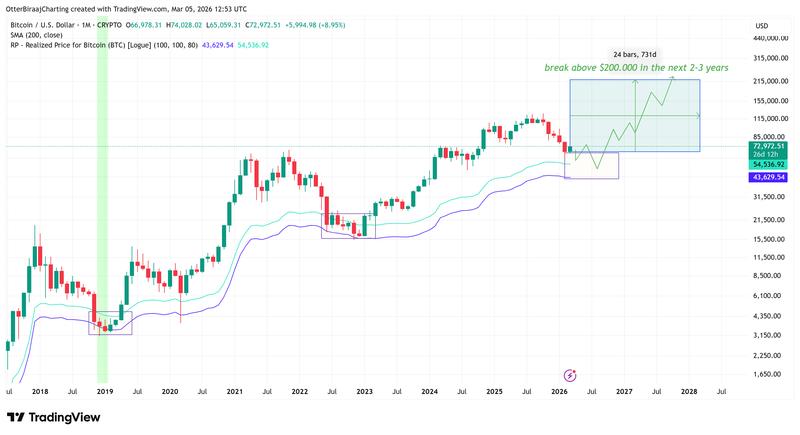
Since 2015, these bands have successfully identified long-term accumulation opportunities. The current Bitcoin realized price stands near $55,000, while the shifted realized price hovers around $42,000.
Dating back to 2015, Bitcoin's realized price bands have consistently aligned with cycle bottoms, and the price recoveries that emerged from these zones have launched multi-year rallies.
This pattern correlates directly with the return data presented earlier. Investors who built positions near bear-market lows generally entered while the price was trading at or beneath these valuation bands.
Research from institutional sources has also emphasized the importance of extended holding periods. Matt Hougan, chief information officer at Bitwise, referenced a study demonstrating that incorporating Bitcoin into a traditional 60/40 portfolio enhanced both cumulative and risk-adjusted returns across every three-year period examined. The success rate stands at 93% across two-year periods, with an allocation of approximately 5% delivering the optimal balance.
An additional Bitwise analysis examining Bitcoin data spanning from July 2010 through February 2026 demonstrated the probability of experiencing losses declines to 0.7% when BTC is maintained for three years. That risk decreases further to 0.2% over five years and ultimately reaches zero across ten-year holding periods.
Shorter investment horizons introduce greater uncertainty. Historical data shows day traders have faced a 47.1% chance of experiencing losses, while one-year holding periods still demonstrated a 24.3% probability of remaining underwater.