Bitcoin Cycle Bottom: Expert Analysis Suggests More Decline Ahead
Market experts remain divided on whether Bitcoin has reached its lowest point, with some forecasting a potential drop to $40,000 levels.

The current market conditions surrounding Bitcoin present an increasingly complex landscape to navigate.
Currently trading near $64,000, Bitcoin has experienced a decline of approximately 50% from its peak during this cycle. While this represents a less severe correction compared to historical cycles, the current bull market failed to achieve the same magnitude of gains.
The 2025 upward movement benefited from substantial exchange-traded fund (ETF) capital inflows, post-halving dynamics and resurgent institutional appetite, propelling prices to an unprecedented all-time high exceeding $126,000 in October 2025.
Following that peak, prices have continued their downward trajectory, though market experts remain divided over the significance of this decline.
Standard Chartered, along with other optimistic institutional trading desks, suggests Bitcoin potentially established its cycle low during the previous month, citing structural support from ETFs and corporate treasury purchases, combined with strengthening long-term capital movement patterns that diminish the probability of a more severe correction.
Meanwhile, other market observers maintain a more conservative stance, viewing Bitcoin as potentially entering the concluding phase of its bear market while stopping short of confirming a definitive bottom.
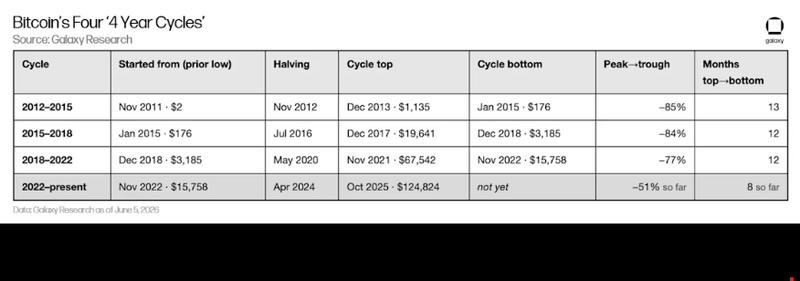
Galaxy Research noted in June that conventional cycle indicators have yet to fully recalibrate, suggesting the possibility of additional downward pressure remains on the table.
Interestingly, market analysts now find themselves divided not merely on price projections but on the fundamental definition of what constitutes a "cycle bottom" within a market progressively influenced by ETFs, macroeconomic liquidity conditions, and evolving international capital movement patterns.
Certain analysts maintain expectations for continued price weakness
Representing the most conservative perspective is Russell Thomson, who serves as chief investment officer at asset management firm Hilbert Capital.
In his conversation with Cointelegraph, Thomson indicated his belief that Bitcoin continues to experience a downward cycle and will likely decline below recent support levels before establishing a sustainable foundation. He emphasized that the present market structure remains primarily influenced by global macroeconomic factors and liquidity dynamics rather than cryptocurrency-specific indicators.
Thomson anticipates Bitcoin will initially retest the $56,000-$52,000 territory, which corresponds to summer 2024 support levels, before potentially experiencing additional losses extending toward the $40,000 to $45,000 zone, a price range he connects with previous consolidation periods during the early 2024 market formation.
Regarding timeline expectations, he perceives Bitcoin's broader cyclical pattern as remaining largely unchanged, with a prospective low potentially materializing around October 2026, though he emphasized that macroeconomic policy adjustments could accelerate that timeframe.
Fed rate cuts and/or [the CLARITY Act] passing could put the bottom in earlier than that.
He contends that institutional investment has not shielded Bitcoin from macroeconomic cycles, but has instead amplified its responsiveness to global liquidity dynamics, causing it to function more as a "high-beta macro instrument" rather than a "detached crypto-native asset."
This perspective finds support from Citibank analysts, who reduced their 12-month Bitcoin price forecast to $82,000 from $112,000 on July 1, emphasizing how Bitcoin's increasing incorporation into conventional financial systems has enhanced its correlation with risk-oriented assets and macroeconomic liquidity patterns rather than diminishing price volatility.
Advanced bear market phase, though bottom remains unverified
A more optimistic yet still measured perspective emerges from André Dragosch, who heads research (Europe) at Bitwise.
Speaking with Cointelegraph, Dragosch characterized the present market environment as a "late-stage bear market," contending that numerous indicators already point toward downside exhaustion.
He observed that market sentiment has declined to levels comparable to those witnessed following the FTX collapse in 2022, a timeframe characteristically associated with seller exhaustion.
However, Dragosch maintains reservations about declaring the cycle low as established. "I don't think that we have seen the final bottom just yet, although we are probably very close," he stated, stressing that no individual indicator can dependably identify a cycle bottom.
He further emphasized the structural transformation occurring in the market, referencing the emergence of ETFs and institutional involvement, which have expanded off-chain trading activity and diminished the dependability of certain historical cycle metrics.
Notwithstanding this uncertainty, he suggested downside exposure appears progressively constrained at present levels, noting that Bitcoin might begin exceeding artificial intelligence equity performance throughout the upcoming months should macroeconomic circumstances stabilize.
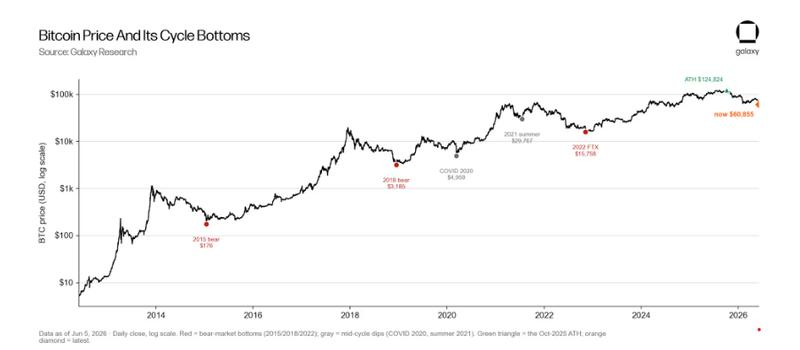
Within Galaxy's baseline projection, the research firm identified a potential decline toward the $40,000 to $46,000 range, contingent upon liquidity conditions and macroeconomic developments.
Questioning 'when will Bitcoin bottom?' may be misguided
A more framework-oriented analysis originates from Dean Chen, an analyst with Bitunix Exchange.
Chen shared with Cointelegraph his assessment that Bitcoin remains within a declining phase, though one progressively characterized by global liquidity competition rather than internal cryptocurrency market dynamics.
I believe Bitcoin remains in a down cycle, although it has entered a relatively stable valuation range supported by the structural capital base created after the approval of US spot Bitcoin ETFs in 2024.
While acknowledging that ETFs have established a more consistent institutional buying presence, Chen contended that Bitcoin now faces direct competition with other significant global capital narratives, especially artificial intelligence and traditional equity markets, for incremental liquidity.
The bigger challenge isn't Bitcoin itself; it's the competition for global liquidity. Capital continues to flow toward AI infrastructure, equities, and other high-growth opportunities.
From his viewpoint, this fundamentally transforms how cycle analysis ought to be conceptualized.
The wrong question is 'when will Bitcoin bottom?' The more important question is: 'when will crypto once again become the most attractive destination for global risk capital?'
He pointed out that derivatives markets currently occupy a substantially more prominent position in price discovery mechanisms than during prior cycles, with funding rates and open interest progressively influencing short-term price fluctuations.
This dynamic suggests Bitcoin may not establish a pronounced V-shaped recovery pattern whatsoever, he indicated, but rather undergo a prolonged period constructing a structural foundation.
A Bitcoin cycle bearing little resemblance to historical patterns
Looking beyond specific price predictions, these divergent perspectives reveal a fundamental disagreement regarding how Bitcoin's cyclical framework should be conceptualized.
Thompson perceives Bitcoin as remaining decidedly within a macroeconomic-driven downward cycle, where liquidity circumstances have yet to experience a complete reversal.
Dragosch identifies a mature bear market phase where exhaustion indicators are presently observable, despite confirmation remaining outstanding.
Chen maintains that Bitcoin now directly competes with worldwide capital allocation themes including AI and equities, rendering conventional bottom-identification methodologies progressively inadequate.
During this cycle, it appears, the discussion centers not exclusively on Bitcoin's ultimate bottom but on whether a "bottom" continues to represent a singular event whatsoever.