Bitcoin and Risk Assets Face Liquidity Shifts Following Historic US-Japan Yen Intervention
A coordinated yen intervention by the United States and Japan, the first in nearly three decades, occurs against a backdrop of historic bond yields and yen carry trade concerns.

A coordinated effort by the United States and Japan to intervene in yen markets may eventually prove favorable for Bitcoin (BTC) and other risk assets.
Key points:
- The initial joint currency intervention targeting the yen by both the US and Japan since the closing years of the 1990s may establish a framework for subsequent actions.
- Questions surrounding Bitcoin and risk assets emerge as a liquidity crisis connected to the yen carry trade develops, while both nations navigate a delicate balance between currency stabilization and preserving US Treasury market functionality.
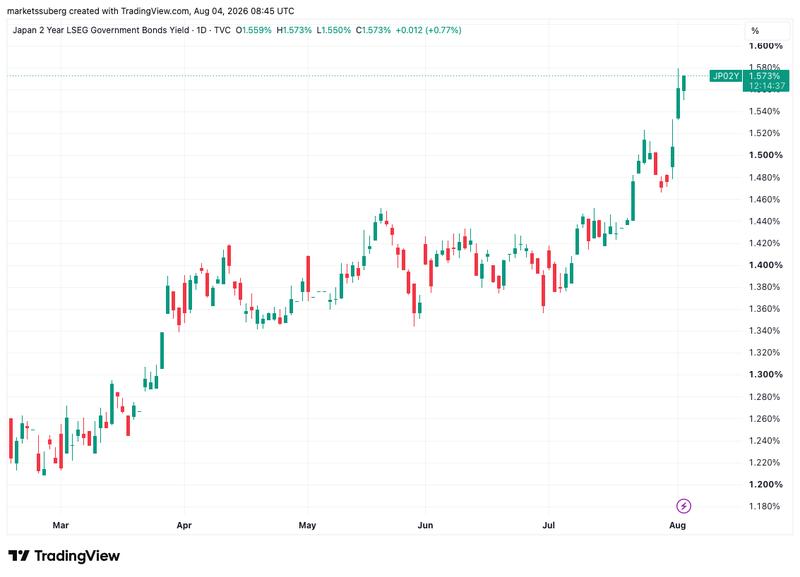
- Two-year bond yields in Japan climbed beyond 1.57% during Monday trading.
Bessent signals new era of US yen involvement
The increasing level of cooperation between Washington and the Bank of Japan (BoJ) suggests the possibility of enhanced global dollar liquidity — although this confronts the unwinding of the yen carry trade, which threatens to create a liquidity squeeze should the trend accelerate.
During the previous week, a rare joint intervention was executed by the US and Japan aimed at supporting the yen, which had deteriorated to four-decade lows reaching 164 against the dollar — marking the first such coordinated action since 1998. On behalf of the US Treasury, the New York Fed conducted euro sales rather than dollar transactions. These sales utilized the Exchange Stabilization Fund, or ESF, a repository of foreign currency reserves.
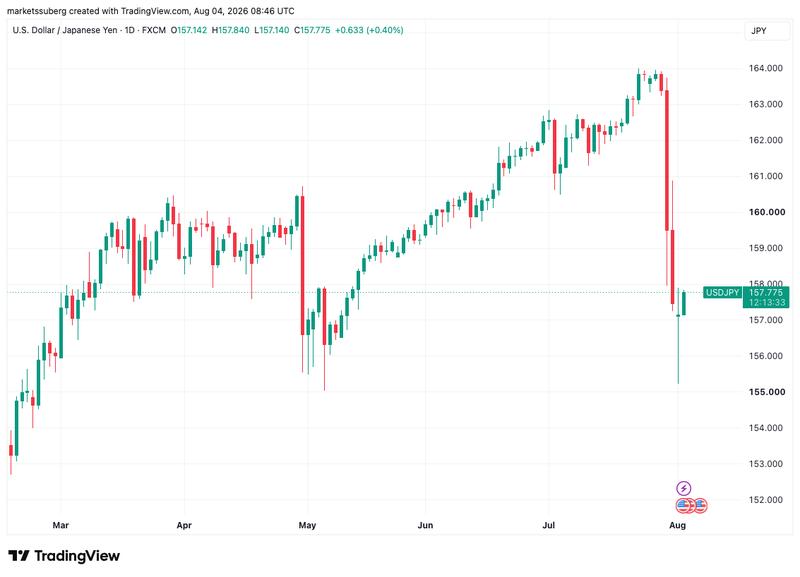
Following this intervention, Scott Bessent, the US Treasury Secretary, publicly highlighted the importance of his forthcoming meeting with Kazuo Ueda, the BoJ Governor, during the G20 finance ministers' gathering scheduled for North Carolina at the conclusion of August.
Japan's economy continues to perform well under Prime Minister Takaichi, Governor Ueda, and the Bank of Japan Board, which has demonstrated a strong commitment to monetary and financial stability. We continue to enjoy a strong relationship and close coordination.
Among the limited number of central banks granted access to the Federal Reserve's Foreign and International Monetary Authorities (FIMA) repo facility is the BoJ, which enables dollar liquidity access while avoiding the necessity to liquidate US Treasuries. As the primary holder of Treasuries globally, Japan could trigger yield increases if Treasury sales were to intensify, consequently elevating borrowing expenses for the US government, corporate entities, and individual consumers.
In an additional statement, Bessent highlighted FIMA specifically, advocating for the facility's expansion.
The FIMA Repo Facility is an important backstop. We would encourage it to be upsized in the coming months. We strongly support Japan's decisive market and monetary steps to correct the substantial undervaluation of the yen.
When FIMA is utilized, the Fed supplies dollars to foreign institutions that pledge treasuries as collateral, resulting in a net positive effect on dollar liquidity by expanding the dollar supply in international markets.
Bitcoin to rise from the yen carry trade's ashes
The intervention drew varied responses, with economist Mohamed El-Erian observing that the government had committed itself to sustained coordination with the BoJ moving forward.
Washington has now signed onto a strategy whose ultimate success doesn't rest in its own hands. Instead, as discussed in previous posts, it hinges on a comprehensive policy alignment in Tokyo among the Bank of Japan, the Ministry of Finance, and the Prime Minister's Office.
Within Bitcoin communities as well, concerns emerged regarding the extended ramifications of continued yen interventions — despite these actions potentially strengthening the bullish narrative for BTC. Market participants have long forecasted the eventual collapse of the yen carry trade as the BoJ transitions away from the low-interest-rate policies maintained over recent decades.
Additional elements of Japan's domestic fiscal strategy are accelerating this development. Elevated levels of government expenditure have driven government bond yields to heights unseen in multiple decades, which consequently diminishes the appeal of yen-based funding strategies. On Monday, Japanese two-year bond yields surpassed 1.57%, indicating an approaching conclusion to the low-interest-rate environment sooner than markets had projected. The risk of further carry trade unwinding intensifies as Japanese investors bring capital back home to capitalize on this fundamental transformation in the domestic economic landscape.