Binance's CZ Envisions Future Where Crypto Integration Replaces Crypto Conversation
Former Binance chief CZ anticipates cryptocurrency will become normalized infrastructure within the next five years, transitioning to ubiquitous usage rather than constant discussion, mirroring how society now treats the internet and programming languages.

Changpeng 'CZ' Zhao, who co-founded Binance, expressed his aspiration that by 2031, blockchain technology and cryptocurrencies will have seamlessly integrated into everyday infrastructure without fanfare, comparable to how the internet functions in modern society.
During an appearance on the Wolf of All Streets podcast with Scott Melker that aired Thursday, Zhao acknowledged that innovation and novel applications will persist but expressed hope that discussions surrounding the underlying technology will fade as it becomes woven into the fabric of routine activities.
"I'm hoping that we don't talk about crypto as crypto in five years, just like we don't talk about the internet anymore, we don't talk about TCP/IP, we don't talk about HTML, JavaScript, etc. We don't talk about that stuff anymore. We just use it."
"I think in five years, I'm hoping we'll just use crypto," he added. "There will be other use cases for the blockchain, for data storage, so there will be other cases, but I'm hoping in five years, we stopped talking about the technology, we are just using it and it will be used everywhere."
The optimistic vision for crypto in 2030
The worldwide embrace of cryptocurrency continues its upward trajectory. Data and analytics company DemandSage reports that approximately 559 million individuals across the globe are currently utilizing crypto in 2026.
Experts within the industry forecasted last September that the cryptocurrency sector might be merely one market cycle removed from achieving widespread mainstream acceptance.
Zhao's ambitious outlook for the future is shared by other prominent figures in the space.
A January report from Cathie Wood's ARK Invest projected that digital assets might expand into a $28 trillion industry by 2030, while Reeve Collins, who co-founded Tether, stated last October that he anticipates all forms of currency will transition to stablecoins within that identical time period.
Additionally, Chainalysis, a blockchain analysis company, recently projected that stablecoin transaction volumes might reach $1.5 quadrillion by 2035, and a Citi survey conducted among banks and asset managers last September revealed that the majority anticipate one-tenth of global post-trade market turnover will be processed via stablecoins and tokenized securities within the next five years.
AI could speed up blockchain development
Zhao further suggested that artificial intelligence could accelerate both the adoption and advancement of blockchain technology.
"The speed of development, the speed of writing code is going to increase quite dramatically, and AI agents are going to use crypto a lot," Zhao said, adding that "I'm hoping that blockchain, and I also kind of know blockchain will get there."
Last March, Zhao made the argument that developers working on AI agents ought to concentrate on their fundamental utility rather than creating proprietary native tokens as a fundraising mechanism.
Countries that avoid AI and blockchain will fall behind
Simultaneously, Zhao cautioned that nations choosing to sidestep blockchain technology and artificial intelligence will face significant competitive disadvantages moving forward.
"I think there's really three big industries in my adult lifetime: the internet, blockchain and AI. Any country that misses one of them is going to be severely disadvantaged," he added.
In its January blog post, Signzy identified Switzerland as holding the top position among crypto-friendly nations. Arkham similarly highlighted the country as among the leading innovators in the space.
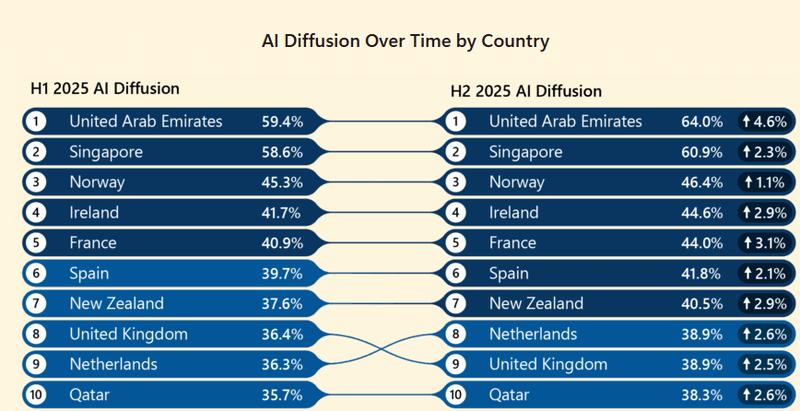
Microsoft's January artificial intelligence report, on the other hand, identified the US as the frontrunner in AI infrastructure development and frontier model creation, although the report observed that the country trails behind smaller, highly digitized nations such as the United Arab Emirates when it comes to practical implementation and usage.