Banking consortium Qivalis welcomes 25 additional institutions for euro stablecoin initiative
The banking consortium Qivalis has grown its membership to 37 institutions following the addition of 25 banks from 15 nations, strengthening its euro-backed stablecoin initiative targeting launch in late 2026.

A European banking consortium known as Qivalis, which is working on a regulated stablecoin pegged to the euro, grew its membership to 37 financial institutions this Wednesday following the inclusion of 25 additional banks spanning 15 different countries.
Among the newly added members are ABN AMRO, Rabobank, Nordea and Intesa Sanpaolo. The consortium, which operates from Amsterdam, has set its sights on a launch during the latter half of 2026, as indicated in a statement provided to Cointelegraph.
"We are not merely building payment rails; we are ensuring that European principles around data protection, financial stability and regulatory rigour are embedded into the next generation of digital money,"
Howard Davies, chairman of Qivalis' supervisory board
This expansion arrives as financial institutions across Europe compete to develop viable alternatives to stablecoins pegged to the US dollar, which presently dominate 98% of the overall market, based on data from CoinGecko.
Spain leads new bank wave
Among the 25 newly joined members of Qivalis, Spain has emerged with the highest representation, contributing five financial institutions to the consortium, which include ABANCA, Banco Sabadell, Bankinter, Cecabank and Kutxabank.
This significant representation from Spain aligns with additional indicators of early uptake in euro-based stablecoins, as recent data from Brighty has identified Spain as a prominent retail market when it comes to the adoption of Circle's EURC stablecoin.
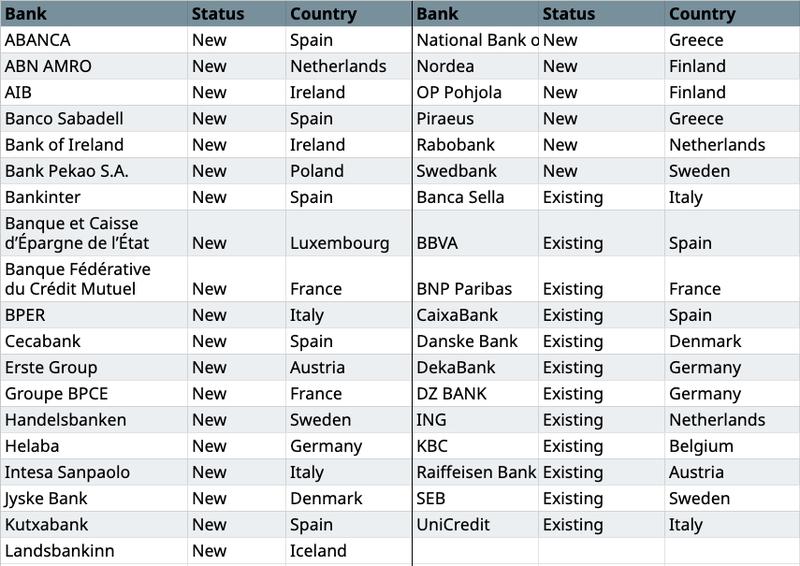
Italy contributed two additional banking institutions to the consortium. Meanwhile, France, Sweden, Greece, the Netherlands, Finland and Ireland each contributed two new member banks as well, demonstrating widespread engagement from both northern and southern regions of Europe.
This geographically diverse expansion reinforces Qivalis' objective of establishing a comprehensive, regulated infrastructure for euro stablecoins operating within the European Union's Markets in Crypto-Assets (MiCA) regulatory framework.
ECB stance contrasts stablecoin push
The plans put forward by the consortium arrive during a period of intensified discussion across Europe regarding the function of privately issued stablecoins in bolstering the euro's standing on the global stage.
Christine Lagarde, President of the European Central Bank (ECB), stated in early May that stablecoins do not represent Europe's optimal pathway toward enhancing the euro's international standing, offering pushback against proposals to counter US dollar-backed stablecoins through euro-denominated alternatives.
Notwithstanding that position, bank-driven initiatives such as Qivalis are continuing to build traction as financial institutions pursue regulated options that can serve as alternatives to stablecoins backed by the dollar.
The consortium has been in discussions with cryptocurrency exchanges in preparation for the planned launch of its euro stablecoin.
During March, Qivalis chose Fireblocks, a provider of digital asset custody solutions, to supply tokenization technology, wallet infrastructure and custody services, in addition to tools that support regulatory compliance.
"The euro is Europe's currency, and on-chain financial infrastructure should carry it - built by European institutions and governed by European rules,"
Qivalis CEO Jan Sell