AI Infrastructure Shift Drives Core Scientific to $347M Quarterly Loss While Bitcoin Mining Declines
Core Scientific reported a quarterly loss of $347.2 million as its Bitcoin mining operations declined sharply while high-density colocation services emerged as the company's primary revenue driver.

Core Scientific (CORZ) disclosed a $347.2 million net loss for the first quarter as Bitcoin self-mining revenue experienced a significant decline while high-density colocation services took the lead as the company's primary revenue generator.
According to the earnings report released on Wednesday, the company recorded a net loss of $1.06 per diluted share throughout the quarter. During the comparable period one year prior, Core Scientific had posted diluted earnings of $1.24 per share.
The company attributed the loss to several factors, including $266.5 million in non-cash impairment charges alongside a $30.8 million non-cash loss stemming from fair value adjustments to warrants and contingent value rights.
Total revenue climbed to $115.2 million compared to $79.5 million in the prior-year quarter, though it failed to meet Wall Street projections. According to Zacks Equity Research, analysts had anticipated $120.2 million in revenue, meaning Core Scientific's actual results fell approximately 4.1% short of expectations.
These financial results underscore Core Scientific's ongoing transformation from a Bitcoin mining company into an artificial intelligence infrastructure provider, with high-density colocation services now accounting for the majority of its revenue. While this strategic pivot has expanded the company's overall business, it simultaneously reveals the deterioration of its traditional mining operations.
Bitcoin mining revenue falls
The company's digital asset self-mining revenue plummeted to $30.1 million from $67.2 million in the year-ago period, with Core Scientific successfully mining 279 Bitcoin (BTC) throughout the quarter, representing a 45% decline from the equivalent period in 2025. The company's 10-Q filing revealed that Core Scientific liquidated 2,385 Bitcoin during the quarter, generating $208.3 million to finance anticipated capital expenditures and satisfy other cash requirements.
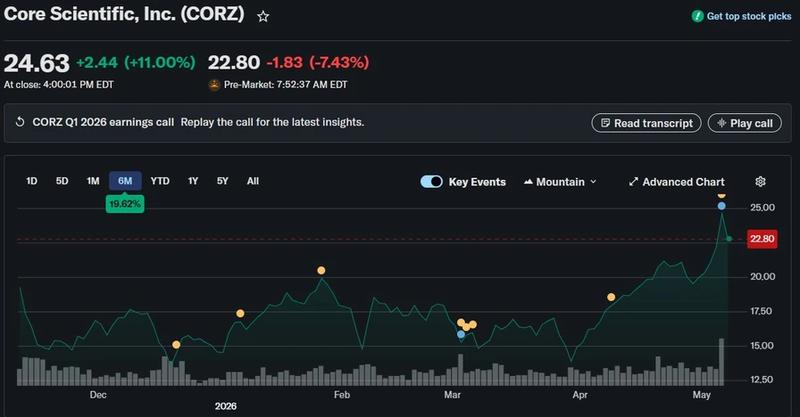
Notwithstanding the disappointing mining performance, Core Scientific's stock has appreciated during the past six months. Data from Yahoo Finance indicates CORZ concluded trading at $24.63 on Wednesday, reflecting approximately 19.6% growth over the six-month period, though the stock subsequently declined 7.43% to $22.80 during pre-market trading at the time of publication.
In a related announcement, Core Scientific disclosed plans to expand its Muskogee, Oklahoma, facility to approximately 1.5 gigawatts of gross power capacity, or roughly 1.0 gigawatt of leasable power, partially through the anticipated acquisition of Polaris DS. Additionally, the company has commenced construction on a second, currently unleased 82.5-megawatt facility at the campus.
Core Scientific expands AI-linked colocation business
The company's first-quarter expansion originated from high-density colocation services instead of Bitcoin production, with mining revenue and Bitcoin generation decreasing while its AI-focused hosting operations became the dominant revenue contributor.
According to the company, colocation revenue surged to $77.5 million during the first quarter from $8.6 million in the corresponding quarter last year, propelled by increased billable customer power capacity delivered throughout the period.
As of March 31, the company reported billing for 243 megawatts of capacity, which translates to approximately $350 million in average annualized colocation revenue.
This revenue transformation follows multiple hosting arrangements established with CoreWeave. In June 2024, Core Scientific announced it had executed 12-year agreements to provide approximately 200 megawatts of infrastructure for hosting CoreWeave's high-performance computing operations.
The partnership between the companies subsequently broadened. According to an SEC filing submitted in February 2025, CoreWeave's total contracted high-performance computing infrastructure with Core Scientific had expanded to approximately 590 megawatts distributed across six separate sites.